How to Balance Individual Learner Preferences with Strict Business Objectives
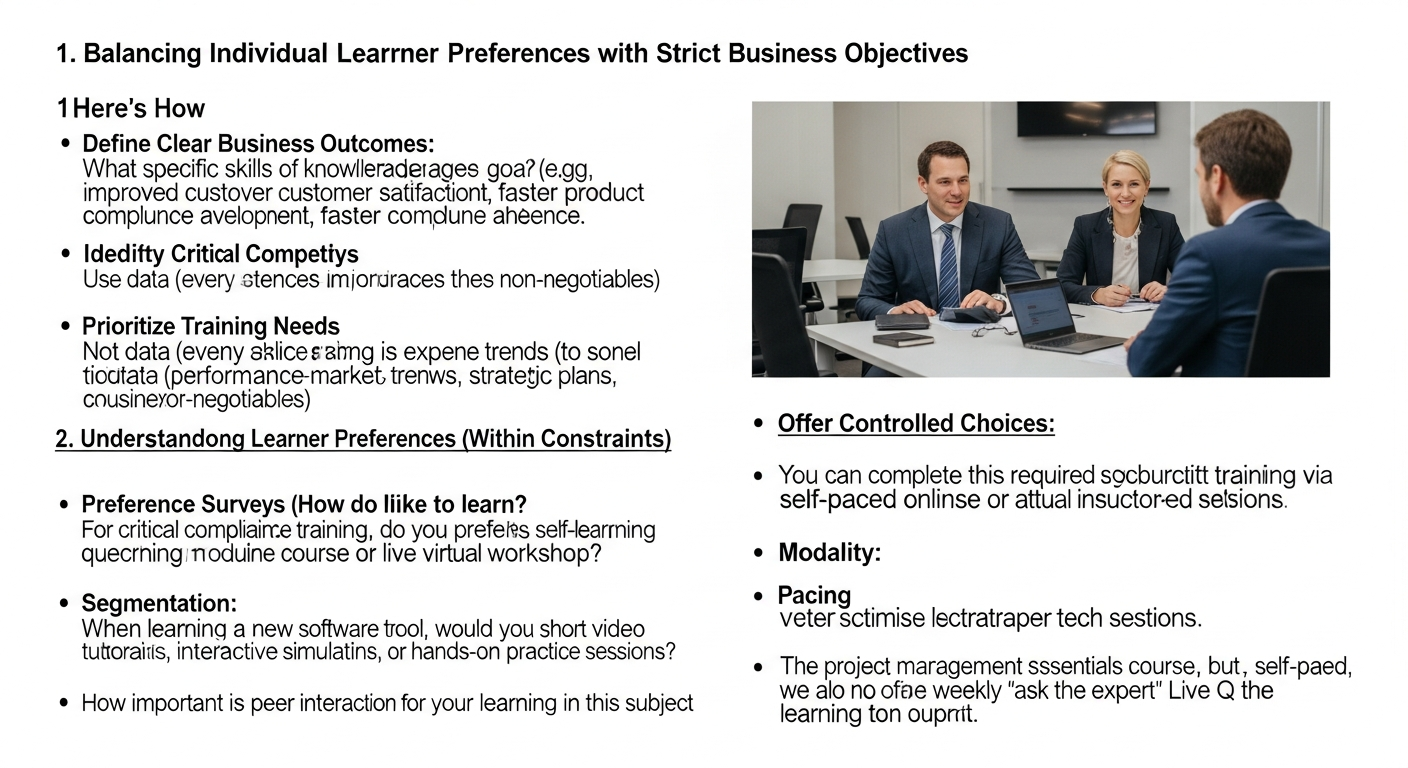
Balancing Act: Harmonizing Individual Learner Preferences with Strict Business Objectives in L&D
In the dynamic world of corporate learning and development, L&D Vice Presidents, Directors, and Senior Managers face a perpetual challenge: how to design training programs that not only engage individual learners but also rigorously achieve critical business outcomes. From ensuring compliance in banking and healthcare to boosting sales performance in retail, or mitigating risk in oil and gas, the stakes are incredibly high. The tension often lies between catering to diverse learning styles and the unwavering demand for measurable, impactful results that contribute directly to the bottom line.
The Evolving Landscape of Corporate Learning
Today's workforce is more diverse than ever, comprising multiple generations with varying tech proficiencies and learning expectations. Simultaneously, businesses operate in increasingly complex regulatory environments and competitive markets, requiring highly specialized, efficient, and Risk-focused Training. This dual pressure makes the art of balancing individual preferences with strict business objectives a cornerstone of effective L&D strategy.
Understanding Individual Learner Preferences
Learners are not monolithic. They come with unique backgrounds, prior knowledge, motivations, and preferred ways of absorbing information. Ignoring these preferences often leads to disengagement, poor retention, and ultimately, wasted training investment.
- Modalities: Some thrive on visual content like videos and infographics, while others prefer auditory formats like podcasts, or kinesthetic experiences through simulations and hands-on exercises.
- Pace and Flexibility: Busy professionals value the ability to learn at their own pace, on their own schedule, and via their preferred devices. Microlearning LMS platforms are particularly effective here, delivering bite-sized content that fits into tight schedules.
- Interaction and Engagement: From collaborative group projects to self-paced modules, the level of desired interaction varies. Many are motivated by interactive elements, progress tracking, and recognition, which a Gamified LMS can powerfully provide.
- Relevance: Learners are most engaged when the content directly relates to their job role, career aspirations, or immediate challenges.
Defining Strict Business Objectives
While individual preferences are vital, they must never overshadow the core purpose of corporate training: to drive specific, measurable improvements for the business. These objectives are often non-negotiable and dictated by market demands, regulatory bodies, or strategic growth initiatives.
- Compliance: In industries like Banking, Finance, Pharma, and Healthcare, regulatory compliance training is paramount. Failure can lead to hefty fines, legal repercussions, and reputational damage. An effective learning management system (LMS) is essential for tracking completion and understanding knowledge gaps.
- Performance Improvement: Sales teams in Retail need training that directly impacts conversion rates. Hospitality staff require training to elevate guest experience. Operational teams in Manufacturing and Oil & Gas need skills to enhance efficiency and safety.
- Skill Development & Gap Closure: Identifying critical skill gaps across the workforce (e.g., new software proficiency, leadership capabilities) and rapidly upskilling employees to meet evolving business needs.
- Cost-Effectiveness & ROI: L&D initiatives must demonstrate a clear return on investment, justifying budget allocation by showing tangible benefits to productivity, revenue, or risk reduction. An enterprise learning management system can help track this.
Strategies for Harmonization: Bridging the Divide
The key to success lies not in choosing one over the other, but in strategically integrating both individual needs and business imperatives. Modern eLearning technologies offer unprecedented opportunities to achieve this balance.
1. Leverage Advanced Learning Technologies
- Adaptive Learning Paths: Utilize an Adaptive Learning system that adjusts content and pace based on a learner's performance and preferences. This ensures efficient learning for individuals while guaranteeing all essential business-critical modules are completed.
- Blended Learning Approaches: Combine self-paced online modules, instructor-led sessions, and practical application. This caters to diverse preferences while ensuring core concepts are reinforced. A robust Microlearning LMS can seamlessly manage these varied components.
- Rich Content Variety: Offer the same core information through multiple formats – videos, interactive quizzes, short articles, simulations. This gives learners agency over how they consume content without compromising the message. A modern learning content management system (LCMS) helps organize and deliver this.
- Gamification for Engagement: Incorporate points, badges, leaderboards, and challenges into training. A Gamified LMS can significantly boost learner motivation and completion rates, especially for mandatory compliance training, turning potentially dry subjects into engaging experiences.
2. Data-Driven Insights and Continuous Improvement
- Analytics: Utilize the powerful analytics capabilities of a modern learning management system to track learner progress, identify areas of difficulty, and understand engagement patterns. This data informs content optimization and helps prove the ROI of training initiatives.
- Feedback Loops: Regularly solicit feedback from learners regarding content, delivery, and relevance. This ensures programs remain engaging and aligned with evolving preferences.
- Performance Measurement: Link training outcomes directly to business KPIs. For instance, track how sales training impacts revenue per employee, or how safety training reduces incidents in Mining or Oil & Gas. This proves the value of your learning management software and initiatives.
AI's Transformative Role in Achieving Balance
Artificial intelligence is rapidly becoming an indispensable ally for L&D leaders striving to perfect this balance. By automating personalization and enhancing efficiency, AI empowers organizations to meet both individual and corporate training needs with unparalleled precision.
How can artificial intelligence personalize learning experiences for diverse employees?
AI-powered platforms can analyze individual learning patterns, comprehension levels, and job roles to deliver highly personalized content recommendations. This might involve suggesting specific modules from an LMS based on a learner's past performance or tailoring explanations to match their preferred learning style. An Adaptive Learning system, supercharged by AI, can dynamically adjust the curriculum, presenting more challenging material when a learner grasps concepts quickly, or offering supplementary resources when they struggle. This ensures optimal engagement and knowledge retention for every individual.
What benefits does AI bring to meeting strict corporate training goals?
AI significantly enhances the efficiency and effectiveness of corporate training. For instance, an AI Powered Authoring Tool can dramatically speed up content creation, allowing L&D teams to generate high-quality, relevant training materials much faster. In compliance-heavy industries like Finance or Pharma, AI can identify learners at higher risk of non-compliance based on their learning data, triggering targeted interventions. Furthermore, AI-driven analytics can provide deeper insights into training effectiveness, correlating learning outcomes with business performance metrics, helping an learning management solution prove its value.
How can AI support effective training for a geographically spread workforce?
For global organizations, managing training across different regions and languages is a monumental task. AI can automate content localization, providing instant translation and cultural adaptation of learning materials, ensuring relevance and accessibility for all employees. A cloud based learning management system integrated with AI can deliver consistent, high-quality training experiences regardless of geographical location, addressing diverse learning styles while upholding uniform corporate standards. This ensures that a global team in industries like Hospitality or Oil & Gas receives the same critical information, tailored to their local context.
Conclusion
Balancing individual learner preferences with strict business objectives is no longer an aspirational goal but a strategic imperative for modern L&D. By embracing advanced eLearning technologies, adopting data-driven methodologies, and strategically integrating artificial intelligence, L&D leaders can create dynamic, engaging, and highly effective training programs. These programs not only empower employees to grow but also consistently deliver tangible, measurable value to the organization. The future of enterprise learning management lies in this harmonious integration, paving the way for a more skilled, engaged, and productive workforce.
Ready to transform your organization's learning strategy? Explore how advanced LMS and learning management solutions, like MaxLearn LMS, can help you achieve this critical balance and drive business growth.


Comments
Post a Comment