Why is Neil Fleming’s VARK Model Crucial for Mobile Learning?
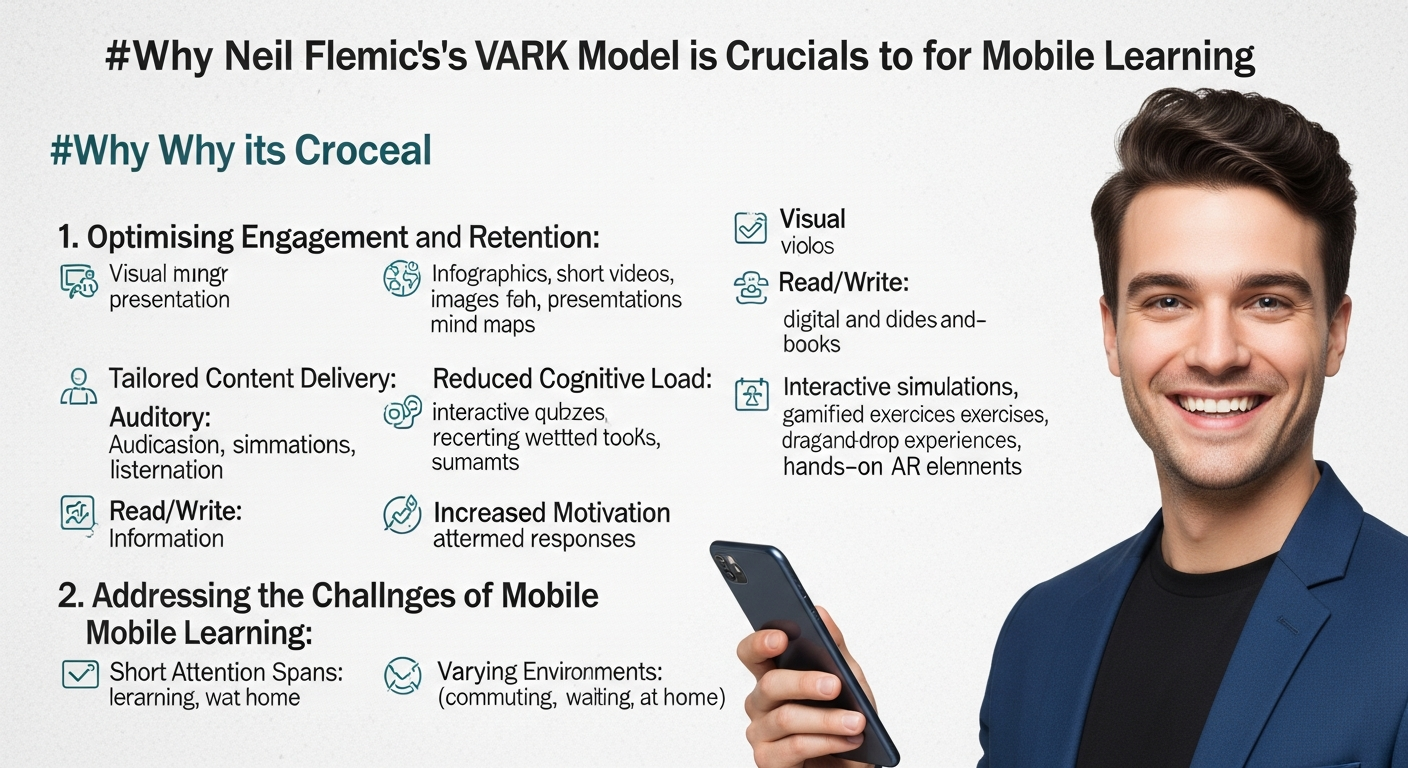
Why Neil Fleming’s VARK Model is Crucial for Mobile Learning Success in the Enterprise
In today's fast-paced corporate landscape, learning and development (L&D) leaders face the formidable challenge of equipping their workforce with essential skills quickly and effectively. From ensuring stringent compliance in banking and finance to driving sales performance in retail and pharma, or managing critical operations in oil and gas, the need for agile and impactful training is paramount. Mobile learning has emerged as a powerful solution, offering unparalleled flexibility and accessibility. However, merely deploying content on mobile devices isn't enough. To truly unlock its potential, L&D professionals must embrace personalized learning strategies, and at the heart of this lies Neil Fleming’s VARK model.
For Vice Presidents, Directors, Senior Managers, and Managers of L&D, understanding how to leverage the VARK model within a mobile learning framework isn't just an academic exercise—it's a strategic imperative. It's about transforming generic training into deeply engaging, retention-boosting experiences that directly impact business outcomes.
Understanding the VARK Model: A Foundation for Personalized Learning
The VARK model, developed by Neil Fleming, categorizes learners into four primary sensory modalities: Visual (V), Aural (A), Read/Write (R), and Kinesthetic (K). While most individuals exhibit a blend of these preferences, identifying a predominant style allows for the customization of learning content to maximize comprehension and engagement.
- Visual Learners (V): Prefer to see information presented graphically through charts, diagrams, infographics, videos, and demonstrations.
- Aural Learners (A): Learn best by hearing information, often through lectures, discussions, podcasts, and audio explanations.
- Read/Write Learners (R): Absorb information most effectively by reading text, making notes, and writing summaries or reports.
- Kinesthetic Learners (K): Learn through doing, experiencing, and engaging with hands-on activities, simulations, role-playing, and practical exercises.
Ignoring these inherent preferences can lead to disengaged learners, poor retention, and ultimately, ineffective training programs, regardless of how innovative your LMS or learning content management system might be.
The Ascent of Mobile Learning in the Enterprise
Mobile learning has fundamentally reshaped how organizations approach training. Its ubiquity, convenience, and ability to deliver "just-in-time" learning make it ideal for the modern, distributed workforce. Industries from healthcare to hospitality are increasingly adopting mobile platforms to deliver crucial training, from new product launches in retail to safety protocols in mining. A robust cloud based learning management system empowers employees to access modules anytime, anywhere, fitting learning into their workflow rather than disrupting it.
However, mobile learning also presents unique challenges. Screen sizes are smaller, attention spans are shorter, and distractions are abundant. This is where the synergy between the VARK model and mobile delivery becomes critical. By tailoring content to individual learning styles, L&D leaders can overcome these hurdles, transforming potential weaknesses into significant strengths.
The Synergy: VARK and Mobile Learning Effectiveness
Integrating VARK principles into mobile learning design ensures that content resonates with each employee, maximizing engagement and knowledge retention. This personalized approach is a cornerstone of effective learning management solutions.
Visual Learners on Mobile
For visual learners, mobile devices are a canvas. Infographics, short animated videos, interactive charts, and clear visual summaries can convey complex information efficiently. In compliance training for banking, a visual learner might grasp data privacy regulations faster through flowcharts demonstrating secure data handling than through dense text.
Aural Learners on Mobile
Mobile learning excels for aural learners through podcasts, audio explanations, and voiceovers accompanying slides. Sales teams can listen to product feature updates while commuting, while healthcare professionals can absorb new protocols via concise audio summaries, fostering continuous learning through an intuitive lms learning management system.
Read/Write Learners on Mobile
These learners thrive on well-structured text, digital articles, interactive quizzes requiring written responses, and opportunities to take notes directly within the mobile application. Detailed case studies on financial risk management or step-by-step guides for pharmaceutical sales techniques can be highly effective. A mobile learning management software offering robust text-based content and annotation features is invaluable here.
Kinesthetic Learners on Mobile
The mobile platform can facilitate kinesthetic learning through interactive simulations, drag-and-drop exercises, scenario-based problem-solving, and gamified challenges. For hospitality staff, a mobile simulation might involve interacting with virtual guests to practice customer service. In oil and gas, a Kinesthetic learner might benefit from interactive simulations of equipment operation. A Gamified LMS is particularly effective for this group, transforming learning into an engaging, active experience.
Addressing Specific Industry Needs with VARK-Driven Mobile Learning
The application of VARK in mobile learning is transformative across diverse sectors:
- Compliance: In finance and banking, visual timelines for regulatory changes, aural explanations of complex legal jargon, and interactive quizzes for policies ensure comprehensive understanding.
- Sales: Retail and pharma sales teams benefit from short videos demonstrating product features (Visual), audio testimonials (Aural), scripts for pitches (Read/Write), and simulated sales calls (Kinesthetic).
- Healthcare: Nurses and doctors can use visual anatomical guides, audio notes on patient care, articles on new research, and interactive diagnostic simulations.
- Hospitality: Employees can learn through visual guides for service standards, audio instructions for task execution, detailed service manuals, and role-playing scenarios.
This tailored approach, often powered by a Microlearning LMS, ensures that every learning moment on mobile is optimized for impact.
Leveraging Technology for VARK-Aligned Mobile Experiences
Modern enterprise learning management systems are increasingly sophisticated, offering features that directly support VARK-aligned mobile learning. The integration of artificial intelligence (AI) is a game-changer in this regard.
How can advanced technology help in understanding learner preferences for mobile content?
AI can analyze learner engagement data, quiz results, interaction patterns, and even explicit self-assessments to infer an individual's predominant learning style. This intelligence allows the LCMS to recommend or even dynamically generate content tailored to those specific VARK preferences. This represents a significant leap towards truly personalized learning paths.
What tools support the creation of diverse content for different learning styles on mobile?
Platforms equipped with an AI Powered Authoring Tool enable L&D teams to rapidly develop and adapt multimedia content, interactive simulations, and various exercise types suitable for all VARK preferences. This ensures a rich, diverse content library that caters to every learner on their mobile device.
Can mobile learning be truly personalized for a global workforce?
Absolutely. By combining a robust learning management system with VARK principles and AI-driven personalization, content can be not only adapted to individual learning preferences but also localized for diverse geographical and cultural contexts. Adaptive Learning capabilities further refine this process, adjusting the learning path based on individual progress and mastery.
Benefits for L&D Leaders
Adopting a VARK-informed mobile learning strategy offers tangible benefits for L&D leaders:
- Increased Engagement and Retention: Personalized content keeps learners motivated and improves knowledge retention, directly impacting performance.
- Improved Performance and Productivity: Well-understood training translates into better job performance, leading to increased productivity across all segments, from sales to operations.
- Enhanced Compliance and Reduced Risk: In high-stakes industries, clear, targeted training ensures employees fully grasp critical regulations and procedures, mitigating risks. This is especially vital for Risk-focused Training.
- Optimized Training ROI: By delivering more effective training, organizations see a better return on their L&D investments.
- Scalability: A modern MaxLearn LMS, designed with VARK in mind, can scale personalized learning experiences across thousands of employees globally.
Conclusion
For L&D VPs, Directors, and Managers navigating the complexities of modern corporate training, Neil Fleming's VARK model is more than just a theory—it's a practical framework for optimizing mobile learning. By thoughtfully integrating VARK preferences into mobile content design, supported by advanced learning management solutions and AI, organizations can move beyond simply delivering content to creating truly impactful, personalized learning experiences. This strategic alignment ensures that every employee, regardless of their preferred learning style or industry, is equipped with the knowledge and skills necessary to drive business success in an ever-evolving world.


Comments
Post a Comment