What Is the Role of Fleming’s Learning Styles in Modern LMS Platforms?
The Evolving Role of Fleming’s Learning Styles in Modern LMS Platforms
In the dynamic world of corporate learning and development, the quest for effective, engaging, and impactful training solutions is unending. As L&D leaders, VPs, Directors, and Managers, you're constantly seeking ways to maximize return on investment from your training initiatives, whether in Compliance, Sales, Banking, Finance, Insurance, Retail, Pharma, Health care, Hospitality, Oil and Gas, or Mining. The concept of learning styles, particularly Fleming's V.A.R.K. model, has long been a cornerstone of pedagogical thought. But what is its relevance in an era dominated by sophisticated learning management system platforms? This article explores how modern LMS solutions are not just accommodating, but transcending traditional learning styles to deliver truly personalized and performance-driven learning experiences.
Understanding Fleming's V.A.R.K. Model in a Corporate Context
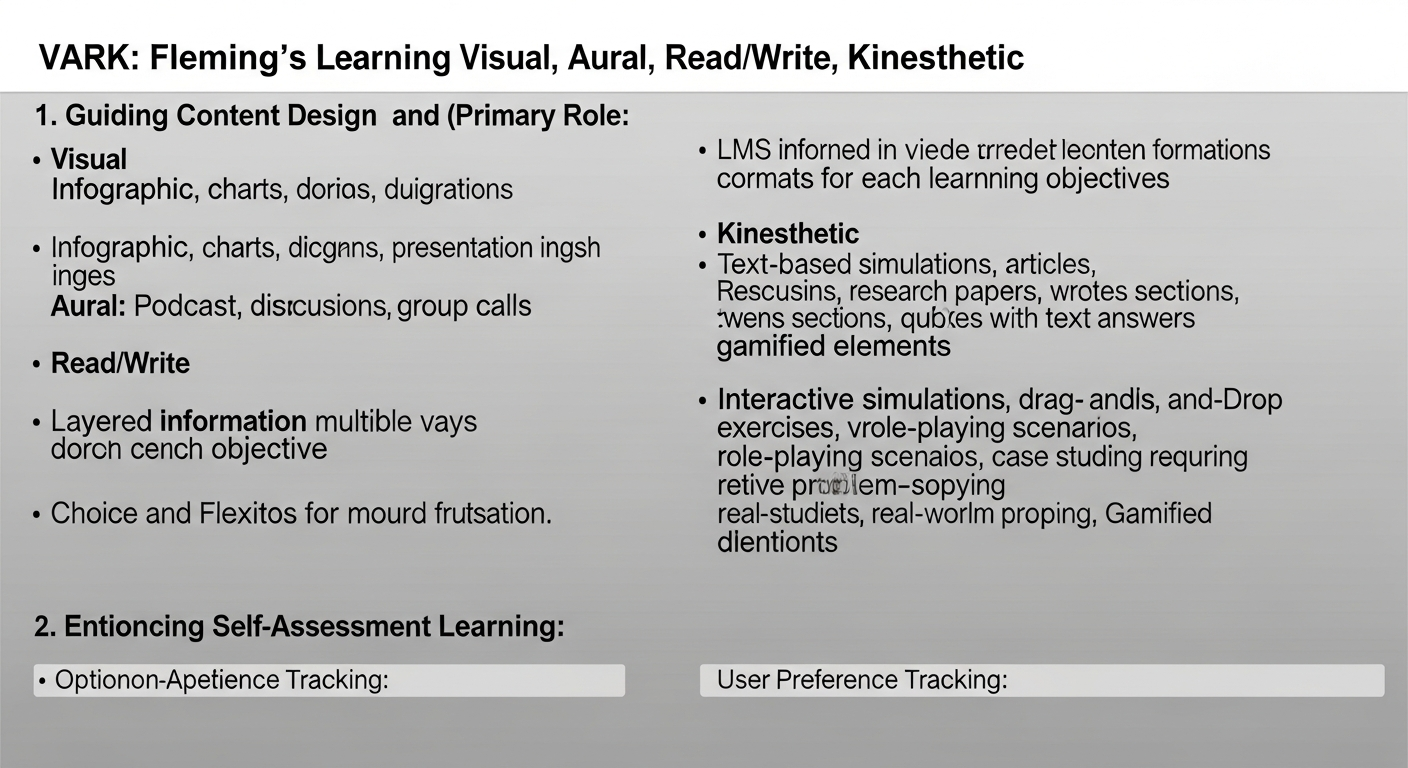
Before diving into the capabilities of advanced learning management software, it's crucial to briefly revisit Fleming's V.A.R.K. model. V.A.R.K. categorizes learners into four primary preferences:
- Visual (V): Learners who prefer to see information presented in charts, graphs, diagrams, and videos.
- Auditory (A): Learners who learn best through listening, such as lectures, podcasts, discussions, and verbal instructions.
- Read/Write (R): Learners who prefer to process information through text, making notes, reading manuals, and written assignments.
- Kinesthetic (K): Learners who learn by doing, through hands-on activities, simulations, role-playing, and practical applications.
For decades, L&D professionals have strived to create training materials that cater to these diverse preferences. However, traditional training often struggled to offer true multi-modal experiences at scale, leading to content that might only appeal to a subset of the learners.
The Shift from Static to Dynamic Learning Platforms
The advent of modern LMS platforms has fundamentally changed this landscape. No longer are organizations limited to one-size-fits-all training. Today's learning management solutions, particularly those built as a robust learning content management system (LCMS), offer unparalleled flexibility and adaptability. Where can organizations find an effective learning content management system that supports multi-modal delivery?
A sophisticated lms learning management system goes beyond simply hosting content; it intelligently delivers it. This shift is particularly vital for organizations with geographically dispersed teams, such as those in Oil and Gas or global Pharma companies, where a cloud based learning management system ensures accessibility and consistency across all regions.
Personalization Through Adaptive Learning
One of the most profound advancements in modern elearning is the rise of Adaptive Learning. This methodology, often integrated within a modern Microlearning LMS, moves beyond merely offering choices to proactively tailoring the learning path based on an individual's interactions, performance, and indeed, their preferred learning style. For a sales professional in Retail or Banking, this might mean a system that identifies a visual learner and serves up more video tutorials and infographics, while an auditory learner receives more explanatory audio clips and virtual discussions.
- Adaptive Learning pathways ensure that content is always relevant and engaging, significantly improving knowledge retention and skill application.
- A Microlearning LMS further enhances this by breaking down complex topics into bite-sized modules, allowing learners to consume information in formats and at paces that suit them best.
Engaging Diverse Learners with Gamification and Interactivity
How can businesses improve training effectiveness for diverse corporate teams? Modern platforms understand that engagement is key. This is where features like a Gamified LMS come into play. Gamification isn't just about badges and leaderboards; it’s about creating immersive, interactive experiences that naturally appeal to different learning styles:
- Kinesthetic learners thrive on simulations, virtual labs, and interactive scenarios that mimic real-world challenges, common in sectors like Healthcare or Mining. A Gamified LMS provides these "doing" opportunities within a safe, digital environment.
- Visual learners are captivated by rich multimedia, animated explanations, and visually striking progress dashboards that are hallmarks of a gamified experience.
- Auditory learners benefit from interactive dialogue, audio feedback, and narrative-driven game elements.
Such engaging features are critical for high-stakes compliance training or product knowledge for a Finance firm, where active participation directly correlates with understanding and adherence.
Leveraging Content with AI and LCMS Capabilities
The ability to create and manage vast amounts of diverse content is another area where modern learning management solutions excel. An AI Powered Authoring Tool, often integrated within an LCMS, streamlines content creation, enabling L&D teams to quickly generate and adapt materials for all V.A.R.K. styles. For instance, an AI tool might automatically generate summaries (Read/Write), convert text to speech (Auditory), or suggest interactive elements (Kinesthetic) based on core content.
Consider a sales team in the Hospitality sector: an AI Powered Authoring Tool could help rapidly develop training modules that cater to varied sales scenarios, complete with role-play simulations, product videos, and detailed sales scripts, ensuring comprehensive readiness.
Industry-Specific Applications and Strategic Advantages
The practical application of these advanced LMS features across specific industries is profound. How can enterprise learning management be optimized for diverse global teams?
- Compliance & Finance: In highly regulated environments like Banking and Insurance, Risk-focused Training is paramount. Modern platforms offer detailed tracking, certification management, and scenario-based learning that caters to Kinesthetic learners, ensuring employees understand and apply complex regulations effectively.
- Pharma & Health care: Training on new drugs, medical devices, or patient care protocols demands accuracy and retention. Visual and Kinesthetic learners benefit from high-fidelity simulations and interactive modules for practical skill development, while Auditory learners engage with expert interviews and case study discussions.
- Sales & Retail: Product knowledge and sales techniques are best learned through practical application. A Gamified LMS with role-playing and competitive challenges is ideal for Kinesthetic and Visual learners, boosting performance and engagement.
The ability of an enterprise learning management system to integrate these varied approaches means that organizations can move beyond simply addressing learning styles to truly optimizing learning outcomes. MaxLearn LMS, for example, embodies these principles, offering a holistic platform designed for modern corporate training needs.
Addressing Modern Challenges with Integrated Learning Management System
Beyond individual learning styles, modern LMS platforms address broader L&D challenges. What are the key benefits of a modern learning management software?
- Scalability: A robust cloud based learning management system can scale from hundreds to hundreds of thousands of users, making it perfect for global corporations in any industry.
- Analytics: Sophisticated analytics provide insights into learner performance, content effectiveness, and engagement levels, enabling L&D leaders to continuously refine their strategies.
- Accessibility: Ensuring all employees, regardless of location or device, have access to high-quality training is a fundamental requirement. A modern LMS facilitates this, often even offline.
The Future: Beyond Styles, Towards Performance
While Fleming's V.A.R.K. model offers valuable insights into learner preferences, modern LMS platforms like MaxLearn LMS are pushing the boundaries further. They're not just about catering to a specific style, but about creating an ecosystem where all styles are supported, learners are engaged, and, crucially, performance outcomes are achieved. The focus has shifted from "how does an individual prefer to learn?" to "how can an individual learn most effectively and apply that knowledge to excel in their role?"
By leveraging Adaptive Learning, Microlearning LMS, Gamified LMS features, and AI Powered Authoring Tool capabilities, today's learning management system empowers L&D professionals to build truly transformative training programs. This holistic approach ensures that every employee, from a new hire in Hospitality to a seasoned engineer in Oil and Gas, receives the optimal learning experience necessary to thrive and contribute to the organization's success.


Comments
Post a Comment