What is Gardner’s Multiple Intelligences Theory in Corporate Training?
What is Gardner’s Multiple Intelligences Theory in Corporate Training?
In the dynamic landscape of corporate training, the traditional "one-size-fits-all" approach is becoming increasingly obsolete. Learning and Development (L&D) leaders – Vice Presidents, Directors, and Senior Managers – are constantly seeking innovative methodologies to enhance employee engagement, retention, and performance. One profound theoretical framework that offers a powerful lens for this endeavor is Howard Gardner’s Theory of Multiple Intelligences (MI).
Gardner's theory, first proposed in 1983, challenges the conventional view of intelligence as a single, quantifiable entity. Instead, it posits that individuals possess several distinct types of intelligence, each operating relatively independently. For L&D professionals, understanding and applying these diverse intelligences can revolutionize corporate training, making it more effective, inclusive, and impactful across various industries, from Compliance and Sales to Banking, Healthcare, Oil & Gas, and beyond.
Unpacking Gardner's Multiple Intelligences
At its core, MI theory suggests that true intelligence is not just about logical reasoning or linguistic prowess, but a broader spectrum of abilities. Recognizing these different strengths within a workforce allows L&D teams to design richer, more adaptive, and personalized learning experiences. This is crucial for any modern LMS seeking to deliver superior learning content management system capabilities.
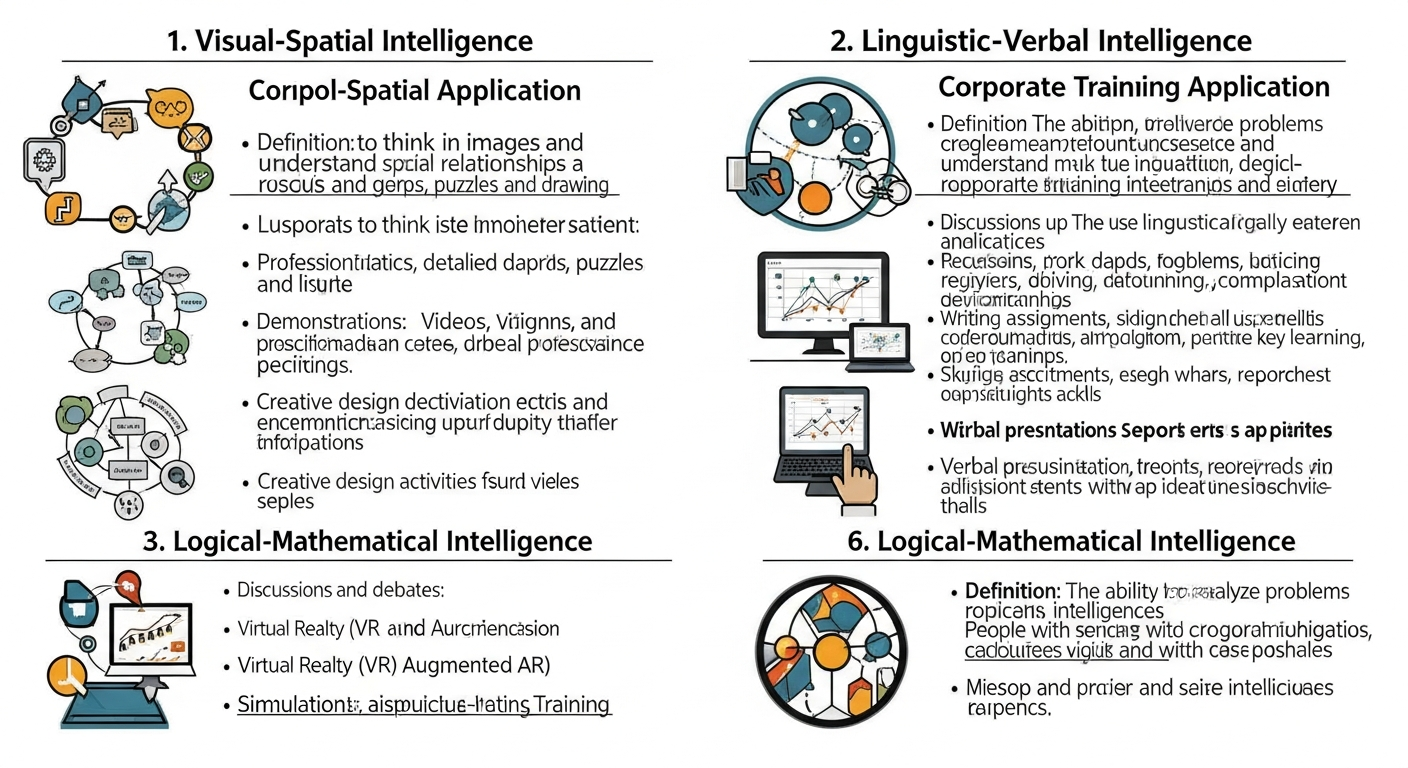
The Eight Intelligences and Their Corporate Training Relevance
- Linguistic Intelligence: The ability to use language effectively, both orally and in writing.
- Training relevance: Storytelling, debates, written reports, presentations, and comprehensive guides are ideal.
- Logical-Mathematical Intelligence: The capacity to analyze problems logically, carry out mathematical operations, and investigate scientifically.
- Training relevance: Case studies, data analysis exercises, problem-solving simulations, coding tasks, and strategic planning.
- Spatial Intelligence: The ability to recognize and use patterns of wide space and more confined areas.
- Training relevance: Visual aids, infographics, simulations, virtual reality (VR) training for equipment operation, architectural design, and flowcharts.
- Bodily-Kinesthetic Intelligence: The potential to use one's whole body or parts of the body to solve problems or fashion products.
- Training relevance: Role-playing, hands-on workshops, physical demonstrations, practical skill drills, and experiential learning.
- Musical Intelligence: The capacity to recognize, compose, and appreciate musical patterns.
- Training relevance: While less direct, using background music for focus, creating jingles for memorization, or incorporating rhythm in presentations can appeal.
- Interpersonal Intelligence: The ability to understand the intentions, motivations, and desires of other people.
- Training relevance: Group projects, team-building exercises, negotiation simulations, customer service training, and peer coaching.
- Intrapersonal Intelligence: The capacity to understand oneself, one's feelings, fears, and motivations.
- Training relevance: Self-reflection journals, goal setting, mindfulness exercises, personal development plans, and leadership assessments.
- Naturalistic Intelligence: The ability to recognize and categorize objects and characteristics in nature.
- Training relevance: Environmental training, sustainability initiatives, observation skills for market trends, and pattern recognition in complex systems.
Why MI Theory is a Game-Changer for Corporate Training
Incorporating MI theory into your learning management software strategy moves beyond mere academic interest; it delivers tangible benefits that directly impact business outcomes. A robust learning management system, especially a cloud based learning management system, can seamlessly integrate these diverse approaches.
Driving Deeper Engagement and Retention
When training aligns with an individual's natural intelligence, they are more likely to find the content engaging and relevant. This translates into higher participation rates, better comprehension, and significantly improved knowledge retention. Instead of employees feeling disengaged by a purely lecture-based approach, they can interact with material in ways that resonate with their inherent strengths. This is where modern learning management solutions excel.
Fostering a Culture of Continuous Learning
By offering varied learning pathways, organizations empower employees to take ownership of their development. This personalized approach, often facilitated by an enterprise learning management system, builds a stronger culture of continuous learning, as individuals discover that learning can be enjoyable and tailored to their unique cognitive profiles. MaxLearn LMS is designed with this adaptability in mind.
Implementing Multiple Intelligences in Your Training Strategy
The practical application of MI theory requires a strategic shift in how training content is designed and delivered. It's about creating an LCMS that supports a rich tapestry of learning experiences.
Crafting Diverse Learning Experiences
Moving away from singular training formats means embracing a multimodal approach. For instance, rather than just reading a manual, an employee might watch a video (spatial), participate in a role-play (bodily-kinesthetic, interpersonal), analyze a data set (logical-mathematical), and then write a reflective summary (linguistic, intrapersonal).
- Leverage a Microlearning LMS to break down complex topics into bite-sized modules, each appealing to different intelligences.
- Integrate a Gamified LMS to introduce competitive elements, puzzles, and interactive challenges that engage logical-mathematical and interpersonal learners.
Question: How can intelligent systems dynamically suggest content formats that align with an individual's predominant intelligence, based on their past learning interactions and performance data?
Personalized Learning Paths
This is where the power of an lms learning management system truly shines. By using pre-assessments or AI-driven diagnostics, L&D teams can identify an employee's strongest intelligences and then recommend or even mandate a learning path optimized for those strengths. This approach is at the heart of Adaptive Learning.
Question: What smart technologies can accurately assess an employee's learning preferences and predominant intelligences to build a truly bespoke learning journey, ensuring maximum impact?
The Power of Advanced Authoring Tools
To create the diverse content needed for MI-informed training, an efficient AI Powered Authoring Tool is invaluable. Such tools can help L&D teams rapidly develop varied formats – from interactive quizzes and branching scenarios to visual guides and audio explanations – without extensive manual effort. This makes it feasible to produce high-quality learning content tailored to multiple intelligences.
Industry-Specific Applications and Strategic Questions
The versatility of MI theory allows it to be applied across diverse sectors, addressing specific industry challenges.
Compliance Training: Navigating Complexity
In industries like Banking, Finance, Insurance, and Pharma, compliance training is non-negotiable but often perceived as dry. Applying MI means using interactive modules, scenario-based learning (interpersonal, logical), visual timelines (spatial), and engaging discussions. This also enhances Risk-focused Training effectiveness.
Question: For an organization operating across different regulatory landscapes, how can technology intelligently adapt compliance modules to suit regional legal nuances and diverse learning profiles simultaneously?
Sales Training: Beyond the Script
For Sales teams, MI theory can improve communication and negotiation skills. Training might involve role-playing scenarios (bodily-kinesthetic, interpersonal), analyzing customer data (logical-mathematical), or developing persuasive storytelling techniques (linguistic).
Question: What AI-driven methods can precisely identify the communication strengths of individual sales representatives and recommend tailored training modules to enhance their unique approach to client engagement?
Banking & Finance: Precision and Problem-Solving
In Banking and Finance, logical-mathematical and spatial intelligences are key. Training might include complex financial modeling simulations, data visualization tools, and case studies requiring intricate problem-solving.
Question: In a global financial institution, how can smart learning management solutions deliver culturally sensitive training on complex financial products, ensuring comprehension and compliance across all employee segments, regardless of their dominant learning style?
Healthcare & Pharma: Empathy and Expertise
Healthcare professionals benefit from training that combines logical reasoning with interpersonal and intrapersonal skills. Simulations of patient interactions, ethical dilemma discussions, and reflective practice are vital.
Question: Considering the critical nature of medical training, what innovative learning systems can simulate patient interactions and ethical dilemmas effectively for professionals with varying interpersonal and logical strengths, ensuring preparedness for real-world scenarios?
Retail & Hospitality: Service Excellence
For front-line staff in Retail and Hospitality, interpersonal, bodily-kinesthetic, and linguistic intelligences are paramount. Training could involve interactive customer service scenarios, visual merchandising guides, and hands-on operational practice.
Question: How can data analytics identify which training interventions – such as role-playing, visual guides, or written protocols – are most effective for improving specific customer service skills across different front-line staff profiles, ensuring optimal guest experiences?
Oil & Gas / Mining: Safety and Technical Mastery
These industries demand high levels of spatial and bodily-kinesthetic intelligence for operating machinery and adhering to safety protocols. VR/AR simulations, detailed technical diagrams, and hands-on maintenance workshops are crucial.
Question: What advanced simulation platforms are available to train operational staff on complex machinery and safety protocols, catering specifically to spatial, bodily-kinesthetic, and logical learners without the inherent risks of real-world environments?
The Future of Learning: Maximize Potential with MI
Embracing Gardner's Multiple Intelligences Theory is not just about adopting a new fad; it's about making a strategic investment in your workforce's potential. For L&D leaders, this means moving towards a more sophisticated and inclusive approach to training, supported by advanced learning management software and learning management solutions.
By recognizing and catering to the diverse intelligences within your organization, you can unlock unprecedented levels of engagement, boost performance, and cultivate a truly adaptable and resilient workforce. Tools like a sophisticated LMS, coupled with an intelligent learning content management system (LCMS), provide the infrastructure to make this vision a reality. Consider how MaxLearn LMS can empower your organization to build a learning ecosystem that truly understands and responds to every individual's unique brilliance.


Comments
Post a Comment