What Is Fleming’s VARK Model in Corporate Microlearning?
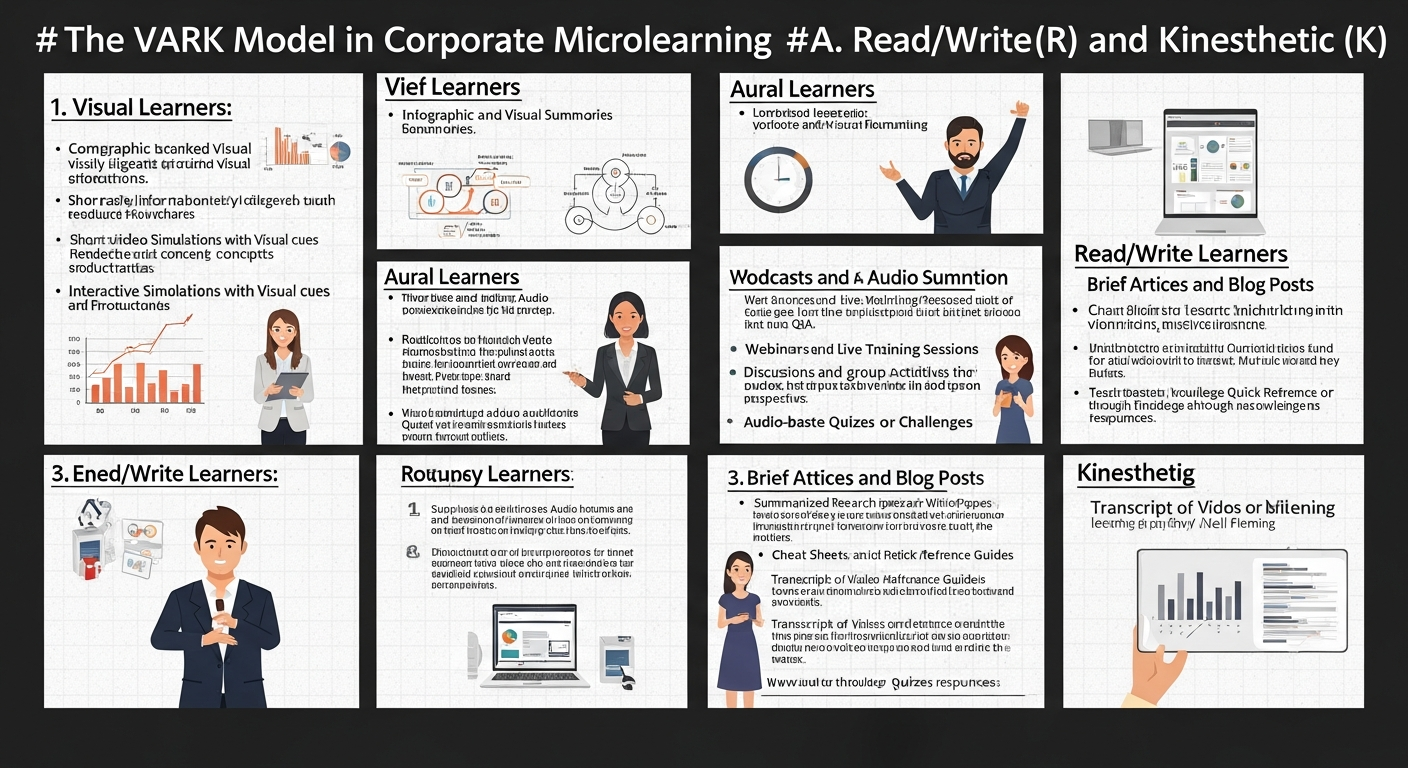
What Is Fleming’s VARK Model in Corporate Microlearning?
In the fast-evolving landscape of corporate learning and development, the demand for highly effective, engaging, and personalized training solutions has never been greater. Traditional, one-size-fits-all training programs often fall short in capturing learner attention and ensuring long-term knowledge retention. This challenge is particularly pronounced for Vice Presidents, Directors, and Managers of L&D tasked with upskilling diverse teams across industries such as Compliance, Sales, Banking, Finance, Insurance, Retail, Pharma, Health care, Hospitality, Oil and Gas, and Mining.
Enter microlearning – a methodology focused on delivering bite-sized, targeted content designed for quick consumption and immediate applicability. While microlearning inherently addresses many modern learning challenges, its true potential is unlocked when integrated with an understanding of diverse learning styles. This is where Fleming’s VARK Model becomes an invaluable framework. By aligning microlearning content with VARK preferences, organizations can create a learning experience that is not only efficient but also deeply resonates with individual learners, significantly boosting engagement, comprehension, and skill transfer.
Decoding the VARK Model
Developed by Neil Fleming, the VARK model categorizes learning preferences into four primary types: Visual, Aural, Read/Write, and Kinesthetic. While individuals often exhibit a preference for one or two styles, most are multimodal, meaning they learn effectively through a combination of these approaches. Understanding these preferences is the first step toward crafting truly impactful training.
Visual (V)
Visual learners grasp information best when it is presented through images, diagrams, charts, infographics, flowcharts, and videos. They tend to remember what they see and are often drawn to aesthetically pleasing and well-organized visual content. For these learners, "seeing" is believing and understanding.
Aural (A)
Aural learners prefer to hear information. They learn effectively through spoken words, discussions, lectures, podcasts, audio recordings, and verbal instructions. They often retain information by listening intently and may even repeat concepts aloud to solidify their understanding.
Read/Write (R)
Read/Write learners thrive on text-based information. They prefer learning through reading articles, manuals, reports, and writing notes, summaries, and essays. They appreciate well-structured text, bullet points, lists, and the opportunity to process information through written exercises.
Kinesthetic (K)
Kinesthetic learners learn by doing. They prefer hands-on experiences, practical exercises, simulations, role-playing, demonstrations, and real-world application. For them, active participation and tactile engagement are key to understanding and retaining new skills.
The Synergy: VARK and Corporate Microlearning
The inherent design of microlearning—short, focused, and easily digestible modules—makes it an ideal partner for the VARK model. Traditional lengthy courses often struggle to accommodate varied learning styles within a single format, leading to disengagement for many. Microlearning, however, allows for the diversification of content delivery, catering specifically to each VARK preference within a single learning pathway.
Imagine a compliance training module on data privacy. Instead of a 30-minute video, microlearning could break it down into:
- A 2-minute infographic (Visual) explaining key regulations.
- A 3-minute audio clip (Aural) detailing best practices from an expert.
- A 1-minute text summary (Read/Write) of do's and don'ts.
- A 5-minute interactive simulation (Kinesthetic) where learners identify privacy breaches.
This approach ensures that every learner finds content tailored to their preferred style, leading to higher engagement, better retention, and improved application of knowledge in critical areas like Risk-focused Training, sales techniques, or new product introductions.
Practical Application: Integrating VARK into Your Microlearning Strategy
To effectively leverage VARK in your corporate microlearning initiatives, consider the following strategies when designing your learning content management system:
Visual Learners
For Visual learners, prioritize high-quality visual aids. Use infographics to simplify complex processes, short animated videos to explain concepts, and clear diagrams for hierarchies or workflows. Incorporate images that directly relate to the content. A modern Microlearning LMS should effortlessly support and display a rich array of visual media.
Aural Learners
Cater to Aural learners with concise audio explanations, voiceovers accompanying visual presentations, and short podcast-style modules. Consider recording expert insights or case studies. Ensure that any video content has clear narration and that key points are reiterated verbally. An effective learning management system will provide robust audio streaming capabilities.
Read/Write Learners
These learners benefit from well-structured text. Provide brief articles, bullet-point summaries, and checklists. Offer downloadable resources like cheat sheets or glossaries. Incorporate short-answer questions or fill-in-the-blank exercises that require them to write. A flexible LCMS is crucial for managing and delivering varied textual assets efficiently.
Kinesthetic Learners
Engage Kinesthetic learners with interactive elements. This includes simulations of real-world scenarios (e.g., a customer service interaction, a financial transaction), drag-and-drop activities, decision-making games, and short quizzes that require active participation rather than passive consumption. A Gamified LMS can be particularly effective here, offering points, badges, and leaderboards for hands-on activities.
The Role of Technology: Powering VARK-aligned Microlearning
Implementing a VARK-aligned microlearning strategy effectively relies heavily on the capabilities of your chosen technology. A robust LMS (Learning Management System) is the backbone, enabling the seamless delivery of diverse content types.
Modern learning management solutions go beyond simple content delivery. They empower L&D professionals to:
- Curate Multimodal Content: Organize and deliver videos, audio clips, interactive exercises, and text-based modules within a single, cohesive learning path.
- Facilitate Adaptive Learning: Some advanced platforms can track learner preferences and performance, then adjust the learning path to provide more content in their preferred style or reinforce areas where they struggle. This personalized approach is a hallmark of truly effective enterprise learning management.
- Simplify Content Creation: An AI Powered Authoring Tool can dramatically speed up the creation of varied content formats, helping L&D teams rapidly produce engaging materials tailored to different VARK styles.
- Track Engagement & Performance: A comprehensive lms learning management system provides analytics on which content formats resonate most with different learner groups, allowing for continuous optimization of the training program.
Future-Proofing Corporate Training with Intelligent Design
As L&D leaders, you're constantly seeking ways to enhance learning effectiveness and efficiency, especially in an era influenced by intelligent systems and global team dynamics. Here are some common questions and how a VARK-informed microlearning strategy, supported by advanced platforms, provides answers:
Q: Can smart systems really tailor learning to individual preferences, almost like a personal tutor?
A: Yes, advanced cloud based learning management system can analyze engagement data and deliver personalized content paths, much like a personalized tutor. By observing how learners interact with different formats (visual, audio, text, interactive), these platforms can proactively suggest or emphasize modules that align with their VARK preferences, ensuring a more intuitive and effective learning journey.
Q: How do we ensure our training content stays relevant and impactful for diverse global teams, spanning different cultures and learning contexts?
A: By utilizing agile content creation tools and a robust Risk-focused Training approach, companies can quickly adapt and deploy modules that resonate culturally and contextually. A flexible learning management software allows for easy localization and diverse content formats, accessible via any lms learning management system, ensuring global teams receive relevant and engaging training regardless of their geographic location or learning style.
Q: What's the best way to optimize our learning and development resources for maximum engagement and skill transfer across all departments?
A: Integrating a learning content management system that supports multimodal delivery, such as MaxLearn LMS, allows for efficient content management and deployment tailored to various learning styles. By breaking down complex topics into VARK-aligned microlearning modules, organizations can significantly boost engagement and knowledge retention across your enterprise learning management initiatives, from sales to compliance to technical training.
Conclusion
Fleming’s VARK Model offers L&D professionals a powerful framework for optimizing corporate microlearning. By understanding and catering to the diverse learning preferences of your workforce – Visual, Aural, Read/Write, and Kinesthetic – you can move beyond generic training to create highly personalized, engaging, and ultimately more effective learning experiences. The synergy between VARK and microlearning, facilitated by advanced learning management system technology, leads to greater knowledge retention, improved skill application, and a more motivated and competent workforce across all critical industries.
Embracing a VARK-informed microlearning strategy is not just about adopting a new trend; it’s about making a strategic investment in your employees' development and your organization's future success. Consider how your current learning management software can be leveraged or enhanced to unlock the full potential of personalized, bite-sized learning.


Comments
Post a Comment