What is the Difference Between Multiple Intelligences and Learning Styles?
The Strategic Edge: Differentiating Multiple Intelligences from Learning Styles for L&D Leaders
In the dynamic landscape of corporate learning and development, understanding how individuals learn is paramount to crafting effective training programs. As L&D leaders, you’re constantly seeking methods to optimize knowledge retention, skill acquisition, and overall employee performance. Two concepts often discussed in this realm are 'Multiple Intelligences' and 'Learning Styles.' While seemingly similar, grasping the fundamental differences between them is crucial for designing truly impactful, inclusive, and future-ready eLearning initiatives. Let's delve into these distinct frameworks and explore how they can inform your strategy, particularly with the advent of sophisticated learning management system technologies.
Understanding Multiple Intelligences: Beyond a Single Score
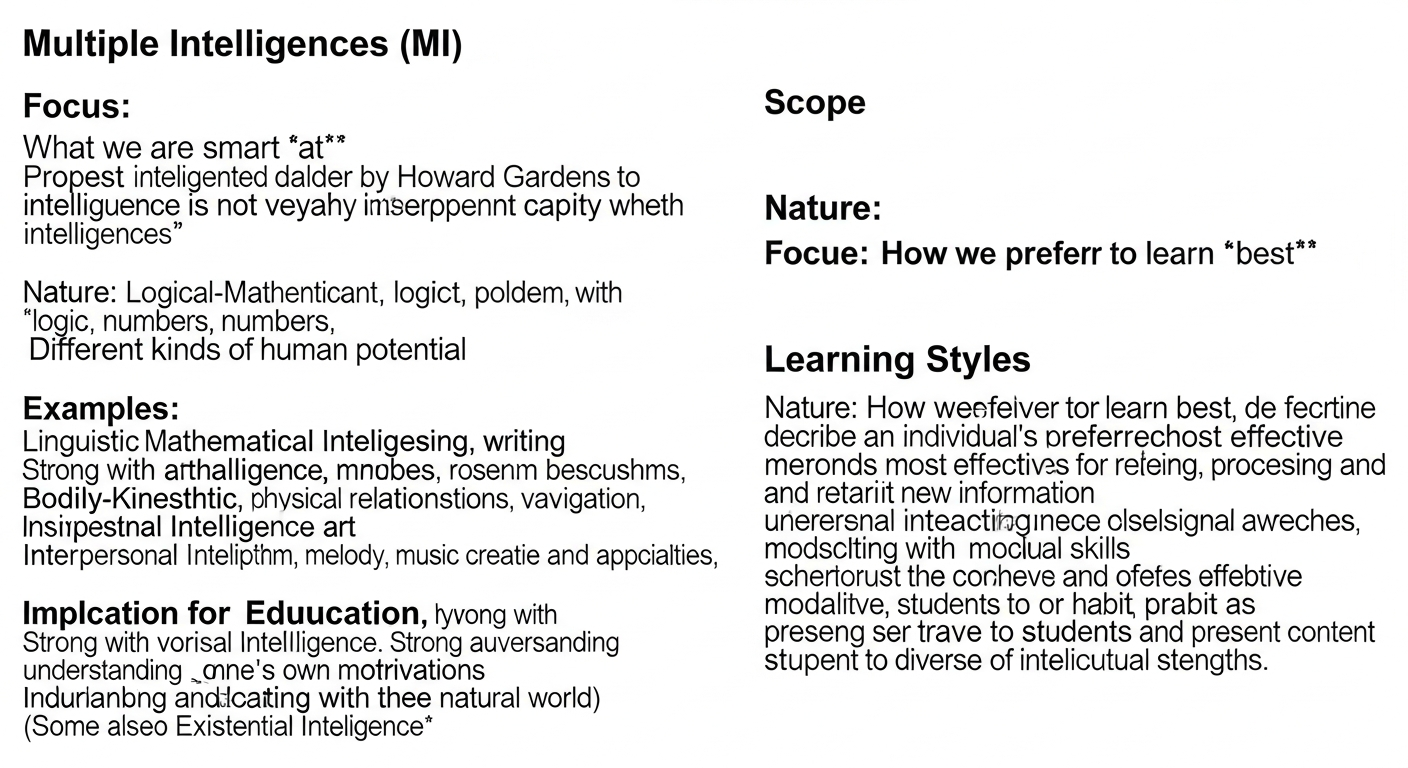
Proposed by Dr. Howard Gardner in 1983, the Theory of Multiple Intelligences posits that intelligence is not a single, monolithic entity that can be measured by a simple IQ test. Instead, it suggests that humans possess several distinct intelligences, each representing a different way of interacting with the world and processing information. Gardner initially identified seven, later expanding to eight or nine:
- Linguistic Intelligence: The ability to use language effectively, both orally and in writing. Think writers, poets, lawyers, and those adept at verbal communication critical in Sales and Banking.
- Logical-Mathematical Intelligence: The capacity for logical reasoning, problem-solving, and numerical proficiency. Scientists, mathematicians, engineers, and financial analysts often excel here.
- Spatial Intelligence: The ability to think in three dimensions, manipulate mental images, and understand spatial relationships. Architects, artists, navigators, and professionals in Oil and Gas or Mining who visualize complex systems.
- Bodily-Kinesthetic Intelligence: Skill in using one's whole body or parts of the body to solve problems or fashion products. Dancers, athletes, surgeons, and individuals performing hands-on tasks in Retail or Hospitality.
- Musical Intelligence: Proficiency in producing and appreciating rhythm, pitch, and timbre. Musicians, composers, and sensitive listeners.
- Interpersonal Intelligence: The ability to understand and interact effectively with others. Teachers, leaders, sales professionals, and customer service roles in any industry.
- Intrapersonal Intelligence: The capacity to understand oneself, one's own emotions, motivations, and goals. Philosophers, psychologists, and self-aware individuals who benefit from reflective practices.
- Naturalistic Intelligence: The ability to recognize, categorize, and understand features of the natural world. Biologists, environmentalists, and professionals managing natural resources.
For L&D, understanding these intelligences means recognizing that employees come with diverse cognitive strengths. Training should ideally appeal to a range of these intelligences, moving beyond purely linguistic or logical-mathematical approaches to engage learners more holistically.
Understanding Learning Styles: Preferences, Not Capabilities
In contrast, the concept of Learning Styles refers to an individual's preferred or habitual way of absorbing, processing, and retaining information. Unlike intelligences, which suggest innate cognitive abilities, styles often describe preferences. One of the most widely recognized models is VARK, which categorizes learners into four main styles:
- Visual (V): Learners who prefer to see information presented visually, through charts, graphs, diagrams, and videos.
- Auditory (A): Learners who best absorb information by hearing it, such as through lectures, discussions, and podcasts.
- Read/Write (R): Learners who prefer to learn by reading and writing, taking notes, and engaging with text-based content.
- Kinesthetic (K): Learners who learn best by doing, through hands-on activities, simulations, and practical experiences.
While intuitively appealing, the concept of learning styles has faced significant scrutiny from educational researchers. A substantial body of evidence suggests that tailoring instruction solely to an individual's self-reported learning style does not significantly improve learning outcomes. In fact, consistently presenting information in only one preferred style might even hinder a learner's ability to adapt to diverse real-world challenges. The consensus leans towards presenting information in multiple modalities, allowing all learners to engage with the material through their strengths while also developing other processing abilities.
The Core Distinction: Intelligence vs. Style
The critical difference lies in their nature: Multiple Intelligences describe what you are good at – your inherent cognitive strengths and potentials. Learning Styles, on the other hand, describe how you prefer to learn – your favored method of taking in information.
Think of it this way: a person might have high Linguistic Intelligence (meaning they are naturally adept with words) but still prefer to learn a new concept through a Kinesthetic activity, like building a model. Their intelligence is their inherent capability, while their style is their preference for instruction.
For L&D professionals, this distinction is profound. Instead of trying to 'diagnose' an employee's learning style and then rigidly match content, the focus shifts. With Multiple Intelligences, the goal is to design rich, multi-faceted training that leverages various cognitive strengths available in your workforce. With learning preferences, the aim is to offer diverse instructional methods, ensuring content accessibility and engagement for all, rather than limiting exposure to a single mode.
Leveraging these Concepts in Modern eLearning
In the modern corporate learning environment, particularly within industries like Compliance, Sales, Banking, and Healthcare, leveraging these insights is crucial for maximizing training effectiveness. A robust LMS (learning management system) serves as the backbone for delivering such sophisticated training.
By understanding Multiple Intelligences, L&D teams can design Microlearning LMS modules that cater to different cognitive strengths. For instance, a compliance course could include:
- Interactive scenarios (Interpersonal, Logical-Mathematical)
- Video demonstrations (Spatial, Bodily-Kinesthetic for process walkthroughs)
- Quizzes with varied question types (Linguistic, Logical-Mathematical)
- Reflective journal prompts (Intrapersonal)
Similarly, while not strictly adhering to 'learning styles,' offering diverse modalities within a Gamified LMS or a comprehensive LCMS (Learning content management system) ensures that learners can engage with content in ways that resonate with their current preferences. This is where modern learning management solutions excel.
For high-stakes sectors, Risk-focused Training demands engaging every learner effectively. Solutions incorporating Adaptive Learning capabilities can dynamically adjust the learning path based on an individual's performance and implicit preferences, rather than a pre-assigned style. An AI Powered Authoring Tool can further streamline the creation of such varied content, making it easier for teams to develop rich, multimodal experiences without extensive manual effort. This approach ensures that your enterprise learning management initiatives are truly inclusive and effective across your global workforce.
The Intelligent Edge: AI's Role in Personalized Learning
The convergence of learning science and artificial intelligence is reshaping how we approach personalized education. Modern cloud based learning management system platforms are increasingly leveraging intelligent algorithms to analyze vast amounts of learner data. These systems don't just 'guess' a learner's style; they observe actual interactions, performance, and progress.
Consider these questions that intelligent platforms are starting to answer:
Enhancing Learner Understanding through Intelligent Analysis
How can advanced analytics enhance our understanding of individual learner diversity beyond simplistic labels? By analyzing how learners engage with various content types, what questions they struggle with, and which formats lead to higher retention, AI can build a nuanced profile of each employee's cognitive strengths and areas for development. This data-driven approach moves beyond self-reported preferences to empirical evidence of effective learning pathways.
Tailoring Global Training with Smart Technology
Can sophisticated platforms help customize learning experiences across diverse geographical locations and cultural backgrounds? Absolutely. Intelligent systems can identify patterns in engagement and effectiveness across different demographics, suggesting localized content adaptations or alternative instructional methods that resonate better with specific regional teams. This ensures that a global compliance training, for instance, is not a one-size-fits-all but a culturally sensitive and effective program, making your lms learning management system truly global.
Driving Program Effectiveness with Predictive Insights
What groundbreaking insights can intelligent technology offer for developing truly transformative training programs? By processing performance metrics, completion rates, and feedback from thousands of learners, AI can predict which instructional strategies are most effective for particular learning objectives or job roles. This predictive capability allows L&D leaders to continuously refine their content and delivery, ensuring that training investments yield maximum ROI and contribute directly to business outcomes, whether it's for Sales, Pharma, or Oil and Gas sectors.
Such intelligent capabilities within a comprehensive MaxLearn LMS move us towards a future where learning is not just personalized by preference but optimized by performance data and cognitive science.
Practical Application for L&D Leaders
For L&D leaders, the takeaway is clear: rather than attempting to categorize employees into rigid learning styles, focus on building a robust learning ecosystem that caters to the spectrum of human intelligence and provides varied instructional approaches.
This means:
- Designing for Diversity: Create content that engages visual, auditory, kinesthetic, and textual modalities within each module. Offer choices where appropriate.
- Embracing Multimodality: Don't stick to one format. Incorporate videos, interactive simulations, discussion forums, practical exercises, and text-based resources.
- Leveraging Technology: Utilize modern learning management software to deliver and track diverse content, enabling Adaptive Learning paths that respond to performance rather than just preference.
- Focusing on Performance: Ultimately, the goal is measurable skill acquisition and behavioral change. Design training with clear learning objectives and assess based on competency, not just completion.
A powerful enterprise learning management solution equipped with an AI Powered Authoring Tool can empower your team to efficiently create and deploy such sophisticated, multi-faceted training programs across all your segments – from Finance to Hospitality, ensuring that every employee has the opportunity to learn and excel.
Conclusion
Understanding the nuanced distinction between Multiple Intelligences and Learning Styles is not merely academic; it’s a strategic imperative for L&D professionals. While Multiple Intelligences illuminate the inherent cognitive strengths we possess, learning styles highlight individual preferences that can guide, but not dictate, instructional design. By moving beyond simplistic categorizations and embracing a rich, multimodal approach—supported by advanced learning management solutions and intelligent technologies—you can unlock the full potential of your workforce. The future of corporate training lies in creating inclusive, adaptive, and engaging experiences that resonate with the diverse ways your employees think, process, and ultimately, excel.


Comments
Post a Comment