What Are the Four Modalities of the VARK Framework in Elearning?
Unlocking Learner Potential: What Are the Four Modalities of the VARK Framework in Elearning?
In the dynamic landscape of corporate training and development, the pursuit of effective and engaging learning experiences is paramount for L&D leaders. From Vice Presidents to Senior Managers, the goal remains consistent: equip employees with the knowledge and skills they need to excel, drive business growth, and maintain a competitive edge. This is especially true across diverse industries such as Compliance, Sales, Banking, Finance, Insurance, Retail, Pharma, Health care, Hospitality, Oil and Gas, and Mining, where effective training directly impacts performance, productivity, and safety.
One powerful framework that has gained significant traction in understanding individual learning preferences is VARK. Developed by Neil Fleming, VARK stands for Visual, Aural, Read/Write, and Kinesthetic. By understanding these four core modalities, L&D professionals can design and deliver eLearning content that truly resonates with their workforce, leading to higher engagement, better knowledge retention, and ultimately, superior business outcomes. In an era where personalized learning is no longer a luxury but a necessity, embracing the VARK framework within your Microlearning LMS strategy can revolutionize your approach to enterprise learning management.
Understanding the VARK Framework
The VARK framework provides a simple yet effective model for categorizing learning styles. It posits that individuals have a preferred way of receiving and processing information. While most people exhibit a blend of these styles, recognizing primary preferences allows for more targeted and impactful instructional design. Implementing VARK in your learning content management system ensures that every learner has an opportunity to grasp complex concepts in a way that aligns with their natural inclinations.
Moving beyond a one-size-fits-all approach, a VARK-informed strategy emphasizes learner-centric design, which is a cornerstone of modern learning management software. Let's delve into each of the four modalities and explore how they can be effectively integrated into your eLearning programs.
The Four Modalities of VARK
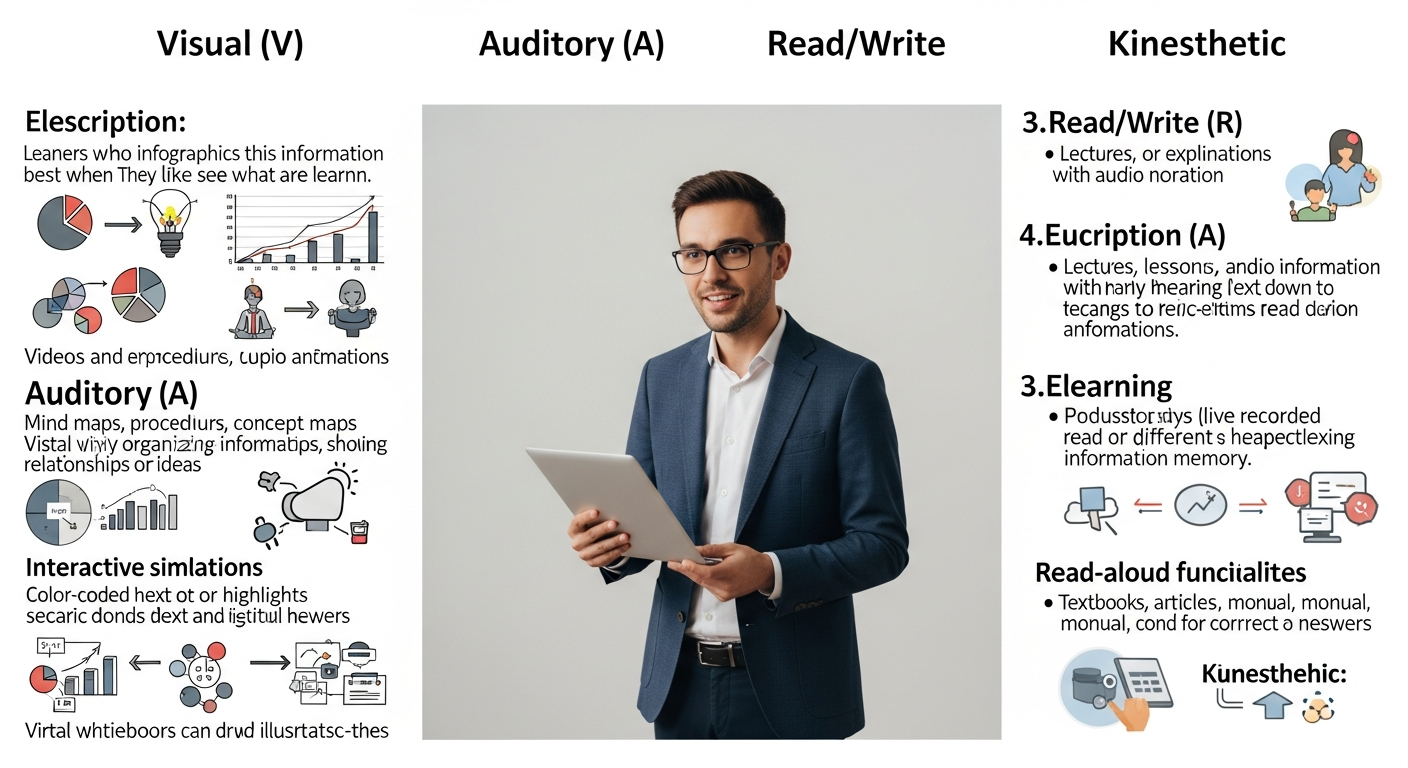
Visual (V) Learners
Visual learners thrive on seeing information presented in a graphic or pictorial format. They prefer to learn through observation and spatial awareness. For these individuals, abstract concepts come to life when translated into diagrams, charts, graphs, and videos.
- Characteristics: Prefer visual aids, remember faces more than names, enjoy documentaries and presentations with strong visuals.
- eLearning Applications:
- Infographics, flowcharts, and mind maps that illustrate processes or relationships.
- High-quality video tutorials and demonstrations.
- Interactive simulations with strong visual feedback.
- Colorful and well-designed presentations within your Microlearning LMS.
Aural (A) Learners
Aural or Auditory learners learn best through listening. They absorb information effectively when it's spoken, heard, or discussed. These learners often benefit from lectures, podcasts, and group discussions where they can articulate and process information verbally.
- Characteristics: Enjoy lectures, group discussions, audiobooks; tend to talk through problems; remember names more than faces.
- eLearning Applications:
- Podcasts, audio lectures, and narrated presentations.
- Recorded webinars and expert interviews.
- Discussion forums and virtual group meetings where learners can verbalize their understanding.
- Voice-over explanations for complex diagrams or processes.
Read/Write (R) Learners
Read/Write learners excel through textual input and output. They prefer to learn by reading and writing, taking detailed notes, and engaging with written materials. These individuals often find value in manuals, reports, articles, and creating their own summaries.
- Characteristics: Love reading textbooks, taking notes, creating lists, and writing essays or reports.
- eLearning Applications:
- Comprehensive articles, detailed guides, and whitepapers.
- Transcripts of audio/video content.
- Opportunities for note-taking, journaling, and reflective writing assignments.
- Quizzes and assessments that require written responses or explanations.
- Access to a rich library of resources within your learning content management system.
Kinesthetic (K) Learners
Kinesthetic learners, also known as tactile learners, learn by doing, experiencing, and moving. They need to physically engage with the material to truly understand and retain it. Hands-on activities, simulations, and real-world case studies are crucial for this group.
- Characteristics: Prefer hands-on activities, experiments, role-playing, simulations; learn best through direct experience and practice.
- eLearning Applications:
- Interactive simulations and virtual labs for practical application (e.g., machinery operation, surgical procedures, financial trading).
- Role-playing scenarios, particularly vital for Sales, Customer Service, and Leadership training.
- Gamified exercises and challenges that require active participation, easily supported by a Gamified LMS.
- Case studies that demand problem-solving and decision-making.
- Clickable prototypes and interactive exercises.
Why VARK Matters in Corporate eLearning
For L&D leaders, understanding and applying the VARK framework offers significant strategic advantages:
- Improved Engagement and Retention: When content aligns with a learner's preferred style, they are more likely to stay engaged, understand the material deeply, and retain information long-term. This is especially critical for complex or high-stakes topics like Compliance or Risk-focused Training.
- Enhanced Learner Satisfaction: Learners feel more confident and competent when they can access and process information in a way that feels natural to them, leading to higher satisfaction with training programs.
- Better Performance Outcomes: Effectively trained employees perform better. By addressing diverse learning styles, organizations can ensure a broader impact of their training initiatives on job performance and business metrics.
- Optimized Training Investment: A well-designed learning experience reduces the need for re-training and boosts the ROI of your training budget. An efficient lms learning management system helps track and optimize this investment.
Implementing VARK with Modern eLearning Technologies
Leveraging modern eLearning technologies is key to delivering a VARK-informed experience at scale. A robust learning management system (LMS) acts as the backbone of such an initiative.
- Content Variety: A sophisticated cloud based learning management system allows for the integration of various media types—videos, audio files, interactive modules, text documents—to cater to all VARK modalities.
- Adaptive Learning Paths: Modern learning management solutions can dynamically adjust content delivery based on pre-assessment of learner preferences or ongoing performance, ensuring each employee receives the most effective learning path.
- AI Powered Authoring Tools: Artificial intelligence can assist in creating diverse content formats rapidly, transforming textual information into visual summaries or audio narratives, making content creation more efficient for your LCMS.
- Personalized Dashboards: An advanced MaxLearn LMS can offer personalized dashboards that highlight recommended content formats based on a learner's identified VARK preference, simplifying navigation and boosting engagement.
AI-Enhanced Learning Questions
As L&D moves further into digital transformation, intelligent systems offer unprecedented opportunities to personalize and optimize learning. Here are some critical questions shaping the future of VARK-integrated eLearning:
How can smart algorithms optimize content delivery based on individual learning preferences?
Intelligent learning platforms can leverage data analytics to identify a learner's dominant VARK modality through interactions, completion rates, and feedback. By analyzing this data, smart algorithms can then dynamically suggest or prioritize specific content formats—e.g., offering a video explanation over a text document if a learner consistently engages better with visual content. This ensures a truly personalized learning journey, optimizing engagement and knowledge transfer for every employee within your learning management software.
Can intelligent systems tailor learning experiences to regional compliance standards?
Absolutely. For industries like Banking, Finance, Pharma, and Health care, regional compliance is non-negotiable. Advanced learning management solutions, especially those with robust enterprise learning management capabilities, can be configured to deliver content that adheres to specific geographic regulations and cultural nuances. Intelligent systems can automatically localize content, provide relevant examples, and ensure that compliance training is not only effective but also contextually appropriate for learners in different regions, minimizing risk and ensuring global consistency while respecting local requirements.
What are the key considerations for designing learning paths that cater to diverse organizational roles?
Designing effective learning paths for varied roles—from front-line retail staff to executive leaders in Oil and Gas—requires an understanding of job-specific knowledge, required skills, and the preferred learning styles prevalent within those roles. Intelligent systems can map skills to specific content modalities, recommend learning sequences based on career progression, and even suggest collaborative activities that align with team structures. This holistic approach ensures that learning is not just personalized by VARK, but also by professional context, making every training module relevant and impactful for individual career growth and organizational objectives.
Conclusion
The VARK framework offers L&D leaders a clear lens through which to view and optimize their eLearning strategies. By understanding and catering to Visual, Aural, Read/Write, and Kinesthetic learning preferences, organizations can foster a more inclusive, engaging, and effective learning environment. In today's competitive landscape, leveraging a comprehensive Microlearning LMS like MaxLearn LMS, equipped with features for Gamified LMS, Adaptive Learning, and an AI Powered Authoring Tool, is no longer an option but a strategic imperative. Embrace the VARK modalities to unlock the full potential of your workforce and drive unparalleled success across all your business segments.


Comments
Post a Comment