What are the Benefits of Using the Multiple Intelligences Model in L&D?
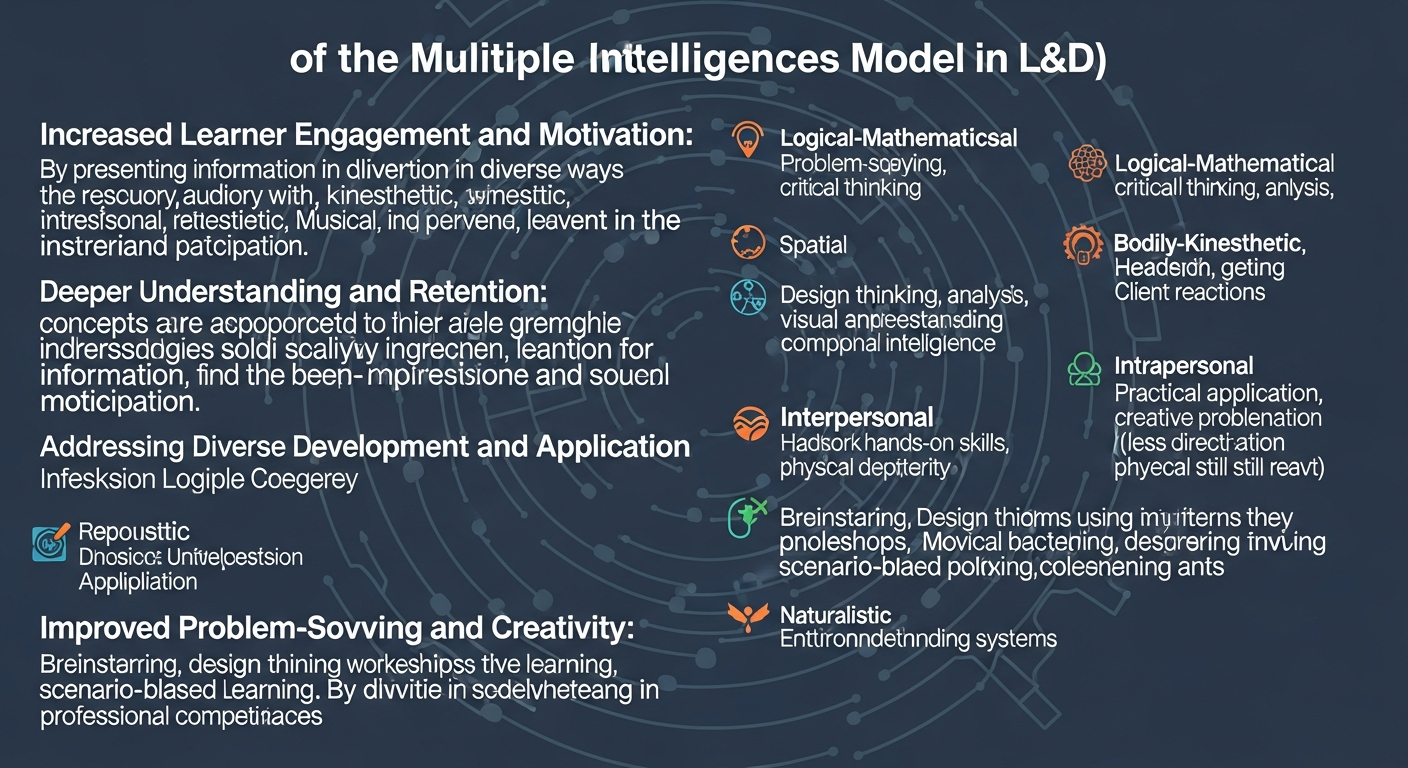
The Strategic Edge: Unlocking Potential with Multiple Intelligences in L&D
In today's dynamic corporate landscape, where innovation and adaptability are paramount, Learning & Development (L&D) leaders face the ongoing challenge of crafting training programs that truly resonate and drive measurable results. The traditional "one-size-fits-all" approach is increasingly obsolete, failing to cater to the diverse cognitive strengths and preferences of a modern workforce spanning industries from Banking and Finance to Pharma and Oil and Gas. This is where the Multiple Intelligences (MI) model, pioneered by Dr. Howard Gardner, offers a powerful, strategic framework. For Vice Presidents, Directors, and Senior Managers of L&D, understanding and applying MI is not just a pedagogical nicety; it's a vital pathway to enhanced engagement, improved performance, and significant ROI.
The MI model posits that intelligence is not a singular, quantifiable entity but rather a spectrum of distinct intellectual abilities, including linguistic, logical-mathematical, spatial, bodily-kinesthetic, musical, interpersonal, intrapersonal, and naturalistic intelligences. By recognizing and designing for these varied strengths, L&D departments can transform passive learning into an active, enriching, and deeply effective experience for all employees, whether they are navigating complex compliance regulations, mastering new sales techniques, or honing critical healthcare protocols.
Why Multiple Intelligences are Crucial for Modern L&D
The contemporary workforce is more diverse than ever, comprising individuals from varied backgrounds, generations, and learning experiences. Expecting a single instructional method to captivate and educate everyone is unrealistic. Integrating MI principles into your Microlearning LMS or Gamified LMS strategy allows you to build a learning ecosystem that acknowledges and leverages individual strengths, turning potential weaknesses into opportunities for growth. This is particularly relevant in high-stakes industries like Mining or Retail, where effective training directly impacts safety, productivity, and customer experience.
Enhanced Learner Engagement and Retention
- Personalized Pathways: When training caters to a learner's dominant intelligences, they find the content more accessible and enjoyable. A visually inclined learner (spatial) thrives on infographics and video, while an interpersonal learner benefits from collaborative group projects. This personalization boosts motivation significantly.
- Deeper Understanding: Presenting concepts through multiple lenses helps learners grasp complex information more thoroughly. For instance, explaining a financial product (logical-mathematical) can also involve role-playing a sales scenario (interpersonal) or creating a visual metaphor (spatial), ensuring a robust understanding across the team.
- Reduced Attrition: Engaged learners are less likely to disengage or abandon training modules. By making learning relevant and enjoyable, MI fosters a positive association with continuous professional development, crucial for talent retention in competitive sectors like Hospitality or Technology.
Improved Performance and Productivity
The ultimate goal of L&D is to equip employees with the skills and knowledge needed to excel in their roles. MI-based training directly contributes to this by:
- Bridging Skill Gaps Effectively: By identifying a learner's strongest intelligence, L&D can tailor interventions that rapidly close specific skill gaps. A bodily-kinesthetic learner might learn best through simulations or hands-on practice, which is invaluable for technical roles in Oil and Gas or manufacturing.
- Fostering Adaptability: Employees exposed to information in various formats become more adaptable and capable of applying their knowledge in diverse real-world situations. This agility is critical for rapid innovation and problem-solving in fast-paced environments.
- Boosting Innovation: A workforce trained to think using multiple intelligences is inherently more creative and capable of approaching challenges from novel perspectives, driving innovation across product development, service delivery, and operational efficiency.
Optimized Training ROI and Scalability
For L&D leaders, the return on investment (ROI) of training initiatives is a constant focus. Incorporating MI offers tangible benefits:
- Efficient Resource Allocation: By understanding how different groups learn best, L&D can allocate resources more effectively, investing in the most impactful training modalities. This means less wasted effort on ineffective programs.
- Measurable Outcomes: When training is tailored and engaging, completion rates increase, and skill acquisition is more profound, leading to measurable improvements in job performance, compliance adherence, and sales figures. An enterprise learning management system built with MI in mind can track these diverse learning pathways and their impact.
- Future-Proofing L&D: Adopting an MI framework prepares your organization for future challenges by creating a versatile and resilient learning culture. It allows for the scalable deployment of Adaptive Learning paths that evolve with your business needs and workforce demographics.
Seamless Integration with Modern eLearning Technologies
The power of the Multiple Intelligences model is amplified when integrated with advanced eLearning technologies. A robust learning management system (LMS) can be the cornerstone of an MI-driven strategy:
- Diverse Content Delivery: A modern LMS enables the creation and distribution of a wide array of content types—videos, interactive simulations, podcasts, collaborative forums, quizzes—catering to every intelligence type.
- Intelligent Content Creation: An AI Powered Authoring Tool can assist in generating diverse learning materials from a single source, automatically adapting content formats for different intelligences, ensuring comprehensive coverage and engagement. This is invaluable for generating nuanced content for Risk-focused Training in highly regulated industries.
- Data-Driven Personalization: A sophisticated learning content management system, or MaxLearn LMS, tracks learner interactions and performance, providing insights that allow for continuous refinement of personalized learning paths. This makes the learning management software truly responsive to individual needs.
Frequently Explored Questions on Intelligent L&D Solutions
As L&D leaders strategize for the future, leveraging advanced technologies to support diverse learning styles is a common point of discussion. Here are some insights:
How can intelligent learning platforms help identify and cater to individual learning strengths across a global enterprise?
Modern learning management solutions use advanced analytics and machine learning to analyze learner behavior, performance data, and engagement patterns. By processing vast amounts of information from various geographic locations and departmental roles, a cloud based learning management system can identify preferred content types (e.g., visual, auditory, kinesthetic) and recommend personalized learning modules that align with an individual's predominant intelligences, regardless of their physical location. This ensures culturally and contextually relevant learning experiences for a globally distributed workforce.
What specific content formats does an advanced learning system recommend to optimize understanding for varied learners within a complex industry like Healthcare or Finance?
An intelligent lms learning management system goes beyond simple video or text. For linguistic learners, it might suggest detailed case studies, podcasts, or rich textual analyses. For logical-mathematical learners, interactive data visualizations, simulations, and problem-solving exercises are prioritized. Spatial learners would receive highly visual content like animated explainers, infographics, and virtual reality experiences. Bodily-kinesthetic learners would benefit from interactive simulations, drag-and-drop activities, and role-playing scenarios. An enterprise learning management system (LCMS) with robust content management can dynamically offer these diverse formats based on learner profiles and course objectives, ensuring optimal comprehension for even the most intricate topics.
Beyond traditional assessments, how do cutting-edge platforms measure the practical application of diverse skills acquired through MI-based training?
Instead of relying solely on multiple-choice quizzes, advanced learning management software integrates experiential assessment methods. This includes performance simulations where learners apply skills in a virtual environment (e.g., operating complex machinery, handling a difficult customer interaction), peer reviews on collaborative projects, and AI-powered evaluations of written or spoken responses for linguistic intelligence. For intrapersonal skills, reflective journaling or self-assessment tools are employed. These methods provide a holistic view of skill acquisition and practical application, ensuring that the training translates directly into improved job performance and tangible business outcomes.
Conclusion
The strategic incorporation of the Multiple Intelligences model into your L&D framework is not merely a trend; it's a foundational shift towards more effective, engaging, and impactful corporate training. For L&D Vice Presidents, Directors, and Managers across all industries—from Compliance and Sales to Banking and Pharma—leveraging MI principles, supported by a sophisticated learning content management system like MaxLearn LMS, allows for the creation of truly inclusive and high-performing learning environments. By embracing the diverse ways in which your employees learn, you empower them to reach their full potential, drive innovation, and ultimately, contribute significantly to your organization's success in an ever-evolving global market. It's time to unlock the strategic edge that a tailored, intelligent approach to learning can provide.


Comments
Post a Comment