Traditional Corporate Training vs. Adaptive Learning Powered by Gardner’s Theory
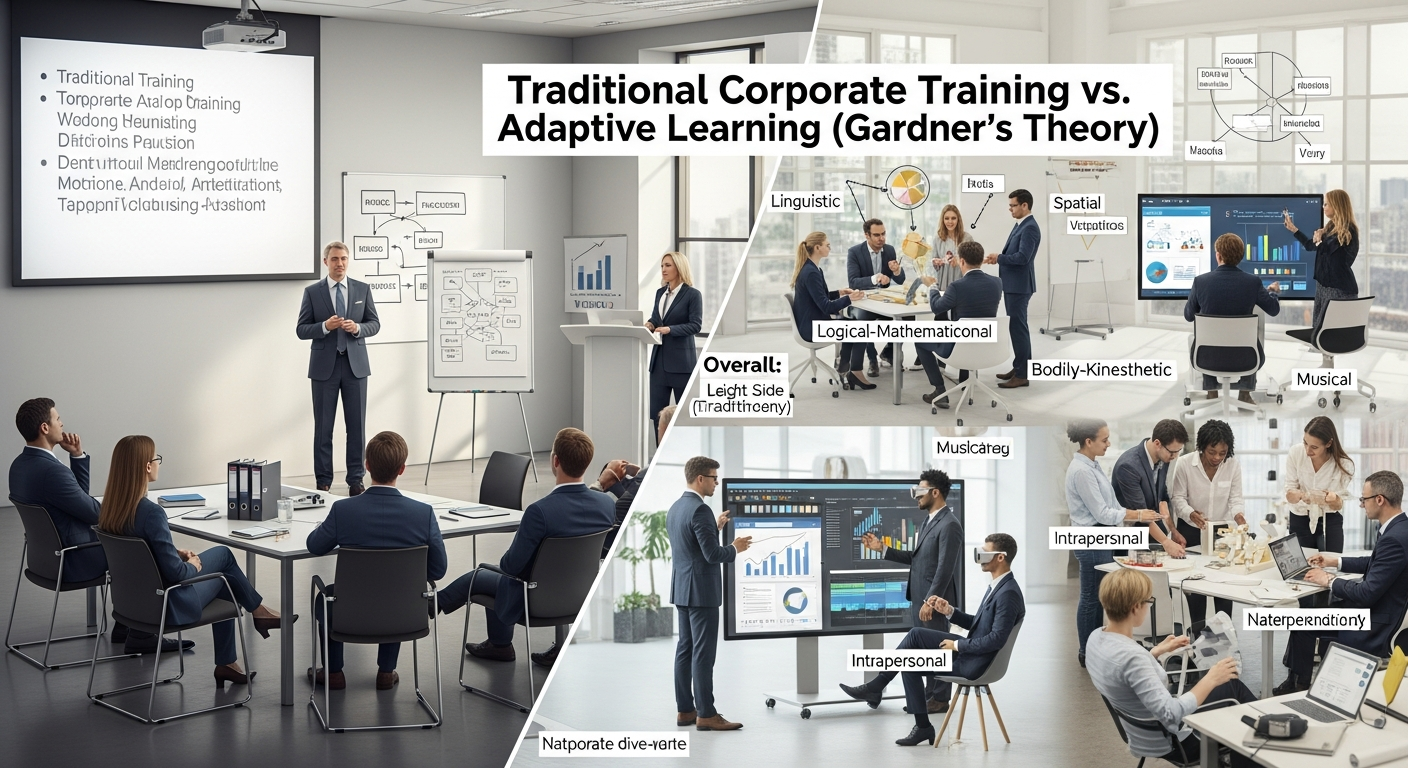
Traditional Corporate Training vs. Adaptive Learning Powered by Gardner’s Theory
In today's fast-evolving corporate landscape, the effectiveness of employee training directly impacts an organization's agility, compliance, and competitive edge. For Vice Presidents, Directors, and Managers of Learning & Development, the perpetual challenge is to move beyond mere knowledge dissemination to genuine skill acquisition and behavioral change. Historically, traditional corporate training, often characterized by standardized curricula and didactic delivery, has been the norm. However, with advancements in educational psychology and technology, a more sophisticated approach is gaining traction: Adaptive Learning, significantly enhanced by insights from Gardner’s Theory of Multiple Intelligences.
This article delves into the inherent limitations of traditional training models and champions the transformative power of adaptive learning, showcasing how an understanding of diverse intelligences can revolutionize how organizations, from Compliance to Sales, Banking to Healthcare, and Oil & Gas to Retail, approach employee development. It's time to explore how a modern LMS can facilitate a truly personalized and impactful learning journey.
The Limitations of Traditional Corporate Training Models
Traditional corporate training, while foundational for many years, often falls short in meeting the complex demands of modern workforces. Its one-size-fits-all methodology assumes a homogenous learning style, which is rarely the case across diverse employee populations and industries.
- Low Engagement & Retention: Employees subjected to generic, lengthy modules often find the content irrelevant or uninspiring, leading to disengagement and poor knowledge retention. This is particularly problematic in sectors like Pharma and Finance, where critical information must be absorbed and retained for compliance and operational excellence.
- Ineffective for Diverse Learners: A lecture-based approach might suit linguistic learners, but what about those who learn best through hands-on experience (bodily-kinesthetic) or visual aids (spatial)? Traditional methods often fail to cater to this spectrum, alienating a significant portion of the workforce.
- Static & Quickly Obsolete: In rapidly changing fields such as Technology, Healthcare, and Banking, content can become outdated almost as soon as it's created. Traditional training struggles to adapt quickly, leaving employees with incomplete or irrelevant information.
- Difficulty Measuring Impact: Beyond completion rates, demonstrating the tangible ROI of traditional training can be challenging. Were new skills truly acquired? Did performance improve? These questions often remain unanswered. This is a critical concern for Risk-focused Training in industries like Insurance and Mining, where the stakes are high.
Understanding Gardner’s Theory of Multiple Intelligences
Howard Gardner’s groundbreaking Theory of Multiple Intelligences posits that intelligence is not a single, monolithic entity, but rather a set of distinct "intelligences" that individuals possess to varying degrees. Originally identifying seven, and later adding an eighth, these intelligences offer a profound framework for understanding how people learn and process information:
- Linguistic Intelligence: The ability to use language effectively, both orally and in writing. (Storytelling, debates, writing assignments)
- Logical-Mathematical Intelligence: The ability to reason, analyze problems, and perform mathematical operations. (Case studies, problem-solving, data analysis)
- Spatial Intelligence: The capacity to think in images and pictures, to visualize accurately and abstractly. (Diagrams, simulations, virtual reality)
- Bodily-Kinesthetic Intelligence: The ability to use one’s body effectively and skillfully. (Role-playing, simulations, hands-on activities)
- Musical Intelligence: The capacity to discern pitch, rhythm, timbre, and tone. (Less direct in corporate, but can involve rhythmic prompts or background music)
- Interpersonal Intelligence: The ability to understand and interact effectively with others. (Group projects, collaborative learning, discussions)
- Intrapersonal Intelligence: The ability to understand oneself, one’s feelings, and motivations. (Reflective journaling, self-paced modules, personalized feedback)
- Naturalistic Intelligence: The ability to recognize and categorize patterns in nature. (Often applies less directly to corporate training, but can involve understanding systems or environmental contexts).
For L&D leaders, this theory provides a crucial insight: a truly effective learning environment must cater to these diverse intelligences, not just one or two.
Adaptive Learning: The Personalized Pathway to Proficiency
Adaptive Learning is a revolutionary educational approach that leverages technology to personalize the learning experience. Instead of a fixed path, it dynamically adjusts the content, pace, and delivery method based on an individual learner's performance, preferences, and progress. This ensures that each employee receives exactly what they need, precisely when they need it, in a format that resonates with their unique learning style.
How does AI help in identifying individual learning styles and preferences across a global workforce?
Artificial intelligence, often integrated into a modern `learning management system`, can analyze a wealth of data points from learner interactions—including quiz results, time spent on content, navigation patterns, and even explicit feedback. By identifying common successful pathways and areas of struggle, AI algorithms can infer an individual's predominant learning preferences. For a global workforce, AI can also factor in cultural nuances and language preferences, offering content in appropriate formats, whether it's interactive simulations for visual learners in Europe or text-based case studies for logical-mathematical thinkers in Asia. This granular insight helps tailor future content recommendations and even adapt the user interface of the `LMS learning management system` to better suit the learner.
Adaptive Learning Powered by Gardner's Theory: A Synergistic Approach
When adaptive learning is imbued with the principles of Gardner's Theory, the training experience transforms from a passive requirement into an active, engaging, and highly effective journey. Here's how:
- Dynamic Content Delivery: An adaptive `Learning content management system` can offer the same core information in multiple formats. For a new product launch in Retail, a linguistic learner might get detailed product specifications, while a spatial learner receives interactive 3D models or virtual tours. A bodily-kinesthetic learner could engage with a simulated sales interaction.
- Personalized Learning Paths: Instead of a linear progression, an adaptive `learning management software` assesses an individual's strengths and weaknesses and then curates a unique sequence of modules. If an employee struggles with analytical tasks (logical-mathematical intelligence), the system can recommend additional problem-solving exercises or case studies, rather than forcing them through more linguistic heavy content.
- Targeted Interventions: Imagine a compliance training module for Banking or Finance. If a learner consistently performs well on quizzes involving regulations but struggles with understanding real-world application, an adaptive system can identify this gap. It can then offer role-playing scenarios (interpersonal/bodily-kinesthetic) or interactive simulations (spatial) to bridge the knowledge-to-application divide, rather than making them re-read dense legal texts.
- Enhanced Engagement through Choice: By providing options for how to learn—whether through videos, interactive quizzes, gamified challenges, or collaborative projects—adaptive learning inherently boosts engagement. A Gamified LMS, for instance, can appeal to competitive learners and those who thrive on immediate feedback, making even mundane compliance modules more captivating.
What role can artificial intelligence play in personalizing learning paths for employees?
Artificial intelligence, particularly within an `enterprise learning management` solution, serves as the engine for true personalization. It meticulously tracks a learner's progress, engagement levels, correct answers, and misconceptions. Based on this continuous data stream, AI can dynamically adjust the curriculum. For example, if a Sales professional quickly masters product features but struggles with objection handling, AI will automatically prioritize modules on negotiation skills or communication techniques, perhaps even suggesting specific coaching resources. It's like having a dedicated, always-on tutor who understands each employee's unique needs, recommending optimal pathways to accelerate skill development and knowledge acquisition. This capability transforms a generic `learning management system` into a powerful tool for individual growth.
The Role of Technology: The Modern LMS in Empowering Adaptive Learning
Implementing adaptive learning, especially one informed by Gardner's theory, requires robust technological infrastructure. A cutting-edge `learning management software` is no longer just a repository for courses; it's an intelligent ecosystem. A Microlearning LMS is particularly effective here, delivering content in bite-sized, digestible chunks that can be easily customized and reconfigured for different learning styles.
- Intelligent Content Delivery: Modern platforms, like MaxLearn LMS, leverage algorithms to match content formats (video, text, simulation, interactive exercise) with identified learner preferences and performance data. This might mean offering a visual learner in Hospitality a video tutorial on customer service, while a logical-mathematical learner receives a decision-tree exercise.
- AI-Powered Authoring Tools: The creation of diverse content types is streamlined by an AI Powered Authoring Tool. These tools can help L&D teams rapidly generate multiple versions of training materials, optimizing them for different intelligences and ensuring rich, varied learning assets. This is invaluable for industries requiring frequent updates, like Pharma and Healthcare.
- Data Analytics & Reporting: A sophisticated `cloud based learning management system` provides deep insights into learner behavior and proficiency. L&D leaders can see not just who completed a course, but how they learned, where they struggled, and which content formats were most effective for different groups. This data then feeds back into refining the adaptive paths.
- Seamless Integration: An `enterprise learning management` solution integrates with other HR and business systems, ensuring that training is not an isolated activity but a continuous, embedded part of an employee's professional development journey.
Can AI predict learning gaps and recommend targeted content to enhance employee performance?
Absolutely. One of the most significant advantages of an `lms learning management system` enhanced with artificial intelligence is its predictive capability. By analyzing historical learning data, current performance metrics, and even job role requirements, AI can identify potential skill deficiencies before they become critical. For instance, in Compliance, if an employee consistently struggles with modules related to data privacy, AI can proactively recommend supplementary `microlearning LMS` modules, interactive scenarios, or even peer-to-peer discussions to address that specific gap. For Sales teams, AI might predict a need for advanced negotiation tactics based on sales cycle data, offering targeted `learning management solutions` well in advance. This proactive approach not only enhances individual performance but also mitigates organizational risks, making the `LCMS` a strategic asset.
Conclusion: Paving the Way for a Smarter, More Engaged Workforce
The shift from traditional corporate training to adaptive learning, especially when informed by Gardner’s Theory of Multiple Intelligences, represents a pivotal moment for L&D professionals. It's about recognizing the inherent diversity of human intellect and leveraging advanced technology to meet each learner where they are. For industries grappling with high stakes, complex knowledge, and rapid change—from Compliance and Healthcare to Oil & Gas and Retail—this personalized approach is not just an advantage, but a necessity.
By embracing a modern `LMS`, such as MaxLearn LMS, equipped with AI capabilities and designed for adaptive, microlearning, and gamified experiences, organizations can cultivate a workforce that is not only highly skilled and compliant but also deeply engaged and continuously learning. This strategic investment in `learning management solutions` will drive sustained growth, innovation, and resilience in an increasingly competitive global marketplace.


Comments
Post a Comment