The Secret to Sticky Learning: Fleming’s VARK Model Meets Microlearning
The Secret to Sticky Learning: Fleming’s VARK Model Meets Microlearning
In today's fast-paced corporate environment, the challenge for Learning & Development (L&D) leaders isn't just delivering training; it's ensuring that learning truly sticks. Knowledge retention, skill mastery, and sustained behavioral change are the ultimate goals, yet often remain elusive. Traditional, one-size-fits-all training methods frequently fall short, leading to disengaged learners and forgotten information. Imagine a learning strategy that not only accommodates individual preferences but also delivers content in digestible, highly effective bursts. This is precisely the powerful synergy achieved when Fleming's VARK model is strategically integrated with microlearning.
For Vice Presidents, Directors, and Managers of L&D across industries like Compliance, Sales, Banking, Finance, Insurance, Retail, Pharma, Healthcare, Hospitality, Oil and Gas, and Mining, understanding and implementing such a strategy is no longer a luxury but a necessity for competitive advantage and sustained organizational growth. It’s about creating a robust learning management system that fosters deep, lasting comprehension.
Understanding Fleming's VARK Model
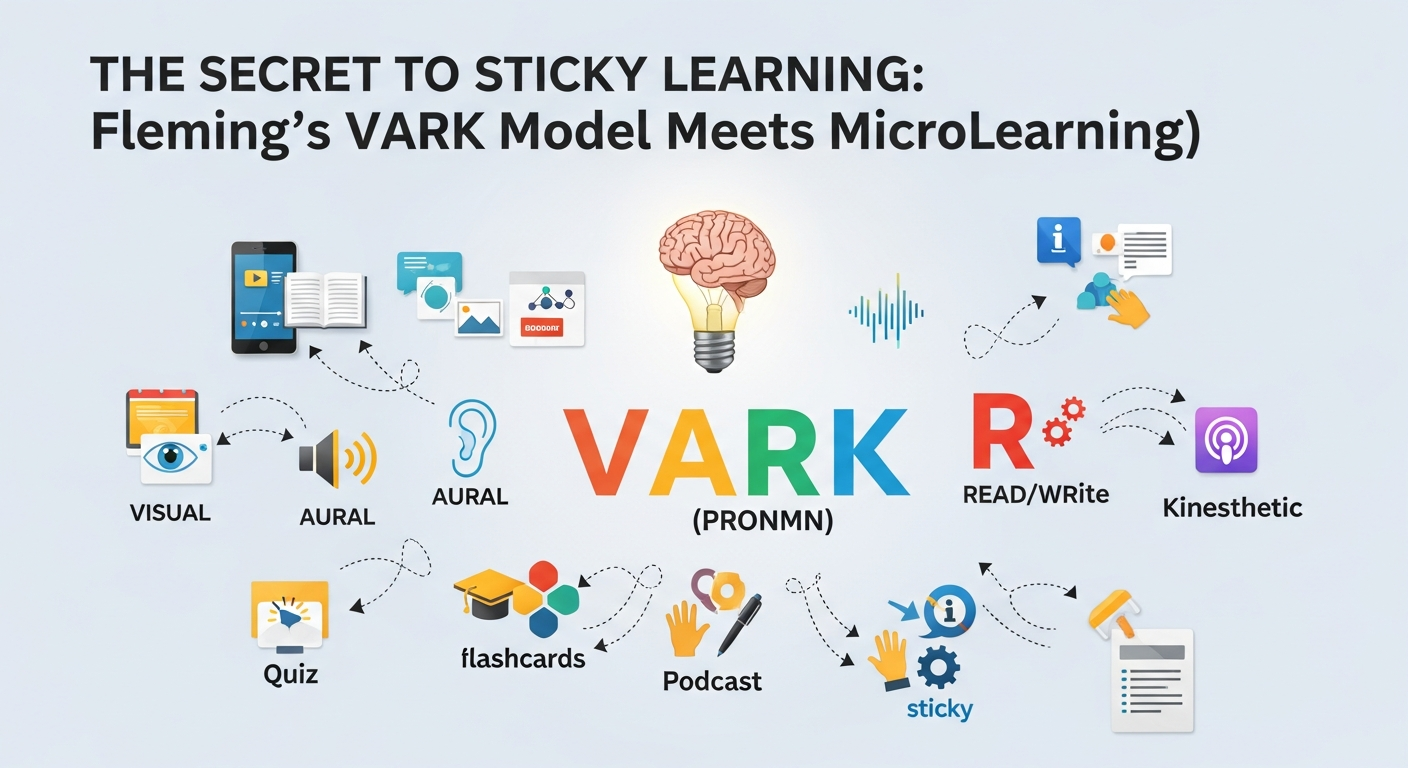
Neil Fleming’s VARK model provides a simple yet profound framework for understanding individual learning preferences. It categorizes learners into four primary styles:
- Visual (V): These learners prefer to see information presented graphically – through charts, diagrams, infographics, videos, and demonstrations. They learn best when information is visually represented.
- Aural (A): Aural learners absorb information effectively through listening and discussion. They benefit from lectures, audio recordings, podcasts, and group discussions.
- Read/Write (R): These individuals prefer information displayed as words. They excel with textbooks, articles, notes, lists, and written assignments. They learn by reading and by writing down information.
- Kinesthetic (K): Kinesthetic learners learn best by doing, experiencing, and practicing. Hands-on activities, simulations, role-playing, and real-world examples are crucial for their understanding.
Recognizing these distinct preferences is the first step towards personalized, impactful training. It highlights why a single delivery method rarely resonates with an entire workforce. An effective enterprise learning management solution must be flexible enough to cater to this diversity.
The Power of Microlearning
Microlearning, characterized by short, focused learning units, perfectly addresses the modern learner's attention span and busy schedule. Instead of lengthy courses, microlearning delivers specific objectives in digestible chunks, typically lasting from 2 to 10 minutes. These bite-sized modules can take various forms: short videos, interactive quizzes, infographics, brief articles, or quick simulations.
The benefits of microlearning are compelling:
- Increased Retention: Shorter modules reduce cognitive overload, allowing learners to absorb and retain information more effectively.
- Enhanced Engagement: Quick, relevant content holds attention better than long-form alternatives.
- Flexibility and Accessibility: Learners can access content anytime, anywhere, on any device, making it ideal for on-the-go learning.
- Just-in-Time Learning: Provides immediate access to necessary information when performance support is needed most.
- Cost-Effectiveness: Often more efficient to produce and update than traditional courses.
Implementing a dedicated Microlearning LMS is key to harnessing these advantages, offering a robust learning management software for content delivery and tracking.
VARK and Microlearning: A Synergistic Approach
The true magic happens when VARK principles guide the design and delivery of microlearning content. By combining these two powerful concepts, L&D teams can create truly personalized and "sticky" learning experiences:
For Visual Learners:
Microlearning can feature concise animated videos, interactive infographics, clear diagrams, and visually rich presentations. A visual learner in a sales role might benefit from a 3-minute video demonstrating a product feature or a flowchart illustrating the sales process.
For Aural Learners:
Short podcasts, audio explanations, narrated presentations, or brief Q&A sessions can be integrated. A compliance officer might listen to a 5-minute audio clip summarizing new regulations while commuting.
For Read/Write Learners:
Microlearning offers concise articles, summaries, bullet-point lists, interactive text-based quizzes, and short policy documents. A banking professional could quickly review a 2-page summary of a new financial product or take a short written assessment.
For Kinesthetic Learners:
This is where interactive microlearning truly shines. Brief simulations, virtual reality snippets, drag-and-drop exercises, and scenario-based challenges provide hands-on experience. Leveraging a Gamified LMS can provide immediate feedback and a sense of achievement, perfect for kinesthetic learners. A healthcare worker could practice a procedural step in a quick simulation or engage in a brief role-play scenario.
This tailored approach doesn't just deliver content; it delivers content in the way each individual is most receptive to receiving and processing it, fostering genuine Adaptive Learning.
Leveraging Technology for Personalized Learning
To effectively combine VARK and microlearning at scale, particularly for large organizations or across diverse industries, a sophisticated learning content management system (LCMS) is indispensable. Modern learning management solutions are equipped to track learner preferences, performance data, and engagement metrics, allowing L&D teams to refine their strategy continually.
The Role of Artificial Intelligence
Artificial intelligence is rapidly transforming the capabilities of an lms learning management system. Consider these insights:
- How can artificial intelligence help in understanding individual learning preferences across a global workforce? AI can analyze learner behavior within the learning management system – content choices, completion rates, assessment results, and interaction patterns – to infer preferred learning styles and recommend tailored microlearning pathways. This capability is particularly vital for a cloud based learning management system supporting diverse teams.
- What analytical insights can AI provide to L&D teams about learner engagement and knowledge gaps? AI-powered analytics can identify trends in engagement for specific content types, highlight common areas of difficulty, and predict at-risk learners. This data empowers L&D professionals to proactively adjust content and support mechanisms, ensuring the training program remains relevant and effective.
- Can AI-driven tools automatically generate diverse microlearning content tailored to various learning styles? Absolutely. An AI Powered Authoring Tool can significantly streamline content creation. By inputting core learning objectives, AI can suggest and even draft variations of microlearning modules (e.g., a text summary, an audio narration, a short video script, or an interactive quiz) optimized for different VARK styles, dramatically accelerating content development.
Real-World Applications Across Industries
The combination of VARK and microlearning holds immense potential for various sectors:
- Compliance: In financial services, microlearning can break down complex regulations into short, visual summaries for visual learners, audio briefings for aural learners, and interactive case studies for kinesthetic learners. This ensures consistent understanding and reduces compliance risks.
- Sales: Sales professionals in retail or pharma can access quick product feature videos (visual), role-play scenarios (kinesthetic), or objection-handling scripts (read/write) just before a client meeting, boosting confidence and performance.
- Healthcare: For nurses or medical staff, micro-simulations (kinesthetic) for new equipment or short informational videos (visual) on patient care protocols ensure critical knowledge is always accessible and up-to-date.
- Oil and Gas/Mining: Safety training can be delivered through quick visual checklists, auditory safety alerts, and interactive hazard identification modules, significantly enhancing Risk-focused Training and operational safety.
Each industry benefits from a bespoke approach, tailored by a sophisticated learning management system that acts as the central hub for all training initiatives.
Implementing a Modern Learning Strategy
For L&D leaders looking to embrace this powerful combination, the journey involves strategic planning and the right technological partners. Here are key considerations:
- Assess Learner Profiles: While not every learner perfectly fits one VARK category, understanding the predominant styles within your workforce can guide content development.
- Content Modularity: Design all learning content with microlearning in mind, ensuring it can be broken down into discrete, digestible units.
- Technology Investment: Invest in a robust learning management software that supports diverse content types, personalized learning paths, and advanced analytics. A platform like MaxLearn LMS is engineered to deliver these capabilities.
- Continuous Iteration: Use data from your LMS to continuously evaluate and improve your microlearning modules and their alignment with learner preferences.
The secret to sticky learning lies not in more training, but in smarter, more personalized training. By marrying Fleming's VARK model with the efficiency and engagement of microlearning, and leveraging the intelligence of AI within a powerful learning management system, L&D leaders can unlock unprecedented levels of knowledge retention, skill development, and ultimately, organizational success. This strategic approach ensures that every training dollar invested translates into measurable, lasting impact.


Comments
Post a Comment