The Learner Experience: Seamless Transitions Between Microlearning and Long-Form Courses
The Learner Experience: Seamless Transitions Between Microlearning and Long-Form Courses
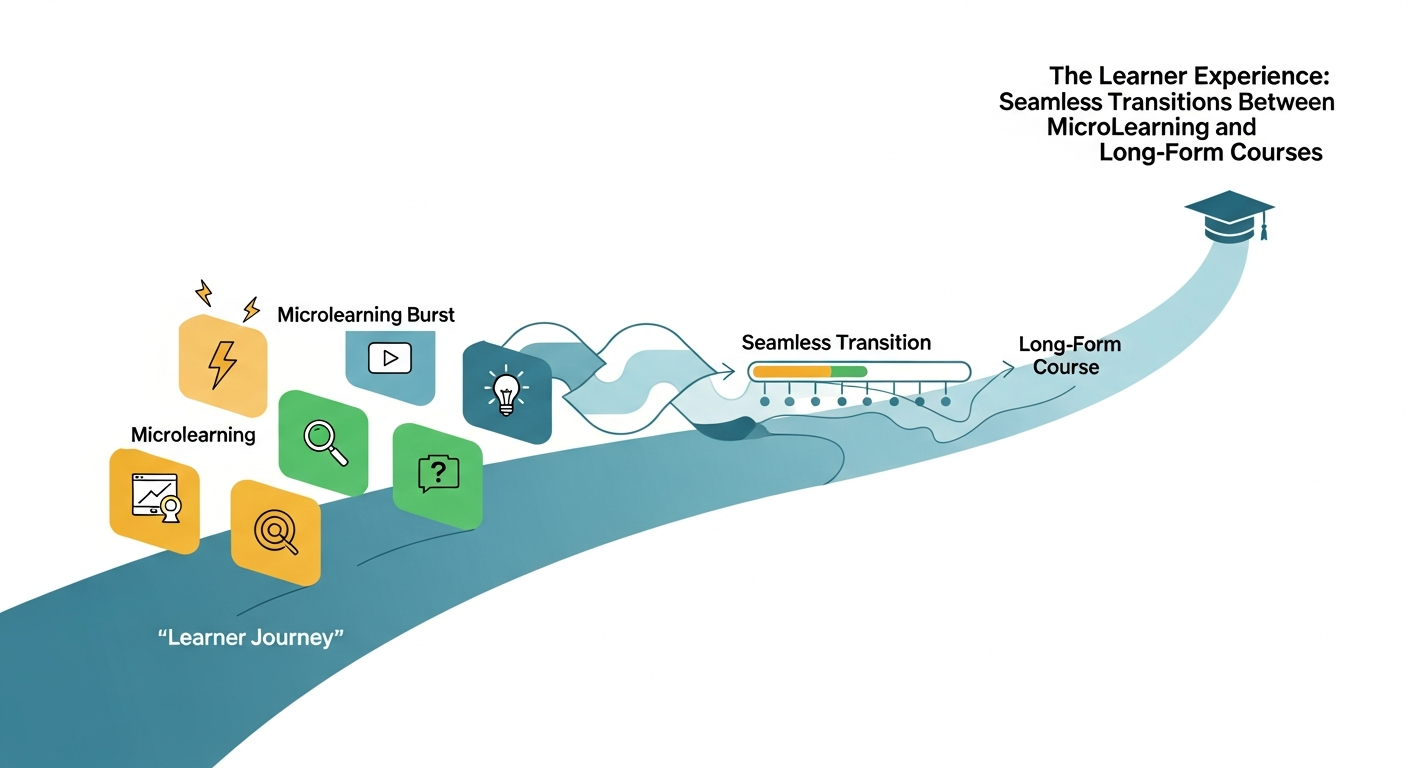
In today's fast-paced corporate environment, the demands on employees are constantly evolving, requiring continuous skill development and knowledge acquisition. For L&D leaders – Vice Presidents, Directors, and Managers – the challenge is not just delivering content, but crafting a learning experience that is both effective and engaging. Traditional long-form courses, while essential for deep dives and foundational knowledge, often struggle with engagement and retention in a time-starved workforce. Conversely, microlearning offers bite-sized, accessible content perfect for just-in-time learning. The true magic, however, lies in orchestrating a seamless transition between these two powerful modalities, creating a cohesive and impactful learner journey.
Imagine a learning ecosystem where an employee can quickly grasp a new sales technique via a short video, then seamlessly transition to a comprehensive course on advanced negotiation strategies, all within the same intuitive platform. This integrated approach is no longer a luxury but a strategic imperative for organizations aiming for optimal performance, especially in highly regulated sectors like Compliance, Banking, Finance, Insurance, Pharma, and Healthcare, or dynamic fields such as Sales, Retail, Hospitality, Oil and Gas, and Mining.
Why the Blended Approach is Crucial for Modern L&D
A blended learning strategy that harmonizes microlearning and long-form courses addresses the diverse learning needs and preferences of a modern workforce. It acknowledges that different learning objectives require different delivery methods.
The Power of Microlearning: Agility and Retention
Microlearning delivers short, focused bursts of information, typically 2-7 minutes in length. This format is ideal for:
- Quick refreshers on existing knowledge.
- Introducing new concepts or processes.
- Reinforcing key takeaways from longer training sessions.
- Just-in-time support for specific tasks.
Its accessibility and brevity make it highly consumable, improving engagement and knowledge retention, particularly when delivered through a specialized Microlearning LMS.
The Depth of Long-Form Courses: Comprehensive Mastery
Conversely, long-form courses are indispensable for developing complex skills, understanding intricate systems, or achieving professional certifications. They provide:
- In-depth theoretical knowledge and practical application.
- Structured progression through complex topics.
- Opportunities for extensive practice and feedback.
- Development of critical thinking and problem-solving abilities.
The challenge, therefore, is not to choose one over the other, but to integrate them effectively within an enterprise learning management strategy.
Bridging the Gap: Creating Seamless Transitions
Achieving a truly seamless learning experience requires thoughtful design and a robust learning content management system. The goal is to make the progression from one learning format to another feel natural and logical, rather than disjointed.
Curated Learning Paths and Personalization
A well-designed learning path acts as a GPS for the learner, guiding them through a sequence of microlearning modules, assessments, and deeper dives into long-form courses. These paths should be personalized based on an individual's role, existing knowledge, and learning goals. This is where the power of an intelligent learning management system comes into play, curating a journey that adapts to the learner.
Contextual Integration: Connecting the Dots
Each microlearning unit should not exist in isolation. It needs to be clearly linked to a larger learning objective or a module within a long-form course. For instance, a microlearning video demonstrating a specific software feature could serve as a prerequisite or a follow-up to a more extensive course on software proficiency. The learning management software should facilitate these contextual connections, helping learners understand the "why" behind each piece of content.
Leveraging Technology for Flow
The right technology is paramount. A modern Microlearning LMS or learning management system must be capable of hosting, tracking, and integrating diverse content types. It should offer intuitive navigation, single sign-on, and a unified learner dashboard where progress across all modalities is clearly visible, ensuring a smooth learner experience.
Intelligence-Driven Solutions for Enhanced Learner Flow
The advent of artificial intelligence is revolutionizing how we design and deliver learning, making seamless transitions more achievable than ever before. L&D professionals are increasingly asking how to leverage these capabilities for superior learner outcomes.
How can advanced algorithms personalize learning paths?
Intelligent algorithms analyze learner performance, preferences, and job roles to recommend the most relevant microlearning modules or direct them to specific sections within longer courses. This form of Adaptive Learning ensures that each learner receives content precisely tailored to their needs, preventing information overload and boosting efficiency. It creates a dynamic learning journey that evolves with the individual, moving them from short, focused content to comprehensive courses and back, based on real-time data.
How can smart systems help curate and sequence diverse learning content?
Beyond individual personalization, intelligence can assist in the structural design of the learning journey. An advanced LMS can suggest optimal sequences of microlearning modules to build up to a larger concept taught in a long-form course. It can identify gaps in knowledge and recommend specific microlearning interventions, ensuring foundational understanding before a learner tackles more complex, extensive material. This intelligent curation makes the transitions feel natural and necessary.
What role do intelligent content creation tools play in bridging these learning formats?
Creating engaging content for both microlearning and long-form courses can be resource-intensive. Tools like an AI Powered Authoring Tool can significantly streamline this process. These tools can help convert existing long-form content into bite-sized microlearning modules, or conversely, expand microlearning concepts into more detailed course sections. They can also assist in generating interactive elements, quizzes, and scenario-based training, ensuring consistency and quality across all learning formats, thus facilitating smoother transitions for the learner.
Real-World Applications Across Industries
The seamless integration of microlearning and long-form courses offers immense benefits across various industries, enhancing training effectiveness and business outcomes.
- Compliance: In industries like Banking, Finance, and Pharma, Risk-focused Training can start with microlearning modules on updated regulations or policy changes. If an employee fails to grasp a concept, the system can automatically direct them to a more comprehensive, long-form course on compliance fundamentals, ensuring full understanding and mitigating risk.
- Sales: Sales teams can benefit from microlearning for quick product updates or competitor analysis. When it comes to mastering complex sales methodologies or advanced negotiation skills, a long-form course with practical simulations is essential. The MaxLearn LMS facilitates this by enabling a salesperson to review a quick video on a new feature and then enroll in a broader course on solution selling.
- Healthcare: For healthcare professionals, microlearning can cover new equipment operation or protocol updates. However, for understanding complex diagnostic procedures or surgical techniques, a detailed long-form course, complete with simulations and case studies, is indispensable.
- Retail & Hospitality: Quick customer service tips via microlearning can be reinforced by extensive training on conflict resolution or leadership skills in a longer course format.
The Role of a Modern Learning Platform
Implementing a truly seamless learner experience hinges on selecting the right learning management software. An effective learning management solution acts as the central nervous system for your training initiatives.
- Integrated Microlearning LMS Features: A robust Microlearning LMS should inherently support both short and long-form content, providing a unified interface for all learning activities. It should be a true learning content management system that handles various media types, from videos and infographics to comprehensive e-learning modules and SCORM packages.
- Gamified LMS for Enhanced Engagement: Gamification elements—such as points, badges, leaderboards, and interactive challenges—can be integrated across both microlearning and long-form courses. This fosters a sense of achievement and healthy competition, keeping learners motivated to progress through their personalized learning journeys, seamlessly moving between short bursts and deeper dives.
- Robust Analytics and Reporting: A sophisticated LMS learning management system provides deep insights into learner behavior and performance across all content types. This data is crucial for L&D leaders to identify knowledge gaps, measure the effectiveness of different learning modalities, and continuously refine learning paths for optimal outcomes.
- Scalability and Accessibility: Whether you're a small team or a large enterprise, a cloud based learning management system or enterprise learning management solution must be scalable and accessible across devices, ensuring learners can engage with content anytime, anywhere, regardless of format.
Conclusion: Empowering the Future of Learning
The learner experience is at the heart of effective L&D. By strategically blending microlearning with long-form courses, and facilitating seamless transitions between them, L&D leaders can create a dynamic, engaging, and highly effective learning ecosystem. This approach not only caters to diverse learning styles and busy schedules but also leverages the strengths of each format to achieve comprehensive skill development and sustained knowledge retention. Embracing an advanced MaxLearn LMS that supports this integrated methodology is no longer an option, but a necessity for organizations looking to future-proof their workforce and drive continuous growth. Invest in a learning solution that empowers your employees to learn continuously, deeply, and effortlessly.


Comments
Post a Comment