Stop One-Size-Fits-All Training: How to Design VARK-Driven Micro-Lessons
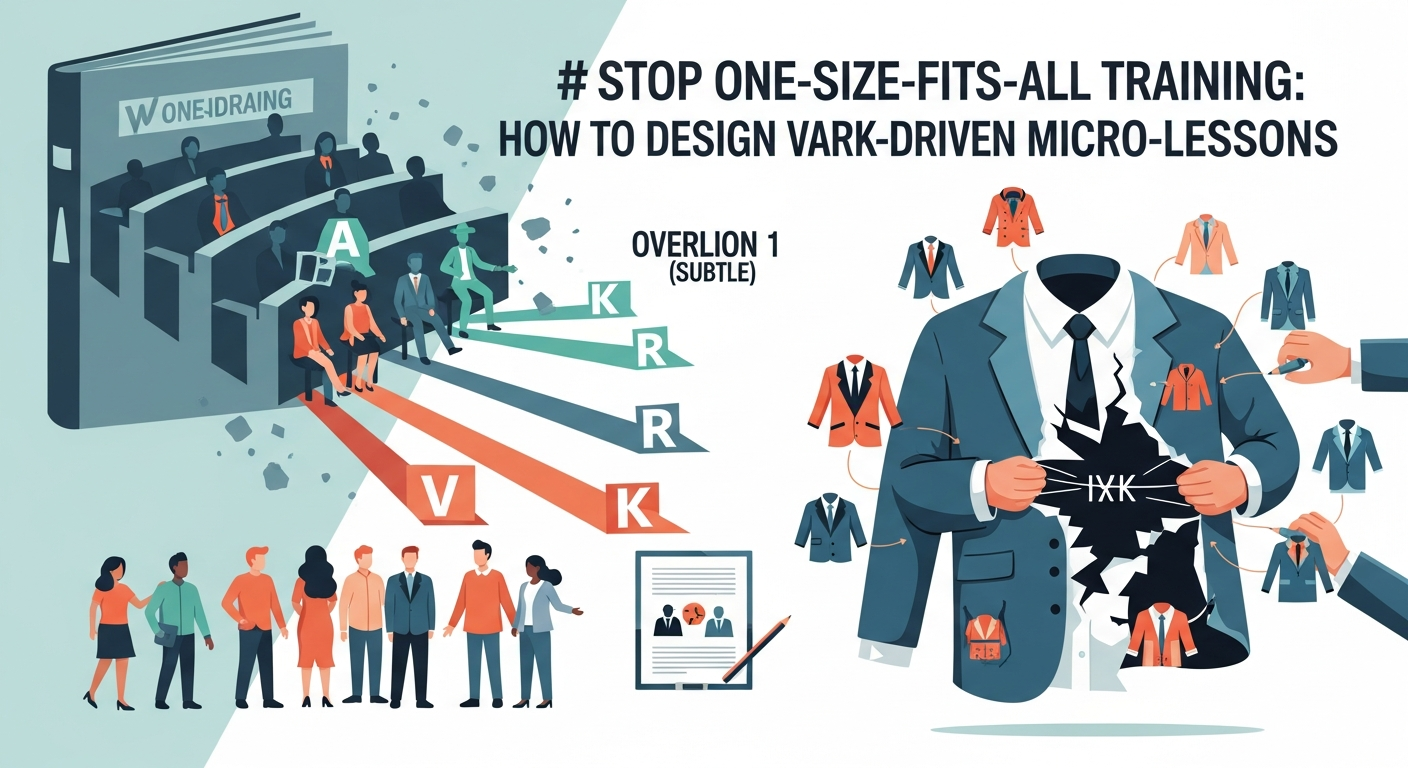
Stop One-Size-Fits-All Training: How to Design VARK-Driven Micro-Lessons
In today's fast-paced corporate world, where information overload is the norm and attention spans are dwindling, the traditional "one-size-fits-all" approach to employee training is rapidly becoming obsolete. Vice Presidents, Directors, and Senior Managers in Learning & Development (L&D) are increasingly recognizing that generic, lengthy training modules fail to engage diverse workforces, leading to poor retention and a diluted impact on business objectives. From compliance to sales, banking to healthcare, and even the complex landscapes of oil and gas or mining, effective learning is paramount. The solution lies in personalization, and a powerful strategy to achieve this is through VARK-driven micro-lessons.
Moving beyond generic content requires a fundamental shift in how we perceive and deliver learning. It's about understanding that each learner is unique, processing information in distinct ways. This article will explore why traditional methods fall short, introduce the VARK model as a framework for understanding learning preferences, and guide you through designing effective, personalized micro-lessons that resonate with your entire workforce, driving tangible results across all industries.
The Undeniable Flaws of Generic Training
Imagine a global organization with employees spanning multiple generations, cultures, and roles, all subjected to the exact same 60-minute e-learning module on a critical compliance topic or a new product launch. The outcome is often predictable: disengagement, low completion rates, and minimal knowledge transfer. This is the inherent problem with generic training.
- Low Engagement & Retention: When content isn't relevant or delivered in a preferred style, learners quickly tune out. This leads to a significant drop in information retention, undermining the entire training effort.
- Inefficient Use of Time & Resources: Developing and deploying lengthy, generic courses consumes considerable L&D resources without guaranteeing a return on investment. Employees spend time "training" rather than learning.
- Failure to Address Diverse Needs: A salesperson in retail needs different practical applications than a financial advisor, even when learning similar core principles. A blanket approach ignores these crucial contextual differences.
- Lack of Measurable Impact: Without tailored content, it's difficult to pinpoint specific areas of improvement or attribute performance gains directly to training, making it hard to justify L&D budgets.
To overcome these challenges, forward-thinking L&D leaders are adopting more agile and learner-centric methodologies, supported by robust learning management solutions.
The Power of VARK: Tailoring Learning Styles
The VARK model, developed by Neil Fleming, provides a simple yet effective framework for understanding individual learning preferences. VARK stands for:
- Visual (V): Learners prefer to see information presented graphically – through charts, diagrams, infographics, videos, and demonstrations.
- Auditory (A): Learners prefer to hear information – through lectures, discussions, podcasts, audio recordings, and verbal instructions.
- Read/Write (R): Learners prefer to learn through text – reading manuals, reports, articles, and taking detailed notes.
- Kinesthetic (K): Learners prefer hands-on learning – through practical exercises, simulations, role-playing, demonstrations, and real-world application.
It's important to note that most individuals exhibit a blend of these preferences, with a primary dominant style. The VARK model is a guiding tool, not a rigid classification. By understanding these preferences, L&D professionals can design training materials that cater to a broader spectrum of learners, ensuring inclusivity and maximizing comprehension. Incorporating a learning management system that allows for diverse content types is crucial here.
Micro-Lessons: The Agile Approach to Learning
If VARK provides the "how" of personalized learning, micro-lessons provide the "what" and "when." Micro-lessons are bite-sized, focused learning units designed to address a single learning objective, typically lasting from 2 to 10 minutes. They are the ideal vehicle for delivering VARK-driven content.
The benefits of micro-lessons are profound:
- Higher Engagement & Retention: Short bursts of information align with modern attention spans, preventing cognitive overload and enhancing memory recall.
- Flexibility & Accessibility: Learners can consume content on demand, anywhere, anytime – fitting learning into their busy schedules. This is a key feature of any modern cloud based learning management system.
- Reduced Cognitive Load: By focusing on one concept at a time, micro-lessons make complex topics feel manageable and less daunting.
- Agility in Content Updates: When regulations change or new products launch, updating a small micro-lesson is far quicker and more efficient than overhauling an entire course. This is where an effective LCMS becomes invaluable.
Combining the personalization offered by VARK with the agility of micro-lessons creates a powerful synergy that transforms traditional training into an engaging, effective, and efficient learning experience. An advanced Microlearning LMS can orchestrate this entire process, ensuring a seamless experience.
Designing VARK-Driven Micro-Lessons: A Step-by-Step Guide
Step 1: Assess Your Audience
Before designing, gather insights into your learners' preferences. While formal VARK assessments can be used, simpler methods include short surveys, informal feedback, or even analyzing engagement data from previous training programs. What types of content do they interact with most? What do they complain about most?
Step 2: Deconstruct Complex Content
Break down larger training topics into their smallest, most essential components. Each component should ideally address a single learning objective. For example, a "Sales Process" module might become micro-lessons on "Prospecting Techniques," "Handling Objections," "Closing Strategies," etc.
Step 3: Craft Multi-Modal Micro-Content
For each micro-lesson, develop content that caters to different VARK preferences. The goal is not to force every learner through every modality, but to provide choices or blend elements thoughtfully. This is where a sophisticated learning content management system or learning management software truly shines.
- Visual: Create short animated videos, infographics explaining processes, flowcharts, or interactive simulations. For banking compliance, this could be a visual guide to fraud detection.
- Auditory: Develop concise audio explanations, short podcast-style interviews with subject matter experts, or voiceovers accompanying visuals. Imagine an audio brief on new market regulations for finance professionals.
- Read/Write: Offer brief summaries, downloadable checklists, short articles, case studies, or interactive quizzes that require written responses. A pharma rep might benefit from a detailed product fact sheet.
- Kinesthetic: Design interactive scenarios, drag-and-drop exercises, decision-making simulations, virtual role-plays, or quick practical assignments. A retail employee could practice a customer service interaction virtually.
Step 4: Leverage the Right Technology
The success of VARK-driven micro-lessons heavily relies on the underlying technology. A modern lms learning management system is indispensable. Look for features that support:
- Content Authoring: An AI Powered Authoring Tool can significantly streamline the creation of diverse micro-content formats.
- Adaptive Learning Paths: A truly impactful enterprise learning management system enables learners to choose their preferred learning path or recommends content based on their observed interactions. Learn more about Adaptive Learning strategies.
- Gamification: Incorporating elements like points, badges, and leaderboards through a Gamified LMS can boost engagement and motivation, particularly for Kinesthetic learners.
- Analytics & Reporting: Track learner progress, engagement with different content types, and mastery of objectives to continuously refine your micro-lesson strategy.
AI and Personalized Learning: The Future is Now
Artificial intelligence is revolutionizing how L&D teams can optimize personalized learning experiences, making VARK-driven micro-lessons even more effective. Here are some key considerations:
Question: How can artificial intelligence help L&D teams understand and boost learner engagement with tailored content?
Answer: AI analyzes interaction patterns, completion rates, and feedback across various micro-lesson formats to recommend optimal content types and delivery methods for individual learners. This dynamic personalization significantly increases engagement by ensuring learners receive information in their most effective style, often facilitated by an advanced learning management system.
Question: What role does advanced analytical processing play in ensuring that learning modules effectively achieve specific training goals across diverse organizational structures?
Answer: Advanced analytics, powered by AI within a comprehensive MaxLearn LMS, can map individual learning paths to broader organizational objectives. It identifies skill gaps, predicts future training needs, and suggests content adjustments to ensure that each micro-lesson efficiently drives measurable outcomes, whether in sales performance or compliance adherence.
Question: How does intelligent automation contribute to maximizing the real-world impact of training programs on an organization's performance?
Answer: Intelligent automation personalizes learning journeys by automatically adapting content difficulty, offering real-time feedback, and providing targeted remediation based on a learner's performance. This direct application translates to improved skill application, stronger adherence to best practices (e.g., in Risk-focused Training), and ultimately, enhanced organizational performance across all segments and industries.
VARK-Driven Micro-Lessons Across Industries
The versatility of this approach means it's applicable across virtually any sector:
- Compliance (Banking, Finance, Healthcare, Oil & Gas): Instead of a lengthy annual ethics video, offer short animated scenarios (V), audio summaries of key regulations (A), policy documents with interactive quizzes (R), and decision-making simulations (K).
- Sales (Retail, Pharma, Hospitality): Micro-lessons on product features (V), objection handling scripts (A), competitor analysis summaries (R), and virtual role-play scenarios (K).
- Technical Training (Mining, Manufacturing): Visual guides for machinery operation (V), audio instructions for complex procedures (A), repair manuals with interactive diagrams (R), and virtual reality simulations for hands-on practice (K).
Conclusion
The era of one-size-fits-all training is over. To truly engage and empower your workforce, L&D leaders must embrace personalized, flexible, and impactful learning experiences. By leveraging the VARK model to understand diverse learning styles and delivering content through concise, engaging micro-lessons, organizations can achieve unprecedented levels of learner engagement, knowledge retention, and ultimately, improved business outcomes. The strategic implementation of a robust MaxLearn LMS that supports adaptive learning and AI-powered content creation is not just an advantage—it's a necessity for future-proofing your talent development strategy. Invest in a learning approach that truly recognizes the unique potential of every individual, and watch your organization thrive.


Comments
Post a Comment