Spaced Repetition vs. Memory Decay: Customizing Lessons for Diverse Intelligences
Spaced Repetition vs. Memory Decay: Customizing Lessons for Diverse Intelligences
In the dynamic landscape of corporate learning and development, the battle against memory decay is a perpetual challenge. As L&D leaders, Vice Presidents, Directors, Senior Managers, and Managers, you understand the critical importance of ensuring knowledge retention and skill mastery across your diverse workforce. From compliance mandates in banking and finance to product knowledge in retail and pharma, or safety protocols in oil and gas and mining, effective learning outcomes directly impact business growth and mitigate risk. This article delves into how advanced eLearning strategies, particularly spaced repetition, can be meticulously customized to cater to varied intelligences, transforming how your organization learns and retains vital information.
Understanding Memory Decay and Spaced Repetition
The Forgetting Curve: An Enduring Challenge
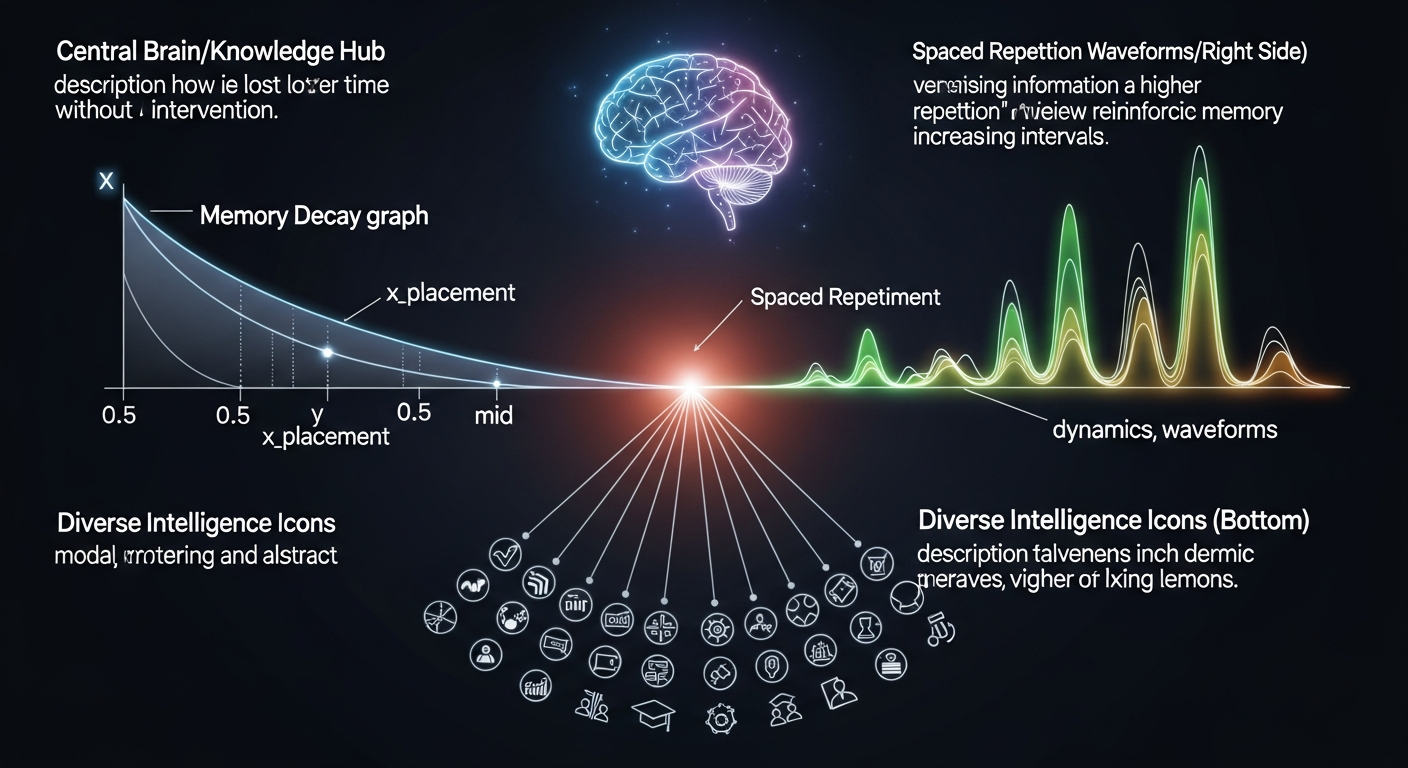
Hermann Ebbinghaus’s "forgetting curve" illustrates a stark reality: without reinforcement, newly acquired knowledge rapidly diminishes over time. For businesses, this translates to wasted training investments, repeated errors, and a constant need for retraining. In industries like healthcare, compliance, and insurance, where accuracy and up-to-date knowledge are paramount, the implications of memory decay can be severe, leading to regulatory fines, reputational damage, or even critical operational failures.
The Power of Spaced Repetition
Spaced repetition is an evidence-based learning technique that strategically schedules reviews of previously learned material at increasing intervals. By revisiting information just as it's about to be forgotten, this method solidifies memories, moving them from short-term to long-term retention. It’s a powerful antidote to the forgetting curve, ensuring that employees genuinely internalize complex concepts, whether it’s new sales techniques, intricate financial regulations, or critical safety procedures. Implementing this within a robust Microlearning LMS can dramatically enhance its effectiveness, delivering knowledge in digestible, reinforcing bursts.
The Challenge of Diverse Intelligences
Every individual brings a unique cognitive profile to the learning table. Howard Gardner's theory of multiple intelligences highlights that people excel in different areas – be it linguistic, logical-mathematical, spatial, bodily-kinesthetic, musical, interpersonal, intrapersonal, or naturalistic intelligence. A one-size-fits-all training approach, even one incorporating spaced repetition, often fails to engage and optimize learning for this inherent diversity.
For instance, a sales team might include individuals who learn best through role-playing (bodily-kinesthetic), others through case studies and data analysis (logical-mathematical), and still others through collaborative discussions (interpersonal). A single, static course will inevitably leave some learners disengaged or underserved, hindering comprehensive knowledge uptake across your workforce. The true power lies in not just repeating information, but in presenting it in formats that resonate with each learner's preferred mode of understanding.
Customizing Learning: Bridging Spaced Repetition and Diverse Intelligences
The convergence of spaced repetition with personalized learning experiences is where modern eLearning truly shines. By tailoring the content, format, and delivery of reinforcement, organizations can create a learning ecosystem that respects and leverages individual cognitive strengths.
Leveraging Technology for Personalization
Modern learning platforms are essential tools in this endeavor. A sophisticated
learning management system
provides the infrastructure for delivering tailored content. Imagine a scenario where a Microlearning LMS delivers short, focused modules. For a visually-oriented learner, these modules might be rich in infographics and video. For an auditory learner, podcasts or narrated explanations could be prioritized. A Gamified LMS takes this a step further, integrating challenges, points, and leaderboards that appeal to competitive or achievement-oriented intelligences, making the repetition process engaging rather than monotonous.The future of learning relies heavily on Adaptive Learning systems. These intelligent platforms dynamically adjust the learning path, content, and review schedule based on a learner's performance, preferences, and pace. Such systems don't just administer spaced repetition; they intelligently optimize it for each individual, ensuring that reviews are presented in the most effective format at precisely the right moment.
The Role of Intelligent Tools
The advent of artificial intelligence is revolutionizing how we customize learning. An AI Powered Authoring Tool, for example, can analyze content and suggest different presentation styles or even generate alternative explanations to cater to various learning profiles. This capability significantly reduces the burden on L&D teams while dramatically increasing personalization.
How can artificial intelligence personalize learning paths efficiently? By analyzing vast datasets of learner interactions, performance, and declared preferences, AI algorithms can predict which content formats and review schedules will be most effective for each individual, creating a truly unique and optimized learning journey. What impact does AI have on skill retention across different global regions? AI can identify cultural or linguistic nuances that affect learning comprehension and retention, helping to localize and adapt content for maximum impact, ensuring consistent skill levels worldwide. Can AI effectively tailor content to individual cognitive strengths? Absolutely. By classifying learning materials based on their cognitive demands (e.g., visual, analytical, procedural) and mapping them against a learner's assessed strengths, AI can curate content that plays to those strengths, building confidence and fostering deeper understanding.
Industry-Specific Applications and Strategic Advantages
Implementing a strategy that combines spaced repetition with customized delivery across diverse intelligences offers immense advantages across various industries:
- Compliance (Banking, Finance, Insurance): For critical regulatory training, Risk-focused Training becomes more robust. Tailored spaced repetition ensures that legal nuances are thoroughly understood by all employees, regardless of their learning style, significantly reducing the likelihood of costly errors and non-compliance.
- Sales and Retail: Product knowledge and sales techniques can be reinforced through interactive scenarios for kinesthetic learners, detailed comparisons for logical learners, and customer testimonials for interpersonal learners, leading to more confident and effective sales teams.
- Pharma and Healthcare: Medical professionals and pharmaceutical representatives need to retain vast amounts of complex information. Personalized review schedules, delivered through their preferred modality (e.g., interactive simulations, detailed textual explanations, or quick visual summaries), ensure better patient outcomes and more informed product discussions.
- Hospitality: Customer service standards and operational procedures can be mastered through varied formats, catering to different learning styles, ensuring consistent service quality across all touchpoints.
- Oil and Gas, Mining: Safety protocols are non-negotiable. Spaced repetition customized for visual, practical, or analytical learners ensures deep understanding and recall of life-saving procedures, reducing workplace accidents and fostering a culture of safety.
Implementing a Smart Learning Strategy
For L&D leaders, the path forward involves strategically adopting technologies that support this nuanced approach. Choosing the right
learning management software
orlearning management system
is paramount. A moderncloud based learning management system
offers the scalability and flexibility required for large organizations, enabling seamless content delivery and data collection for personalization.Consider a comprehensive
LCMS
orlearning content management system
that allows for the creation, management, and deployment of diverse content types, easily adaptable for different intelligences. Anenterprise learning management
solution likeMaxLearn LMS
can provide the integrated platform necessary to combine spaced repetition with adaptive, personalized learning experiences, driving higher engagement and superior retention.Conclusion
The fight against memory decay in corporate training is more than just scheduling reviews; it's about crafting an intelligent, responsive learning environment. By integrating the proven efficacy of spaced repetition with sophisticated customization techniques that cater to diverse intelligences, L&D leaders can move beyond generic training programs. Embrace the power of adaptive technologies and AI to create personalized, engaging, and highly effective learning journeys. The result will be a workforce that not only retains knowledge longer but also applies it more effectively, driving sustained performance and innovation across your organization.


Comments
Post a Comment