Leveraging Fleming’s VARK Model for Captivating Microlearning Design
Leveraging Fleming’s VARK Model for Captivating Microlearning Design
In today’s fast-paced corporate world, where attention spans are shrinking and information overload is the norm, the effectiveness of traditional long-form training is increasingly questioned. Learning and Development (L&D) leaders – Vice Presidents, Directors, and Senior Managers – are constantly seeking innovative strategies to enhance employee engagement, retention, and performance. The answer often lies in microlearning, a method renowned for its bite-sized, focused content. But how do you ensure these short bursts of learning truly resonate with every individual across diverse industries like Compliance, Sales, Banking, Finance, Insurance, Retail, Pharma, Health care, Hospitality, Oil and Gas, and Mining?
The key lies in understanding individual learning preferences. This is where Fleming’s VARK model becomes an invaluable asset. By strategically integrating the VARK preferences (Visual, Auditory, Read/Write, Kinesthetic) into microlearning design, L&D professionals can create highly personalized, impactful, and memorable learning experiences that drive real business outcomes.
Understanding the VARK Model
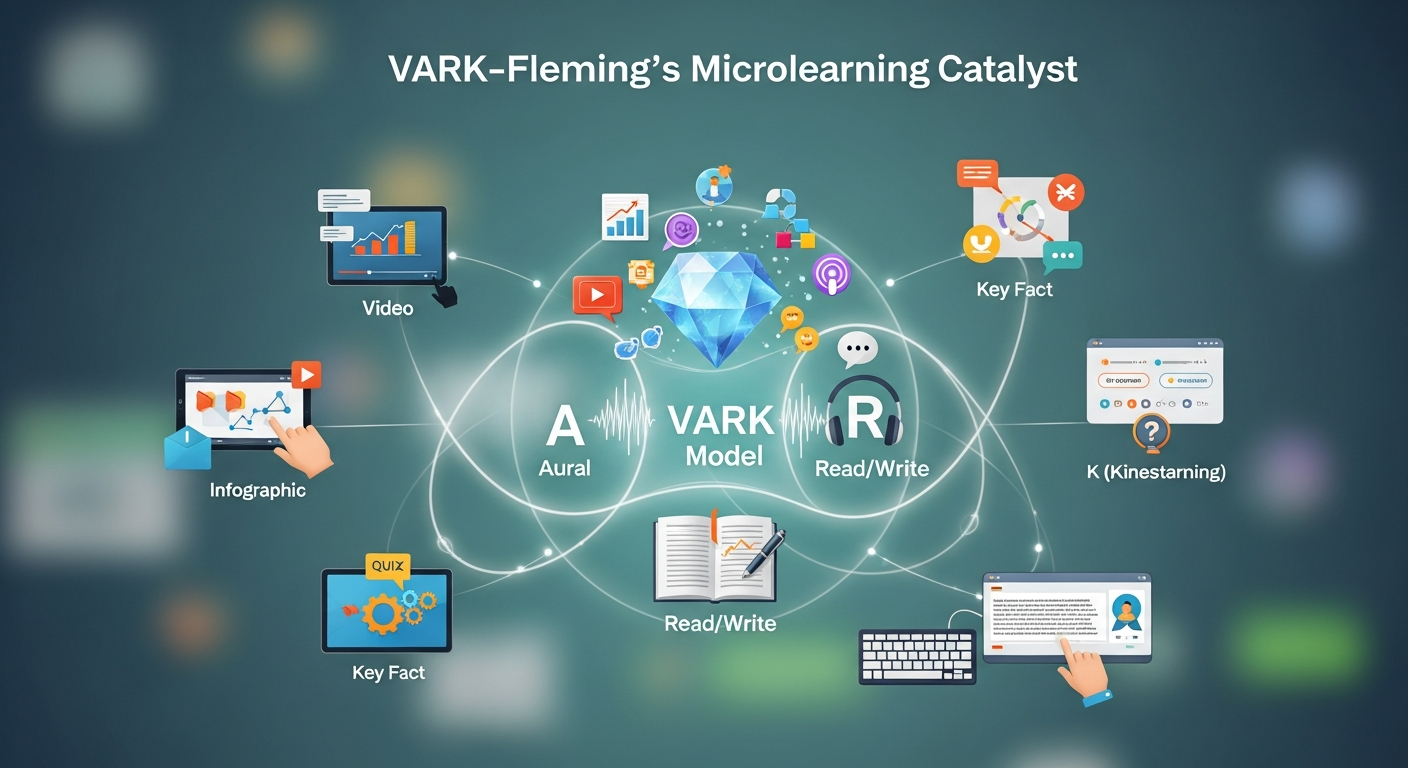
Developed by Neil Fleming, the VARK model categorizes learners into four primary preferences for processing information:
- Visual (V): Learners who grasp information best when it is presented through images, diagrams, charts, videos, and other graphic aids. They need to "see" it to understand it.
- Auditory (A): These individuals learn most effectively by hearing information. This includes lectures, discussions, podcasts, and spoken instructions. They often prefer to talk through concepts.
- Read/Write (R): Learners who prefer to engage with information through text-based formats. They excel with written words, lists, notes, reports, and manuals. Summarizing and writing notes are common learning strategies for them.
- Kinesthetic (K): These learners thrive on hands-on experiences, practical application, simulations, and real-world examples. They learn by "doing" and experiencing.
While individuals often have a dominant preference, many are multimodal, benefiting from a blend of these styles. The power of VARK in microlearning is its flexibility to cater to this spectrum.
Why VARK and Microlearning Are a Perfect Pair
Microlearning, by its very nature, involves short, focused modules, typically lasting 1-10 minutes. This brevity is precisely what makes it so conducive to VARK integration. Instead of forcing all learning preferences into a single, lengthy format, microlearning allows designers to create distinct modules tailored to specific VARK styles. This means an L&D department can develop a series of small, digestible pieces of content covering the same topic, each optimized for a different learning preference.
Consider the challenge of delivering critical Risk-focused Training in a compliance-heavy industry like banking or pharmaceuticals. A singular, hour-long module might bore some and overwhelm others. Breaking it down and applying VARK principles can transform it:
- A 3-minute animated video (Visual) explaining a new regulation.
- A 2-minute podcast (Auditory) featuring an expert discussing the regulation's implications.
- A 4-minute interactive scenario (Kinesthetic) where learners make decisions based on the regulation.
- A 1-minute infographic summary or a quick quiz (Read/Write) reinforcing key takeaways.
This approach maximizes comprehension and engagement across the entire workforce.
Designing for Each VARK Preference in Microlearning
Visual Learners
For your visual learners, focus on rich, engaging graphics. Think short, animated explainers, concise infographics, flowcharts illustrating processes, high-quality images, and short video clips. A Microlearning LMS should seamlessly support multimedia integration to ensure these elements are delivered effectively. These could be used to explain complex financial products in banking, visualize sales processes, or demonstrate safe operating procedures in oil and gas.
Auditory Learners
Engage auditory learners with podcasts, voiceovers, short audio clips from experts, and narrated presentations. Consider brief Q&A audio snippets or sound bites that reinforce key concepts. In sales training, a short audio clip of a successful pitch or negotiation tactic can be incredibly effective. For healthcare professionals, a concise audio summary of a new protocol can be very beneficial.
Read/Write Learners
These learners thrive on written text. Microlearning for them should include brief articles, concise summaries, bullet-point lists, checklists, quizzes with text-based feedback, and interactive glossaries. Providing downloadable PDF guides or text-based scenarios with multiple-choice questions can be highly effective. A robust Gamified LMS often includes leaderboards and badges for completing such modules, appealing to the competitive nature of many Read/Write learners.
Kinesthetic Learners
The "doers" need interactivity. Design microlearning modules that incorporate simulations, drag-and-drop exercises, interactive decision trees, short role-play scenarios, quizzes that require application, and virtual walkthroughs. For retail employees, a micro-simulation of handling a difficult customer interaction can be invaluable. In mining, an interactive module on equipment pre-checks, where users click and identify components, caters directly to kinesthetic preferences. The right learning content management system will offer authoring capabilities to build these interactive experiences.
The Role of Technology and an Advanced Learning Platform
Implementing a VARK-based microlearning strategy requires a powerful and flexible Microlearning LMS. A modern learning management system (LMS) acts as the backbone, enabling the creation, deployment, and tracking of diverse content types. An enterprise learning management solution with a comprehensive learning content management system (LCMS) is essential for managing the rich variety of microlearning assets.
A cloud based learning management system, like MaxLearn LMS, offers the scalability and accessibility needed for global workforces. When you combine VARK with Adaptive Learning paths, learners can even self-select or be guided to the content formats that best suit their preferences, leading to truly personalized experiences. Furthermore, an AI Powered Authoring Tool can significantly streamline the creation of VARK-diverse content, automating elements and suggesting optimal formats based on learning objectives.
Intelligent Insights for Learning Optimization
Here are some common inquiries regarding how advanced digital tools can revolutionize learning design:
How can smart algorithms help personalize learning experiences based on individual preferences?
Intelligent algorithms within a learning management software can analyze a learner's past interactions, completion rates, and performance data across various content types (videos, quizzes, simulations, text). Based on this analysis, the learning management system can then recommend specific microlearning modules that align with their identified preferences, dynamically adjusting their learning path for maximum engagement and comprehension. This ensures that a visual learner is presented with more infographics and videos, while a kinesthetic learner gets more interactive exercises, all managed by the lms learning management system.
What role does intelligent automation play in optimizing learning content delivery across different geographic locations?
Advanced automation can significantly enhance the delivery of microlearning content globally. It can automatically adapt content for different time zones, languages, and cultural nuances. For example, a system might automatically serve up localized examples in compliance training or adjust the pacing of content delivery based on regional internet speeds. This ensures equitable and effective learning experiences for employees worldwide, no matter where they are accessing the MaxLearn LMS.
How can advanced analytics provide insights into the effectiveness of diverse microlearning formats?
Sophisticated analytics tools embedded within a learning management solution can track granular data points – such as how long learners spend on a specific video, their scores on text-based quizzes, or their performance in interactive simulations. By comparing the engagement and performance metrics across different VARK-aligned microlearning formats, L&D managers can gain deep insights into which types of content are most effective for particular learning objectives or employee segments. This data then informs future content development and refinement, ensuring continuous improvement in learning outcomes across the enterprise learning management system.
Benefits for L&D Leaders
Implementing a VARK-informed microlearning strategy offers significant advantages for L&D leaders:
- Increased Engagement: Learners are more likely to engage with content that aligns with their natural learning style.
- Improved Knowledge Retention: Personalized learning experiences lead to deeper understanding and better recall.
- Enhanced Performance: Better retention translates directly into improved on-the-job performance and skill application.
- Greater ROI: By maximizing the effectiveness of training, organizations see a better return on their L&D investments.
- Future-Proofing Training: An adaptive approach using a powerful LMS learning management system prepares the workforce for future challenges.
Conclusion
The combination of microlearning's agility and the VARK model's personalized approach offers a potent strategy for L&D leaders aiming to create truly captivating and effective training programs. By understanding and catering to the diverse learning preferences of your workforce, supported by a sophisticated Microlearning LMS with features like an AI Powered Authoring Tool, you can ensure that every employee, whether in Compliance, Sales, or Hospitality, receives the right information, in the right format, at the right time. This not only boosts individual learning outcomes but also propels organizational growth and adaptability in an ever-evolving market.


Comments
Post a Comment