How to Captivate Busy Learners: The Ultimate VARK Microlearning Blueprint
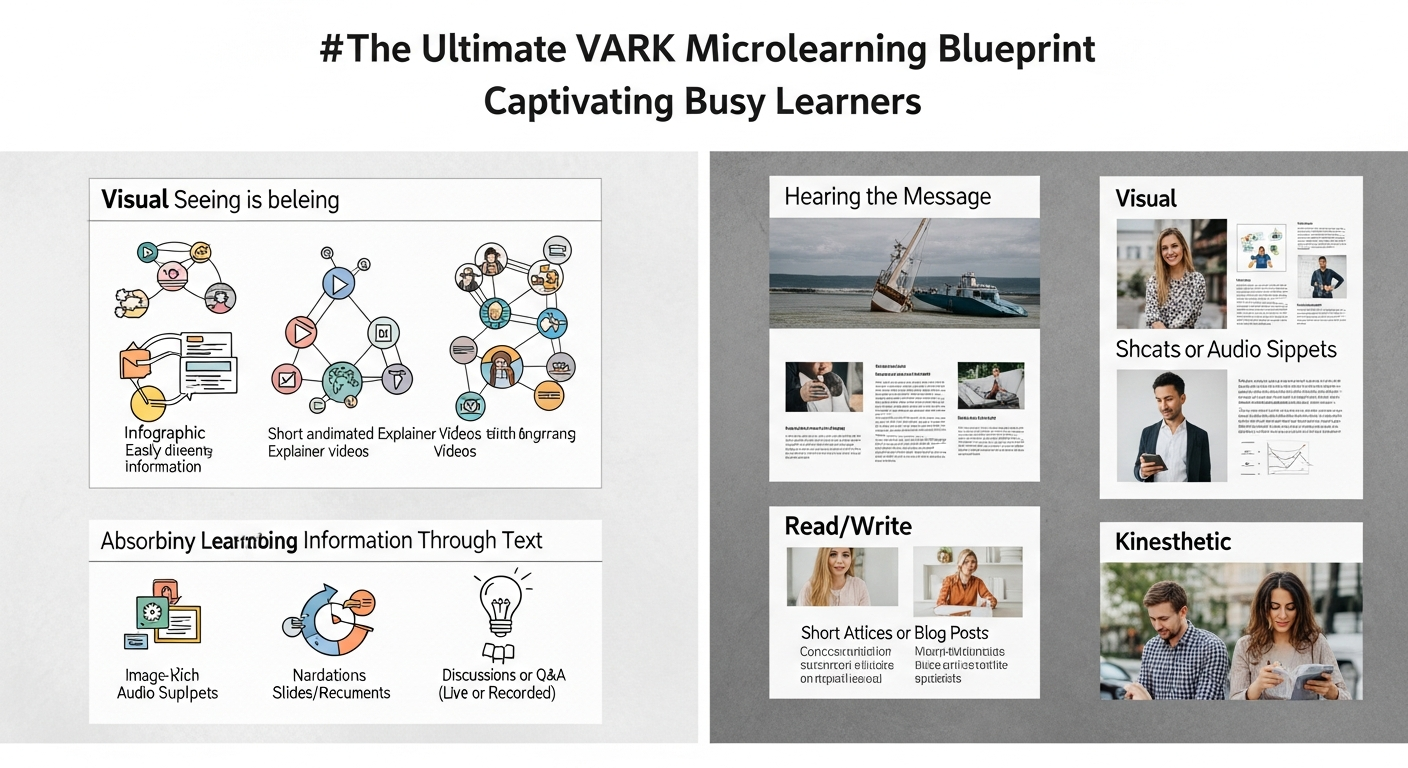
How to Captivate Busy Learners: The Ultimate VARK Microlearning Blueprint
In today's fast-paced corporate environment, the quest to effectively train and develop employees is more challenging than ever. Vice Presidents, Directors, and Managers of Learning & Development across industries like Compliance, Sales, Banking, Finance, Insurance, Retail, Pharma, Healthcare, Hospitality, Oil and Gas, and Mining face a universal dilemma: how to engage busy professionals who have limited time and a wealth of distractions. Traditional, lengthy training modules often fall flat, leading to disengagement and poor retention.
The solution lies in a strategic blend of understanding how people learn and delivering content in a digestible format. Enter the VARK learning model combined with the power of microlearning – an ultimate blueprint designed to captivate even the busiest of learners. This approach doesn't just deliver information; it optimizes how that information is absorbed, retained, and applied.
Why Traditional Training Fails Busy Professionals
Modern corporate life is characterized by demanding schedules, information overload, and shrinking attention spans. Employees are often juggling multiple projects, meetings, and deadlines, leaving little room for lengthy training sessions. Generic, one-size-fits-all training often:
- Fails to respect learners' time, leading to resentment.
- Struggles to maintain engagement, as content may not be immediately relevant or delivered in their preferred style.
- Results in poor knowledge retention, as information is forgotten shortly after the training.
- Offers limited flexibility, clashing with dynamic work schedules.
This creates a clear need for a more agile, personalized, and efficient approach to learning.
Understanding the VARK Model for Deeper Engagement
The VARK model categorizes learning preferences into four primary types: Visual, Auditory, Read/Write, and Kinesthetic. Understanding these preferences is fundamental to creating truly engaging and effective learning experiences. By tailoring content delivery to these styles, L&D professionals can significantly enhance comprehension and retention.
- Visual (V): Learners prefer to see information presented graphically through diagrams, charts, infographics, videos, and demonstrations.
- Auditory (A): Learners absorb information best by hearing it, through lectures, discussions, podcasts, and audio explanations.
- Read/Write (R): Learners prefer text-based information, thriving with written notes, reports, articles, lists, and summaries.
- Kinesthetic (K): Learners learn by doing, through hands-on activities, simulations, role-playing, practical exercises, and real-world applications.
Ignoring these diverse styles means a significant portion of your workforce might not be optimizing their learning potential.
The Microlearning Advantage for Corporate Training
Microlearning delivers short, focused bursts of content designed to meet a specific learning objective. Typically lasting between 2-10 minutes, these bite-sized modules are perfectly suited for the busy professional's schedule. This approach isn't just about brevity; it's about precision and impact.
Key advantages of microlearning include:
- Improved Retention: Smaller chunks of information are easier to process and recall.
- Enhanced Engagement: Quick, relevant content holds attention better than long-form courses.
- Flexibility and Accessibility: Learners can access content on-demand, anytime, anywhere, fitting it into their workday breaks or commutes. A robust Microlearning LMS facilitates this accessibility.
- Targeted Learning: Content can be highly specific, addressing immediate knowledge gaps or performance needs.
- Cost-Effectiveness: Easier and faster to produce and update than traditional courses.
Crafting Your VARK Microlearning Blueprint: Strategies for Each Learner Type
Combining VARK with microlearning creates a powerful synergy, ensuring that your training not only fits into busy schedules but also resonates with individual learning styles. Here's how to build your ultimate blueprint:
Visual Learners: See to Understand
For visual learners, focus on dynamic and graphical content. Think beyond static images to leverage movement and interaction. A modern learning content management system should easily support these formats.
- Short Explainer Videos: Animated videos or quick demonstrations (2-5 minutes) illustrating processes, product features, or compliance procedures.
- Infographics & Visual Summaries: Condensing complex data or steps into easily digestible graphical formats.
- Interactive Diagrams: Clickable diagrams or flowcharts that explain concepts as learners navigate them.
Auditory Learners: Hear to Learn
Auditory learners benefit from listening. Providing audio-centric microlearning elements allows them to learn even when their eyes are busy, such as during a commute or while performing routine tasks.
- Mini-Podcasts/Audio Snippets: 3-7 minute audio files explaining a concept, a quick update, or best practices.
- Recorded Expert Insights: Short interviews or voiceovers from subject matter experts on specific topics.
- Audio-Enhanced Quizzes: Questions and answers delivered through audio, requiring auditory processing.
Read/Write Learners: Engage with Text
Text-based content is crucial for read/write learners. While all microlearning should be concise, this segment particularly appreciates well-structured, clear, and summarized written information. A versatile learning management software can host a variety of these assets.
- Quick Guides & Cheat Sheets: One-page summaries of key processes, policies, or product specifications.
- Brief Articles & Blog Posts: Short, focused text modules that dive into a single topic.
- Interactive Quizzes with Text Feedback: Assessments that provide detailed written explanations for correct and incorrect answers.
Kinesthetic Learners: Learn by Doing
Kinesthetic learners thrive on practical application. Microlearning for this group should involve immediate interaction and opportunities to practice skills in a safe environment. This is where a Gamified LMS can truly shine.
- Mini-Simulations & Scenario-Based Exercises: Short, interactive scenarios where learners make decisions and see immediate consequences.
- Click-Through Demos: Guided interactive tours of software or systems.
- Gamified Challenges: Quick quests or challenges that involve applying knowledge to solve a problem, earning points or badges.
- Role-Playing Prompts: Short prompts for learners to practice a skill (e.g., a sales pitch, a customer service interaction) in a low-stakes setting.
Leveraging Technology: AI and Adaptive Platforms for VARK Microlearning
Implementing a comprehensive VARK microlearning strategy requires more than just content; it demands a robust technological backbone. Many L&D leaders ask: How can artificial intelligence personalize learning experiences for diverse corporate learners? The answer lies in sophisticated Adaptive Learning algorithms, which analyze a learner's performance and preferences to dynamically recommend the most relevant microlearning modules, potentially even suggesting content tailored to their VARK style. This intelligent approach, powered by a cutting-edge learning management system, ensures that each employee receives the most effective training path for their needs.
Another pressing question for L&D professionals is: Can AI help in quickly generating relevant and varied microlearning content tailored to specific VARK styles? Absolutely. An AI Powered Authoring Tool can dramatically accelerate content creation. It can assist in transforming existing longer-form content into concise microlearning units – automatically generating video scripts, summary bullet points, quiz questions, or interactive scenario ideas. This capability within a comprehensive LCMS significantly reduces development time and ensures a steady stream of fresh, varied content for all learning preferences.
Furthermore, L&D managers often ponder: What role does advanced technology play in making training engaging and accessible for busy professionals, particularly in high-stakes industries like compliance or finance? A cloud based learning management system provides ubiquitous access, allowing learners to engage with microlearning from any device. For sectors requiring precise, high-impact training, such as Risk-focused Training, a robust enterprise learning management solution like MaxLearn LMS ensures that critical information is delivered efficiently and effectively. These advanced learning management solutions integrate features like gamification, peer-to-peer learning, and real-time analytics to keep learners motivated and provide valuable insights into engagement and performance. Ultimately, a sophisticated lms learning management system empowers organizations to build truly adaptive and learner-centric environments.
The Tangible Benefits: Driving Performance and ROI
Adopting a VARK microlearning blueprint delivers measurable benefits that directly impact your organization's bottom line:
- Increased Employee Engagement: Tailored content keeps learners motivated and invested.
- Improved Knowledge Retention and Application: Bite-sized, relevant information is easier to remember and apply on the job.
- Enhanced Productivity: Quicker upskilling and reskilling lead to a more capable and efficient workforce.
- Better Compliance and Risk Mitigation: Especially in regulated industries, precise and frequent microlearning ensures employees are always up-to-date.
- Demonstrable ROI: Reduced training time, higher completion rates, and improved performance metrics provide clear returns on your L&D investment.
The days of generic, lengthy corporate training are numbered. To truly captivate busy learners and drive performance in any industry, L&D leaders must embrace strategies that respect their time, cater to their unique learning preferences, and leverage cutting-edge technology. The VARK microlearning blueprint, supported by an advanced learning management system, offers a powerful path forward. By understanding how your employees learn and delivering content in the most effective, efficient way possible, you can transform your organization's learning culture and empower your workforce for sustained success.


Comments
Post a Comment