How Gardner's Principles Challenge the Single IQ Metric in Employee Training
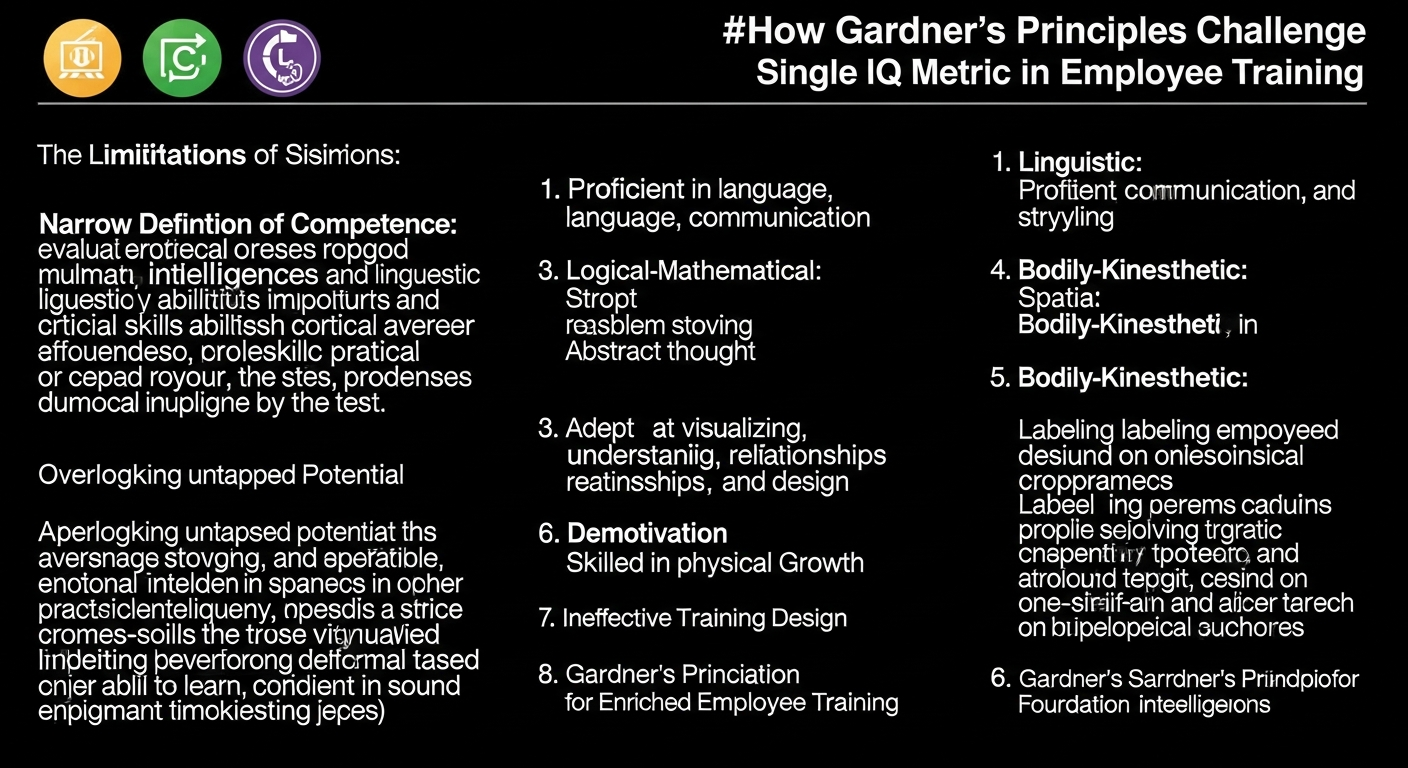
How Gardner's Principles Challenge the Single IQ Metric in Employee Training
In the dynamic world of corporate learning and development, the quest for effective, engaging, and impactful employee training is ceaseless. For decades, the implicit — and sometimes explicit — assumption has been that intelligence is a singular, quantifiable entity, often measured by a static IQ score. This traditional viewpoint has permeated training methodologies, often leading to one-size-fits-all programs that cater primarily to linguistic and logical-mathematical strengths. However, the groundbreaking work of Harvard psychologist Howard Gardner presents a profound challenge to this narrow perspective, advocating instead for a Theory of Multiple Intelligences (MI). For Vice Presidents, Directors, and Senior Managers in L&D, understanding and applying Gardner's principles is not just academic; it’s a strategic imperative for unlocking the full potential of your workforce across diverse industries like Compliance, Sales, Banking, Finance, Insurance, Retail, Pharma, Health care, Hospitality, Oil and Gas, and Mining.
The Foundation: Understanding Gardner's Theory of Multiple Intelligences
Gardner's theory, first introduced in 1983, posited that intelligence is not a single, unified capacity but rather a collection of distinct intellectual strengths. He initially identified seven, later expanding to eight (and considering a ninth), each representing a different way individuals interact with the world and process information. These intelligences include:
- Linguistic Intelligence: The ability to think in words and use language to express and appreciate complex meanings (e.g., writers, speakers, lawyers).
- Logical-Mathematical Intelligence: The capacity to carry out mathematical operations and to reason logically (e.g., scientists, engineers, accountants).
- Spatial Intelligence: The ability to think in three dimensions; to perceive the external and internal imagery accurately and to transform, modify, and re-create it (e.g., architects, artists, navigators).
- Bodily-Kinesthetic Intelligence: The capacity to manipulate objects and use a variety of physical skills (e.g., dancers, athletes, surgeons, craftspeople).
- Musical Intelligence: The capacity to discern pitch, rhythm, timbre, and tone (e.g., musicians, composers).
- Interpersonal Intelligence: The ability to understand and interact effectively with others (e.g., teachers, social workers, salespersons, managers).
- Intrapersonal Intelligence: The capacity to understand oneself—one's feelings, motivations, and goals (e.g., philosophers, therapists, entrepreneurs).
- Naturalistic Intelligence: The ability to recognize and categorize flora and fauna or other critical distinctions in the natural world (e.g., biologists, environmentalists).
Gardner argues that most individuals possess all these intelligences to varying degrees, with certain ones being more prominent. This holistic view directly contradicts the notion that a single IQ score can accurately measure a person's overall cognitive abilities or potential.
The Flaws of a Single IQ Metric in Employee Training
Relying on a uniform, text-heavy, or lecture-based training model, which implicitly assumes a dominant linguistic-logical intelligence, presents significant challenges:
- Exclusion and Disengagement: Employees whose primary intelligences are spatial, kinesthetic, or interpersonal often find traditional training monotonous and ineffective, leading to disengagement and poor knowledge retention.
- Untapped Potential: A single-metric approach overlooks the unique strengths an employee brings. A sales team member might excel in interpersonal intelligence, while an operations specialist might have high spatial intelligence – both crucial, yet often unaddressed by conventional training.
- Inefficient Resource Allocation: When training doesn't resonate, time and budget are wasted on programs that fail to deliver desired outcomes, impacting productivity and compliance across your organization.
- Misguided Performance Assessments: If training only caters to a few intelligences, performance assessments based on that training will inaccurately reflect an employee's true capabilities, potentially hindering career growth and talent mobility.
Applying Gardner's Principles to Modern Employee Training
Embracing Gardner's framework transforms employee training from a rigid curriculum into a dynamic, inclusive, and effective learning ecosystem. This is where advanced eLearning solutions and a sophisticated LMS truly shine.
Personalized Learning Paths for Diverse Minds
Recognizing that employees learn differently allows L&D professionals to create customized learning journeys. For example:
- For individuals strong in spatial intelligence, visual aids, infographics, and interactive simulations are invaluable.
- Bodily-kinesthetic learners thrive with hands-on exercises, role-playing, and virtual reality training modules.
- Interpersonal learners benefit from collaborative projects, group discussions, and peer coaching.
- Intrapersonal learners can deepen understanding through reflective journaling, self-paced study, and personalized feedback loops.
This approach moves beyond basic customization, evolving into truly Adaptive Learning experiences that respond to individual progress and preferences.
Diverse Content Formats and Delivery
A modern learning management system must support a rich variety of content formats. This includes short, focused video tutorials, interactive quizzes, audio summaries, gamified scenarios, and practical exercises. A Microlearning LMS is particularly effective here, delivering bite-sized content that caters to various attention spans and learning preferences, ensuring knowledge is absorbed and retained. Using a versatile Learning content management system (LCMS) is essential for organizing and deploying these diverse resources efficiently.
Engaging and Experiential Learning
Engagement is key to retention. Incorporating elements like a Gamified LMS can appeal to competitive and logical-mathematical intelligences through challenges, leaderboards, and rewards. Simulations, virtual labs, and real-world case studies provide experiential learning that resonates with kinesthetic and spatial learners, especially crucial in sectors like Healthcare and Oil and Gas for practical skill development.
Leveraging AI to Realize Gardner's Vision in Training
Artificial Intelligence (AI) serves as a powerful accelerator in operationalizing Gardner's principles within an enterprise learning management strategy.
How can technology help us understand diverse learning needs globally?
AI-driven analytics within a sophisticated lms learning management system can analyze vast amounts of data from employee interactions with training content. This includes completion rates, quiz scores, engagement metrics, and feedback. By identifying patterns across different demographics and geographical locations, AI can reveal predominant learning styles and intelligence strengths within various employee groups. This insight allows L&D teams to tailor content for cultural relevance and preferred learning modalities, whether for sales teams across continents or compliance training in different regulatory environments. This ensures that a cloud based learning management system can effectively serve a global workforce.
What's the best way for AI to create customized training experiences?
AI excels at personalization. Using algorithms, an AI Powered Authoring Tool can assess an individual's past performance, preferences, and even their stated learning styles (if collected) to recommend or even generate content that aligns with their dominant intelligences. For example, if an employee consistently performs well with visual aids, the AI can prioritize graphic-rich modules. If they excel in collaborative tasks, it can suggest group-based projects. This moves beyond simple course recommendations to truly adaptive pathways, ensuring each employee receives the most effective training format for them, making it a critical learning management software feature.
How can AI ensure our training programs meet specific industry compliance standards and mitigate risks effectively?
In highly regulated industries such as Banking, Pharma, and Insurance, Risk-focused Training is paramount. AI can monitor employee progress and performance within compliance modules, identifying specific areas where an individual or a team might be weak or pose a higher risk. Instead of generic retraining, AI can then recommend targeted, supplementary learning management solutions (LMS) content tailored to address those precise knowledge gaps or behavioral risks. This proactive, data-driven approach ensures that training is not just completed but truly understood and applied, significantly reducing organizational exposure to non-compliance and operational hazards. This is where a robust MaxLearn LMS becomes indispensable.
The Strategic Advantage for L&D Leaders
Adopting Gardner's principles, amplified by modern eLearning technologies like a cloud based learning management system, offers significant benefits for L&D professionals:
- Enhanced Engagement and Retention: When training resonates with an individual's natural strengths, engagement skyrockets, leading to better knowledge absorption and application.
- Improved Performance and Productivity: Empowered employees who learn effectively are more competent, productive, and confident in their roles.
- Stronger Talent Development: By nurturing a diverse range of intelligences, organizations can develop well-rounded leaders and specialists, fostering internal mobility and succession planning.
- Culture of Continuous Learning: An inclusive training environment encourages a lifelong learning mindset, crucial for adaptability in rapidly evolving industries.
- Data-Driven Insights: A comprehensive learning management system provides analytics to prove ROI and continually refine training strategies.
Conclusion: Beyond the Single Metric, Towards Holistic Development
The single IQ metric is a relic in the nuanced landscape of human intelligence. Howard Gardner's Theory of Multiple Intelligences offers a more accurate and empowering lens through which to view and develop talent. For L&D leaders, the challenge—and opportunity—lies in moving beyond outdated, one-size-fits-all training models. By integrating Gardner's principles with the power of modern eLearning platforms, AI-driven personalization, and diverse content strategies, you can cultivate a workforce that is not only highly skilled but also deeply engaged and continually growing. Investing in a sophisticated learning management software and embracing a multi-intelligent approach is not just about training; it’s about strategically building a more capable, adaptable, and resilient organization for the future.


Comments
Post a Comment