Create Lessons That Click: Mastering Fleming’s VARK in Corporate Training
Create Lessons That Click: Mastering Fleming’s VARK in Corporate Training
In the dynamic landscape of corporate learning and development, the quest for truly effective training remains a top priority for L&D Vice Presidents, Directors, and Managers. The challenge isn't just delivering content, but ensuring that it resonates, sticks, and ultimately transforms into tangible performance improvements. This is where Fleming’s VARK model emerges as a powerful framework, enabling organizations across industries – from Compliance and Sales to Banking, Healthcare, and Oil & Gas – to design training that truly "clicks" with every learner.
For too long, corporate training has often adopted a one-size-fits-all approach, leading to disengaged employees, poor knowledge retention, and wasted resources. By understanding and applying the VARK model, L&D professionals can move beyond generic instruction to create personalized, impactful learning experiences that cater to the diverse ways adults absorb information. This isn't merely about ticking a box; it's about fostering a culture of continuous learning and driving real business outcomes.
Understanding Fleming’s VARK Model
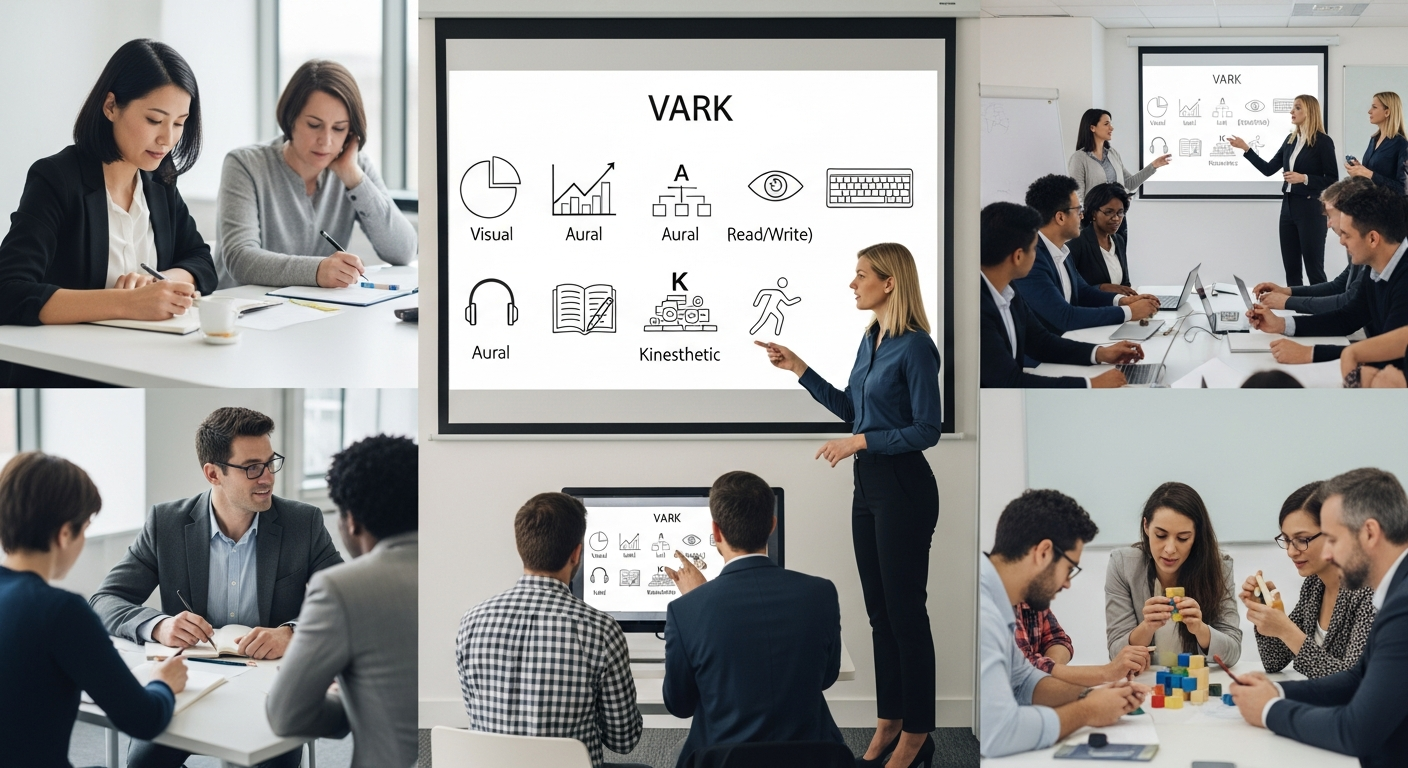
Developed by Neil Fleming, VARK is an acronym that stands for Visual, Auditory, Read/Write, and Kinesthetic – four primary sensory modalities that people use for learning. Recognizing these preferences allows trainers to adapt their delivery methods, making the content more accessible and memorable for a broader audience.
- Visual (V): These learners prefer to see information presented graphically. They respond well to charts, graphs, diagrams, images, videos, and presentations that use strong visual aids.
- Auditory (A): Auditory learners learn best through listening. Lectures, discussions, podcasts, audiobooks, and verbal instructions are highly effective for them.
- Read/Write (R): These individuals prefer to take in information through text. Manuals, reports, articles, lists, notes, and written quizzes are their preferred learning tools.
- Kinesthetic (K): Kinesthetic learners learn by doing, experiencing, and practicing. Role-playing, simulations, hands-on activities, practical exercises, and real-world case studies resonate deeply with them.
Why VARK is Indispensable in Corporate Training
Integrating VARK into your corporate training strategy isn't just a best practice; it's a strategic imperative. Here’s why it matters for your enterprise learning management efforts:
Enhanced Engagement and Motivation
When training aligns with an individual's preferred learning style, engagement skyrockets. Learners feel understood and find the material more interesting, leading to higher participation and motivation. This is crucial whether you are developing Risk-focused Training for financial compliance or sales enablement courses for retail staff.
Improved Knowledge Retention
Information presented in a learner's preferred modality is processed more efficiently and retained for longer periods. This translates to a more skilled workforce and reduced need for repeated training sessions, optimizing your budget and resources.
Increased Performance and Productivity
Effective training directly impacts job performance. When employees truly grasp concepts and develop skills, they apply them more effectively in their roles, boosting productivity and contributing positively to the bottom line across industries like Pharma, Hospitality, and Mining.
Fosters a Culture of Continuous Learning
By demonstrating a commitment to personalized learning, organizations encourage employees to take ownership of their development. A robust Microlearning LMS or Gamified LMS can be instrumental in delivering these varied experiences.
Implementing VARK in Your Training Strategy
Mastering VARK means moving beyond simple recognition to strategic application across all aspects of your learning content management system:
Designing Content for Each VARK Style:
- For Visual Learners: Incorporate high-quality videos, animated explanations, infographics, flowcharts, and clear graphical representations in your learning modules. Use platforms that allow for rich media integration.
- For Auditory Learners: Develop podcasts, webinars, interactive discussions, audio summaries, and opportunities for Q&A sessions. Utilize text-to-speech features within your LMS.
- For Read/Write Learners: Provide comprehensive textual resources, detailed articles, downloadable whitepapers, clear instructions, written assignments, and traditional quizzes. A well-structured learning content management system is key here.
- For Kinesthetic Learners: Integrate simulations, virtual reality experiences, role-playing scenarios, hands-on labs, interactive quizzes, and practical case studies. Consider incorporating Gamified LMS elements to add an experiential layer.
Leveraging Technology for VARK-Aligned Learning
Modern learning management solutions are indispensable for delivering VARK-optimized training. A sophisticated learning management system empowers L&D teams to create and distribute diverse content formats seamlessly.
- A cloud based learning management system can host a variety of content types, from high-definition videos to interactive simulations and detailed documentation.
- Adaptive Learning paths, often powered by AI, can identify a learner's preferred style (or styles, as many are multimodal) and dynamically serve content that best suits them, ensuring a truly personalized journey.
- An AI Powered Authoring Tool within your lms learning management system can significantly reduce the effort required to produce multi-modal content, transforming existing text into audio or generating visual summaries.
- For complex topics such as compliance or Risk-focused Training, an effective learning management software allows for intricate scenario-based training, perfect for kinesthetic learners, while simultaneously offering comprehensive textual resources for read/write learners. MaxLearn LMS provides robust capabilities for this.
AI and VARK: The Future of Personalized Training
The advent of artificial intelligence is revolutionizing how we approach learning styles and content delivery. L&D leaders are increasingly asking:
How can advanced analytics help identify individual learning preferences in a diverse global workforce?
AI-driven analytics within an enterprise learning management platform can analyze learner interactions, quiz results, content consumption patterns (e.g., time spent on videos vs. reading), and even eye-tracking data (where available) to infer preferred learning styles. This data can then inform dynamic content recommendations, providing a highly tailored experience for employees worldwide, from retail associates in one region to engineers in another.
What role does intelligent automation play in personalizing training content for diverse learning styles across an organization?
Intelligent automation, often powered by an AI Powered Authoring Tool, can transform a single piece of content into multiple VARK-aligned formats. For instance, a text-based compliance document could be automatically converted into an audio summary, an infographic, or interactive quiz questions. This significantly speeds up content development and ensures that every learner receives information in their most effective modality, a key strength of modern learning management solutions.
Can AI tools predict which learning methods will be most effective for specific training objectives?
Yes, predictive analytics can forecast learning success. By analyzing historical data on learner performance, preferred styles, and course outcomes, AI can recommend optimal learning pathways and content formats for specific training goals. For example, if a banking course on fraud detection shows higher retention rates for kinesthetic learners using simulations, AI can prioritize this method for future cohorts, creating truly Adaptive Learning experiences.
VARK Across Industries
The beauty of the VARK model lies in its universal applicability. In **Compliance**, visual infographics and kinesthetic simulations of regulatory scenarios can reinforce complex rules. For **Sales** professionals, auditory role-playing and read/write product manuals, augmented by an AI Powered Authoring Tool, can be transformative. **Healthcare** benefits from visual anatomical diagrams and kinesthetic patient interaction simulations. In **Oil & Gas** or **Mining**, kinesthetic safety drills combined with visual hazard maps are critical. Even industries like **Hospitality** can leverage VARK through visual service guides and kinesthetic practice of customer interactions. A robust LCMS facilitates this cross-industry adaptation, ensuring that every type of content is delivered effectively.
Conclusion
For L&D leaders, the journey to "lessons that click" begins with a profound understanding of how people learn. Embracing Fleming’s VARK model, supported by a modern MaxLearn LMS, represents a strategic shift from generic training to personalized, impactful learning experiences. By catering to Visual, Auditory, Read/Write, and Kinesthetic preferences, organizations can unlock deeper engagement, higher retention, and measurable performance improvements across their entire workforce. This is the path to truly effective corporate training, driving both individual growth and organizational success.


Comments
Post a Comment