Boost Training ROI: Leveraging VARK Learning Styles in Bite-Sized Content
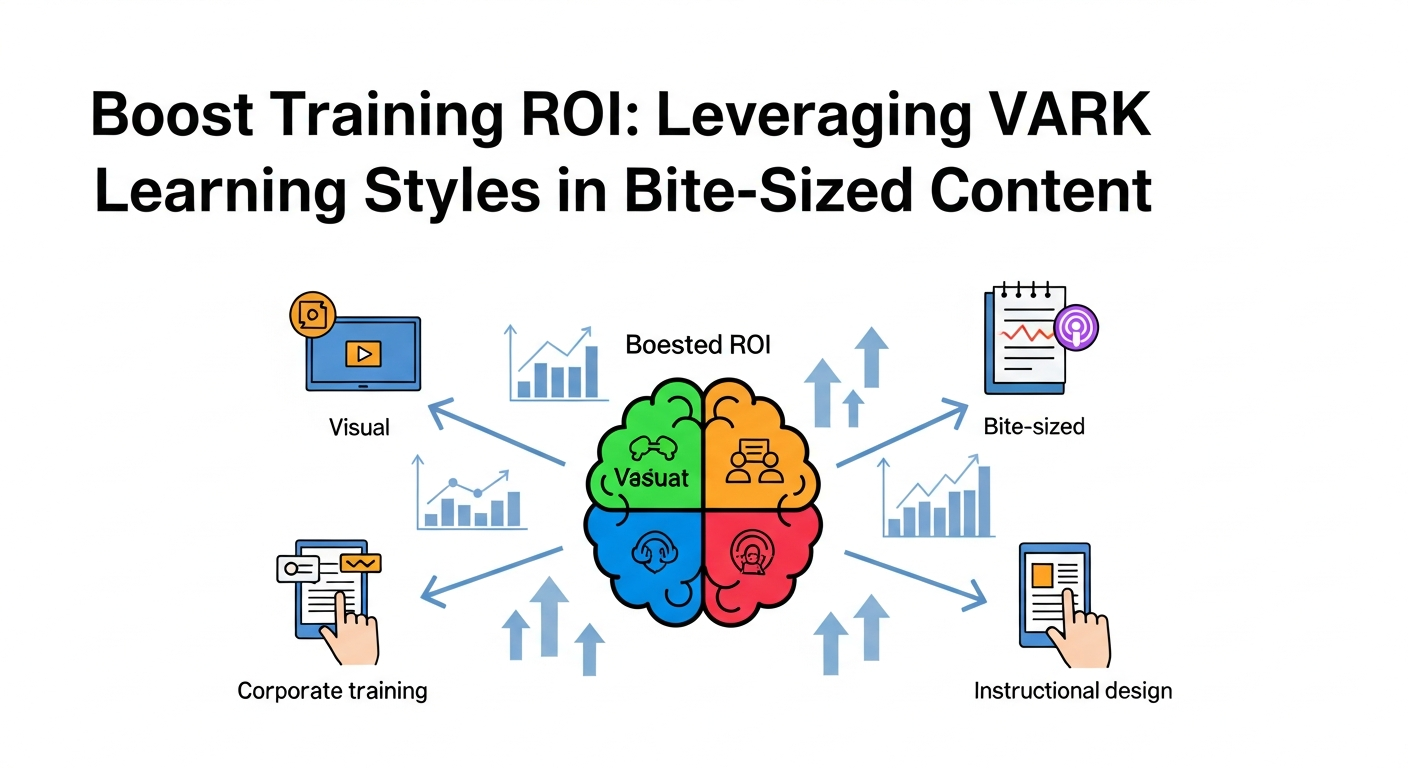
Boost Training ROI: Leveraging VARK Learning Styles in Bite-Sized Content
In today's dynamic corporate landscape, Learning & Development (L&D) leaders face an perennial challenge: demonstrating a tangible return on investment (ROI) for training initiatives. Traditional, long-form training often struggles with engagement, knowledge retention, and direct applicability, leading to questions about its true value. However, a powerful synergy emerges when we combine the science of individual learning preferences – specifically the VARK model – with the proven effectiveness of bite-sized content, often delivered through a sophisticated Microlearning LMS.
This article will explore how L&D VPs, Directors, and Senior Managers across industries like Compliance, Sales, Banking, Finance, Insurance, Retail, Pharma, Health care, Hospitality, Oil and Gas, and Mining can revolutionize their training programs, making them more engaging, effective, and ultimately, more profitable by integrating VARK principles into concise, impactful learning modules.
Understanding the ROI Challenge in Corporate Training
The quest for training ROI isn't just about cost savings; it's about measurable improvements in performance, productivity, and profitability. Many organizations invest heavily in training only to see limited impact due to several common pitfalls:
- Low Engagement: Learners disengage from lengthy, generic courses that don't cater to their individual needs or attention spans.
- Poor Retention: Information overload leads to a rapid decline in knowledge retention after training completion.
- Lack of Application: Learners struggle to translate theoretical knowledge into practical skills applicable to their daily roles.
- Inefficient Delivery: Outdated delivery methods fail to leverage modern technological capabilities and learner expectations.
Addressing these challenges requires a strategic shift towards more personalized and accessible learning experiences. This is where understanding VARK and embracing bite-sized content becomes a game-changer.
The Power of VARK: Tailoring Learning Experiences
VARK is an acronym that represents Visual, Aural, Read/Write, and Kinesthetic learning preferences. Developed by Neil Fleming, the VARK model provides a simple yet effective framework for understanding how individuals prefer to receive and process information. Recognizing and catering to these preferences is fundamental to enhancing learning effectiveness:
- Visual (V): Learners prefer information presented through charts, graphs, diagrams, maps, and other visual aids. They need to 'see' the information.
- Aural (A): Learners best absorb information through listening, such as lectures, discussions, podcasts, and audio recordings. They need to 'hear' the information.
- Read/Write (R): Learners prefer information displayed as text, including lists, notes, handouts, and textbooks. They need to 'read and write' about the information.
- Kinesthetic (K): Learners learn best by doing, experiencing, touching, and practicing. They prefer hands-on activities, simulations, role-playing, and real-world examples. They need to 'do' the information.
By designing training that incorporates elements appealing to each VARK style, L&D professionals can create more inclusive and impactful learning journeys, reducing the likelihood of disengagement and improving comprehension.
Bite-Sized Content: The Modern Learning Imperative
Bite-sized content, often referred to as microlearning, involves delivering learning materials in small, focused modules that can be consumed quickly—typically in 3-10 minutes. This approach aligns perfectly with modern cognitive science and the demands of today's busy professionals.
The benefits of bite-sized content are compelling:
- Increased Engagement: Short, focused modules prevent cognitive overload and maintain learner interest.
- Better Retention: Spaced repetition and targeted information improve memory recall.
- Flexibility and Accessibility: Learners can access content anytime, anywhere, on any device, making it ideal for busy schedules in industries like Health care and Retail.
- Faster Updates: Easier to create, update, and deploy new content, crucial for fast-evolving fields like Finance and Pharma.
- Reduced Cognitive Load: Breaking down complex topics into digestible chunks makes learning less daunting.
A robust learning management system optimized for microlearning is key to effectively deploying such content, ensuring seamless delivery and tracking for all users.
Synergy in Action: VARK Meets Bite-Sized Content
The true power lies in the strategic combination of VARK principles with bite-sized content. This tailored approach ensures that every learner receives information in a format that resonates most effectively with their individual learning style, maximizing absorption and application. Here's how to integrate VARK into your bite-sized strategy:
- For Visual Learners: Deliver micro-modules featuring infographics, short animated videos explaining complex processes, concise diagrams for product features, or interactive charts showing market trends.
- For Aural Learners: Offer short audio snippets explaining concepts, mini-podcast episodes with expert interviews, voiceovers for short explainer videos, or audio-based scenario discussions.
- For Read/Write Learners: Provide crisp summaries of policies, quick reference guides, concise checklists for operational procedures, short articles on best practices, or text-based quizzes to reinforce learning.
- For Kinesthetic Learners: Design interactive simulations for machinery operation in Oil and Gas, drag-and-drop exercises for compliance procedures, short scenario-based challenges in Sales, or Gamified LMS elements that allow hands-on practice through quizzes and challenges.
Implementing a VARK-Driven Bite-Sized Strategy for Maximum Impact
Identifying Learner Preferences
To effectively leverage VARK, you first need to understand your learners. This can be done through:
- Pre-assessments: Short, voluntary surveys or quizzes can help learners identify their own VARK preferences.
- Behavioral analysis: An advanced LMS can track which content formats learners engage with most.
Content Curation and Creation
Once preferences are known, develop or curate content that addresses each style. An AI Powered Authoring Tool can be invaluable here, helping to rapidly generate varied content formats from a single source, saving significant time and resources for your learning content management system.
Adaptive Learning Paths
The true power of this approach comes with personalization. Utilize an lms learning management system that supports Adaptive Learning. This allows the system to recommend or prioritize content formats based on a learner's identified VARK profile, or even based on their ongoing interactions with the learning platform. For instance, a Kinesthetic learner might be directed towards a simulation, while a Visual learner sees an infographic on the same topic.
Measurement and Iteration
Continuously track engagement, completion rates, knowledge retention, and ultimately, how new skills are applied on the job. A robust cloud based learning management system provides the analytics needed to refine your strategy and ensure a consistent positive ROI.
Leveraging Artificial Intelligence in Your Strategy
Modern technology plays a critical role in scaling personalized learning. For L&D leaders considering these advancements, several questions often arise:
Question: How can advanced technology assist in pinpointing individual learning preferences across a large workforce?
Answer: Cutting-edge learning management software, often featuring built-in AI capabilities, can analyze learner interactions, quiz results, and content consumption patterns to infer individual VARK profiles. This goes beyond simple self-assessments, providing dynamic, data-driven insights that help tailor the learning experience without explicit learner input. This insight is crucial for an enterprise learning management system.
Question: With diverse global teams, what methods ensure a consistent training experience that still respects various learning styles in different regions and industries?
Answer: A unified learning management solution employing microlearning, particularly when enhanced by AI, can effectively address this. Microlearning's modularity allows for easy localization and cultural adaptation of content. AI can then recommend specific formats (e.g., more visual content in one region, more text-based in another based on observed preferences) while ensuring the core message and objectives remain consistent globally, whether for Compliance training in Europe or Sales training in Asia.
Question: What capabilities does artificial intelligence offer in automating the creation and dynamic delivery of customized bite-sized content based on identified VARK profiles?
Answer: Artificial intelligence, especially through an AI Powered Authoring Tool within a modern LCMS, can automate significant portions of content creation by transforming existing materials into multiple VARK-friendly formats. Furthermore, AI-driven recommendation engines within an LMS can dynamically assemble personalized learning paths, delivering the most appropriate bite-sized content format (video, audio, text, interactive exercise) to each learner in real-time, optimizing engagement and effectiveness.
Industry-Specific Applications
- Compliance: Use interactive scenarios for Kinesthetic learners to practice Risk-focused Training, short animated videos for Visual learners explaining new regulations, and concise text summaries for Read/Write learners on policy updates.
- Sales: Offer audio tips for Aural learners on objection handling, role-playing simulations for Kinesthetic learners practicing product pitches, and visual infographics for Visual learners on competitor analysis.
- Healthcare: Provide short procedural videos for Visual/Kinesthetic learners, quick audio guides for Aural learners on patient communication, and concise documentation for Read/Write learners on new medical protocols.
- Finance: Develop interactive quizzes for Kinesthetic learners on new financial products, data visualizations for Visual learners on market trends, and concise policy documents for Read/Write learners on regulatory changes.
Conclusion
For L&D leaders striving to elevate training ROI, the combination of VARK learning styles and bite-sized content offers a clear path forward. By understanding how your employees learn best and delivering knowledge in digestible, personalized chunks through an effective learning management system, you can dramatically increase engagement, improve knowledge retention, and foster greater skill application. This approach doesn't just make training more efficient; it transforms it into a powerful driver of organizational performance and growth. Invest in modern learning solutions that empower this synergy, and watch your training ROI soar.


Comments
Post a Comment