5 Ways to Use Fleming’s VARK Model in Your Next Microlearning Lesson
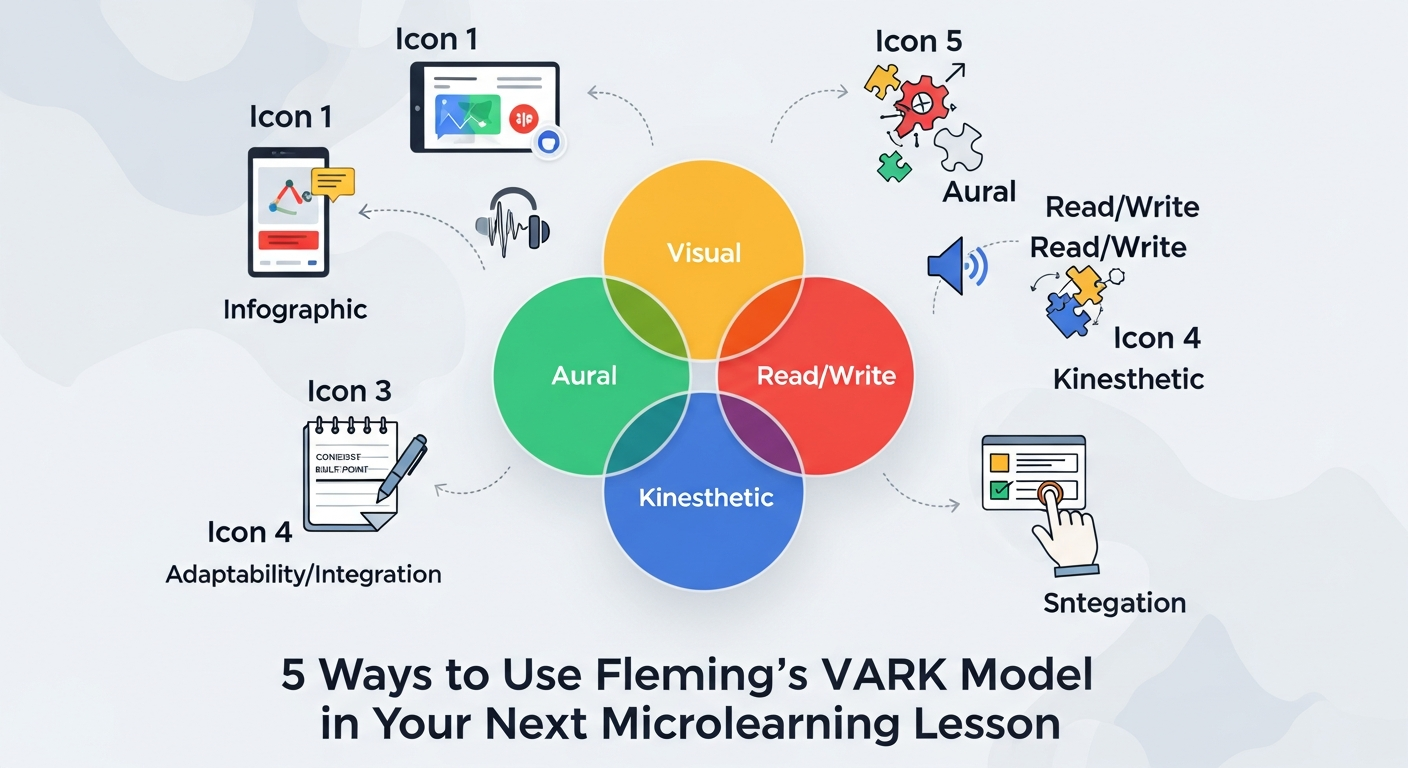
Mastering Engagement: 5 Ways to Use Fleming’s VARK Model in Your Next Microlearning Lesson
As a Vice President, Director, or Senior Manager in Learning & Development, you understand the critical challenge: how to effectively engage a diverse workforce, spanning industries from Compliance to Pharma, Banking to Oil and Gas, with training that sticks. Traditional long-form courses often struggle to capture attention in our fast-paced corporate environments. This is where the powerful combination of microlearning and Fleming's VARK Model offers a strategic advantage, transforming how your teams acquire essential skills and knowledge.
Microlearning, delivered through a robust Microlearning LMS, provides concise, focused bursts of information, perfectly suited for busy professionals. But how do you ensure these bite-sized lessons resonate with every individual, from the visual learner in Sales to the kinesthetic learner in Healthcare? The answer lies in leveraging the VARK model – Visual, Auditory, Read/Write, and Kinesthetic – to design truly inclusive and impactful learning experiences. Implementing these strategies within your learning management system can significantly boost learner retention and application.
Understanding the VARK Model: A Foundation for Diverse Learning
The VARK model, developed by Neil Fleming, categorizes learning preferences into four distinct styles:
- Visual (V): Learners prefer seeing information – charts, graphs, diagrams, videos, and demonstrations.
- Auditory (A): Learners absorb best through listening – lectures, discussions, podcasts, and audio explanations.
- Read/Write (R): Learners excel with text-based information – reading articles, taking notes, creating lists, and reviewing manuals.
- Kinesthetic (K): Learners learn by doing – hands-on activities, simulations, role-playing, practical exercises, and real-world application.
Understanding these preferences is the first step towards creating a truly adaptive and engaging learning content management system. By acknowledging that your workforce comprises individuals with varying preferred methods of consuming information, you can design microlearning that speaks to everyone. A modern LCMS (Learning Content Management System) is instrumental in hosting and delivering this varied content effectively.
The Agile Power of Microlearning in Modern L&D
Microlearning is more than just short training modules; it’s a strategic approach to corporate education. It's about delivering precisely what's needed, exactly when it's needed, in a digestible format. For industries like Finance, Insurance, and Retail, where regulations, product knowledge, and customer interactions are constantly evolving, microlearning ensures that employees are always up-to-date without disrupting their workflow. It's an efficient way to deploy enterprise learning management solutions.
A sophisticated learning management system facilitates this by enabling quick content updates and targeted distribution. Many L&D leaders wonder: "How can intelligent algorithms personalize learning paths to match individual needs and preferences?" Modern cloud based learning management systems, particularly an LMS like MaxLearn LMS, leverage advanced analytics to answer this. They analyze learner engagement and performance, suggesting optimal microlearning modules tailored to specific roles or skill gaps. For instance, "Can technology help us anticipate future skill requirements across different geographical operations?" Predictive analytics and machine learning are now powerful tools within many learning management software platforms, identifying emerging trends and allowing L&D teams to proactively deploy relevant microlearning, ensuring your global teams are always prepared.
5 Ways to Use Fleming’s VARK Model in Your Next Microlearning Lesson
1. Visual (V): Captivating Infographics, Short Videos, and Interactive Demos
For your visual learners, the adage "show, don't just tell" is paramount. In a microlearning context, this means leveraging powerful visual assets that convey information quickly and effectively. Think beyond static images. Develop short, high-impact explainer videos, animated infographics illustrating complex processes, or interactive demonstrations of software or equipment. These formats are perfect for showcasing product features in Sales training, demonstrating new compliance procedures, or explaining intricate financial models. An Adaptive Learning platform can even adjust the visual intensity based on learner preference.
- Practical Application: Create a 90-second animated video demonstrating a new safety protocol for the Mining industry, or an infographic summarizing key data points for a new insurance product.
- Benefit: Quickly communicates complex ideas, enhances retention through visual memory, and is highly shareable across teams.
2. Auditory (A): Engaging Podcasts, Explainer Audio, and Discussion Prompts
Auditory learners thrive on spoken content. Microlearning can effectively cater to this group through short audio snippets, mini-podcasts, or concise voiceovers. Imagine a two-minute audio brief on a new market trend for your Banking team, or an expert discussing best practices in customer service for Hospitality. These can be consumed on the go, making them ideal for busy professionals. Integrating an audio component into a Gamified LMS can also add another layer of engagement, using sound cues and voice narration to guide learners through challenges.
- Practical Application: Develop a 3-minute audio clip of an SME explaining a critical point in a regulatory update, or a short dialogue illustrating effective communication in a sales scenario.
- Benefit: Allows for passive learning during commutes or other tasks, fosters strong listening skills, and can make dry topics more engaging.
3. Read/Write (R): Concise Summaries, Interactive Quizzes, and Templated Guides
Learners with a strong read/write preference appreciate text-based information. Microlearning for this group should focus on clear, concise, and structured written content. This could include bullet-point summaries of key policies, interactive quizzes with detailed feedback, short case studies, or downloadable templates. For Compliance training, providing easily digestible policy summaries and FAQs is invaluable. An AI Powered Authoring Tool can significantly streamline the creation of such materials, ensuring consistency and relevance.
- Practical Application: A one-page cheat sheet for a new HR policy, a quick multiple-choice quiz on identifying phishing attempts, or a fill-in-the-blanks exercise for product specifications.
- Benefit: Provides concrete reference materials, reinforces understanding through active recall, and appeals to those who prefer detailed textual information.
4. Kinesthetic (K): Simulations, Role-Plays, and Interactive Exercises
Kinesthetic learners learn by doing. For them, practical application and hands-on experience are key. Microlearning can simulate these experiences effectively. Think about short, interactive simulations for operating new machinery in Oil and Gas, brief branching scenarios for de-escalating customer complaints in Retail, or virtual role-plays for practicing sales pitches. These activities allow learners to physically or virtually interact with the content, making the learning experience tangible and memorable. This approach is particularly effective for Risk-focused Training, where practical experience with scenarios can prevent costly errors.
- Practical Application: A drag-and-drop exercise to correctly assemble a product, a brief scenario-based quiz where learners choose actions and see the outcome, or a guided virtual walkthrough of a new software interface.
- Benefit: Enhances practical skills, improves problem-solving abilities, and makes learning directly applicable to real-world tasks.
5. Blended Approach: Empowering Choice and Personalization
Recognizing that many individuals possess a blend of learning preferences, the most effective strategy is to offer a multi-modal approach within your microlearning lessons. Instead of forcing one style, empower learners with choice. For a single learning objective, provide options: a short video (Visual), an audio summary (Auditory), a concise article (Read/Write), and an interactive simulation (Kinesthetic). A modern lms learning management system should facilitate this level of customization and choice.
- Practical Application: For a microlearning module on "New Regulatory Changes," offer a 2-min video overview, a downloadable PDF summary, and a quick quiz with scenario questions. Learners choose their preferred path or combine elements.
- Benefit: Maximizes engagement by catering to individual preferences, improves overall learning outcomes, and creates a truly personalized learning journey.
Implementing with the Right Learning Management Solutions
Successfully integrating the VARK model into your microlearning strategy hinges on the capabilities of your learning management solutions. A sophisticated Microlearning LMS doesn't just deliver content; it intelligently manages it. It tracks learner engagement across different media types, provides analytics on preferred learning formats, and can even recommend content based on past interactions. This dynamic feedback loop allows L&D leaders to continuously refine their microlearning offerings, ensuring they remain relevant, engaging, and highly effective for every employee, every time.
Conclusion: Elevate Your L&D Strategy with VARK-Powered Microlearning
By consciously incorporating Fleming’s VARK Model into your microlearning design, you move beyond generic training to create highly personalized, impactful, and memorable learning experiences. This approach not only boosts learner engagement and retention but also demonstrates a deep understanding of your workforce's diverse needs, leading to more skilled, confident, and compliant teams across all industries. Invest in a learning management system that empowers this multi-faceted approach, and watch your L&D initiatives drive unprecedented business growth and success.


Comments
Post a Comment