How to Setup an Automated Spaced Repetition Schedule for New Hires
```html
How to Setup an Automated Spaced Repetition Schedule for New Hires for L&D Leaders
In today’s dynamic corporate landscape, effective onboarding is no longer just about welcoming new team members; it’s about rapidly integrating them into complex operational frameworks, ensuring compliance, and accelerating their path to productivity. For Vice Presidents, Directors, and Senior Managers in Learning & Development, the challenge is immense: how do you ensure consistent knowledge retention across diverse roles and a continuous influx of new talent? The answer lies in leveraging the power of automated spaced repetition, a scientifically-backed methodology that transforms traditional training into an intelligent, adaptive, and highly effective learning journey.
This article delves into how L&D leaders can architect and implement a robust automated spaced repetition schedule for new hires, driving superior performance and mitigating risks across industries from compliance and finance to healthcare and sales.
Why Spaced Repetition is Indispensable for New Hires
The "forgetting curve," a concept popularized by Hermann Ebbinghaus, illustrates how quickly humans forget newly acquired information if it’s not reinforced. For new hires, especially in knowledge-intensive sectors like banking, pharma, or oil and gas, this curve can translate into significant operational inefficiencies, errors, and compliance breaches. Spaced repetition directly counters this by strategically re-exposing learners to information at increasing intervals, strengthening memory consolidation.
What is the science behind effective knowledge retention for new employees?
The efficacy of spaced repetition stems from cognitive psychology, specifically the 'testing effect' and 'desirable difficulties.' By retrieving information from memory at optimal intervals, the brain reinforces neural pathways, making future recall easier and more robust. This method transforms passive learning into active engagement, ensuring that critical procedures, product knowledge, or regulatory guidelines are not just learned, but truly mastered.
- Improved Retention: Drastically reduces the impact of the forgetting curve, ensuring long-term memory of essential information.
- Faster Proficiency: New hires become competent faster, reducing the time-to-productivity.
- Reduced Retraining Costs: Less need for repetitive training sessions due to better initial retention.
- Consistent Performance: Ensures a uniform baseline of knowledge across all new employees, crucial for roles in compliance and customer-facing positions.
The Power of Automation in Spaced Repetition
Implementing spaced repetition manually for a large organization with continuous hiring is an administrative nightmare. This is where automation, powered by a sophisticated Microlearning LMS, becomes a game-changer. An automated system eliminates manual scheduling, tracks individual progress, and adapts the learning path, ensuring scalability and consistency.
How can technology enhance the onboarding experience for a large influx of new hires?
Technology, particularly an advanced learning management system, automates the delivery of spaced repetition, freeing up L&D teams to focus on strategy and content creation. It ensures every new hire receives the right information at the right time, tailored to their pace and performance. This is particularly vital in industries with high turnover or continuous hiring needs, such as retail and hospitality.
- Scalability: Easily manage spaced repetition for hundreds or thousands of new hires without a proportional increase in administrative burden.
- Consistency: Guarantees that every new hire receives the same quality and frequency of reinforcement, standardizing the learning experience.
- Personalization: Adaptive Learning algorithms can adjust schedules based on individual performance, focusing on areas where a learner struggles.
- Efficiency: Streamlines the entire onboarding process, from initial training to ongoing reinforcement.
Key Components of an Automated Spaced Repetition Schedule
Building an effective automated spaced repetition system requires careful consideration of several integrated components:
Content Atomization
Break down complex training materials into digestible, focused micro-modules. This approach is fundamental to effective spaced repetition and is ideally managed within a Microlearning LMS. Short, targeted content pieces are easier to absorb, recall, and reinforce.
Intelligent Scheduling Algorithms
The core of automation. The system should intelligently determine the optimal time to re-present content based on factors like previous recall success, content difficulty, and learner engagement. This is a hallmark of truly Adaptive Learning platforms.
Varied Reinforcement Formats
To prevent monotony and cater to different learning styles, reinforcement should come in various forms: quick quizzes, interactive scenarios, short video refreshers, gamified challenges, or mini-simulations. A Gamified LMS can significantly enhance engagement here.
What content formats are most effective for reinforcing complex regulatory information?
For complex regulatory information (e.g., in finance or healthcare), short, scenario-based quizzes, interactive case studies, and compliance checklists presented via microlearning modules are highly effective. These formats demand active recall and application, which is superior to passive review for retention.
Performance Tracking & Analytics
A robust learning management software provides detailed insights into learner progress, knowledge gaps, and content effectiveness. This data is crucial for continuous optimization of the training program and identifying individuals who may need additional support.
Step-by-Step Guide to Setting Up Your Automated Schedule
1. Define Clear Learning Objectives
Before designing any training, precisely identify what new hires must know and be able to do. For example, in compliance, objectives might include understanding specific regulations or correctly processing certain transactions.
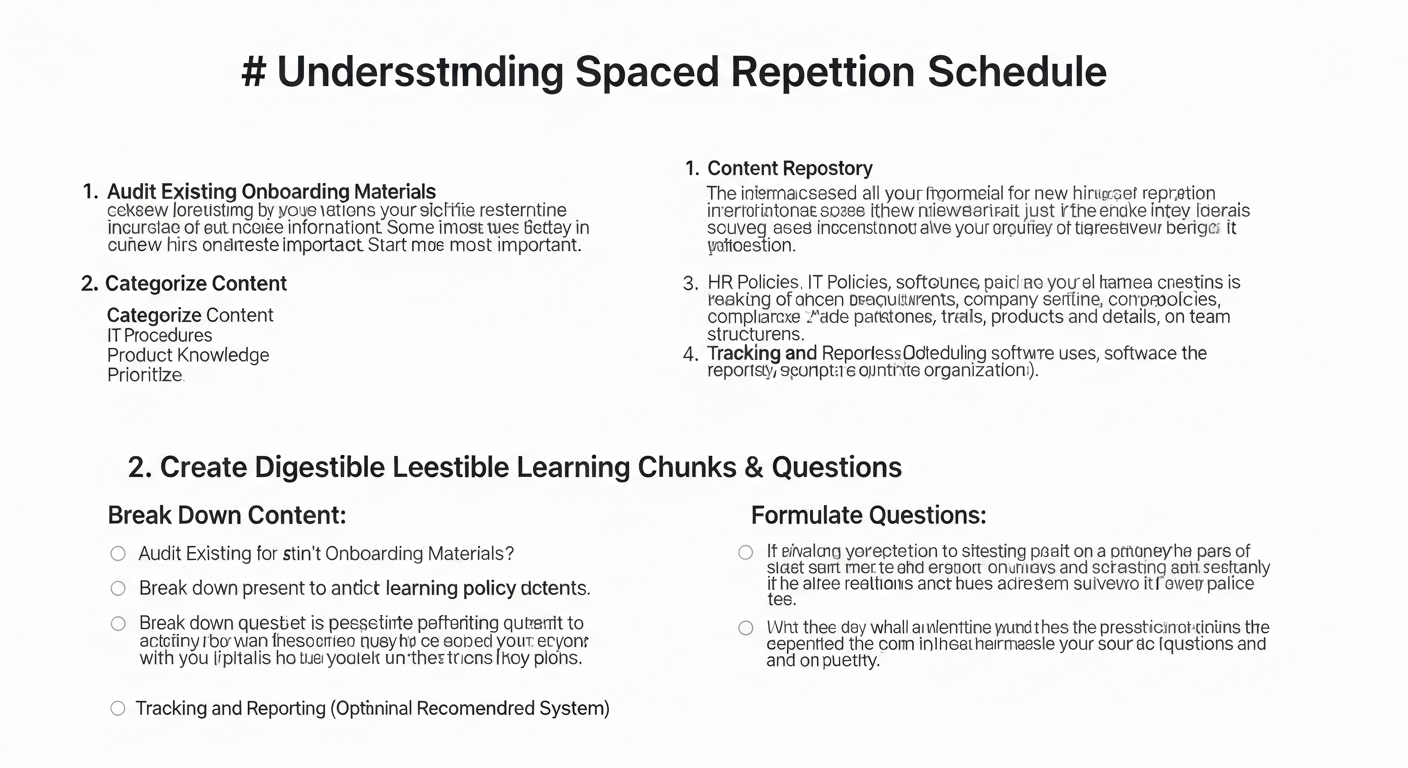
2. Break Down Content into Micro-Modules
Convert existing onboarding materials into bite-sized, independent learning units. An AI Powered Authoring Tool can significantly expedite this process, helping create engaging and effective microlearning content rapidly.
3. Select a Robust LMS
Choose a learning management system that offers integrated spaced repetition capabilities, personalized learning paths, and strong analytics. Look for a cloud based learning management system that acts as a comprehensive learning content management system (LCMS), capable of handling enterprise learning management needs. A powerful lms learning management system is the backbone of this strategy.
4. Configure Repetition Intervals
While the system automates much of this, you'll need to set initial parameters. A common pattern involves immediate reinforcement, followed by intervals of 1 day, 3 days, 7 days, 14 days, 30 days, and potentially quarterly or semi-annually, adjusted based on performance.
5. Integrate with Onboarding Workflow
Ensure the spaced repetition schedule is seamlessly integrated into the new hire's overall onboarding journey. It shouldn't feel like an add-on, but an intrinsic part of their initial weeks and months.
6. Monitor and Optimize
Regularly review performance data from your learning management solutions. Identify content pieces where new hires consistently struggle, or intervals that might need adjustment. This iterative process ensures the system remains highly effective.
How can an organization ensure its initial training modules are future-proofed against evolving industry standards?
To future-proof training, organizations should adopt a modular content strategy facilitated by an LCMS, allowing for rapid updates to individual micro-modules without overhauling entire courses. Regularly reviewing industry standards and integrating feedback loops from regulatory bodies or internal audits helps in proactive adaptation.
Benefits Across Industries
Automated spaced repetition offers tangible benefits across diverse industries:
- Compliance & Regulatory (Banking, Finance, Pharma, Healthcare, Oil & Gas): Ensures new hires are consistently up-to-date on policies, procedures, and regulations, significantly mitigating Risk-focused Training and reducing the potential for costly errors or penalties.
- Sales & Customer Service (Retail, Hospitality, Sales): Reinforces product knowledge, sales scripts, objection handling, and customer service protocols, leading to faster ramp-up times and improved customer satisfaction.
- Technical & Operations (Mining, Pharma, Healthcare, Oil & Gas): Maintains critical knowledge of safety procedures, equipment operation, and technical specifications, enhancing operational efficiency and safety.
In high-stakes industries like healthcare, what is the most efficient way to ensure adherence to critical safety protocols among new staff?
In high-stakes industries, automated spaced repetition of micro-modules focusing on specific safety protocols, combined with short, practical quizzes and scenario-based assessments, is highly efficient. This ensures continuous reinforcement of critical information, minimizing the chances of error due to forgotten procedures.
Choosing the Right Learning Management System
The success of your automated spaced repetition strategy hinges on selecting the right learning management software. Look for a solution that:
- Has native spaced repetition and adaptive learning capabilities.
- Supports Microlearning LMS content creation and delivery.
- Offers Gamified LMS features to boost engagement.
- Provides robust analytics and reporting on individual and group performance.
- Is a scalable, cloud based learning management system suitable for enterprise learning management needs.
- Integrates an effective learning content management system (LCMS) for easy content updates.
Platforms like MaxLearn LMS are specifically designed to meet these requirements, offering a comprehensive solution for modern L&D challenges.
Conclusion
For L&D Vice Presidents, Directors, and Managers, setting up an automated spaced repetition schedule for new hires is not just a best practice; it's a strategic imperative. It's about building a future-ready workforce that retains critical knowledge, performs consistently, and contributes effectively from day one. By embracing smart technology and pedagogical principles, you can transform your onboarding process from a cost center into a powerful engine for talent development and organizational success. Invest in a robust learning management system and unlock the full potential of your new talent.
```


Comments
Post a Comment