Can You Use the DDE Framework to Build Better Compliance Microlearning?
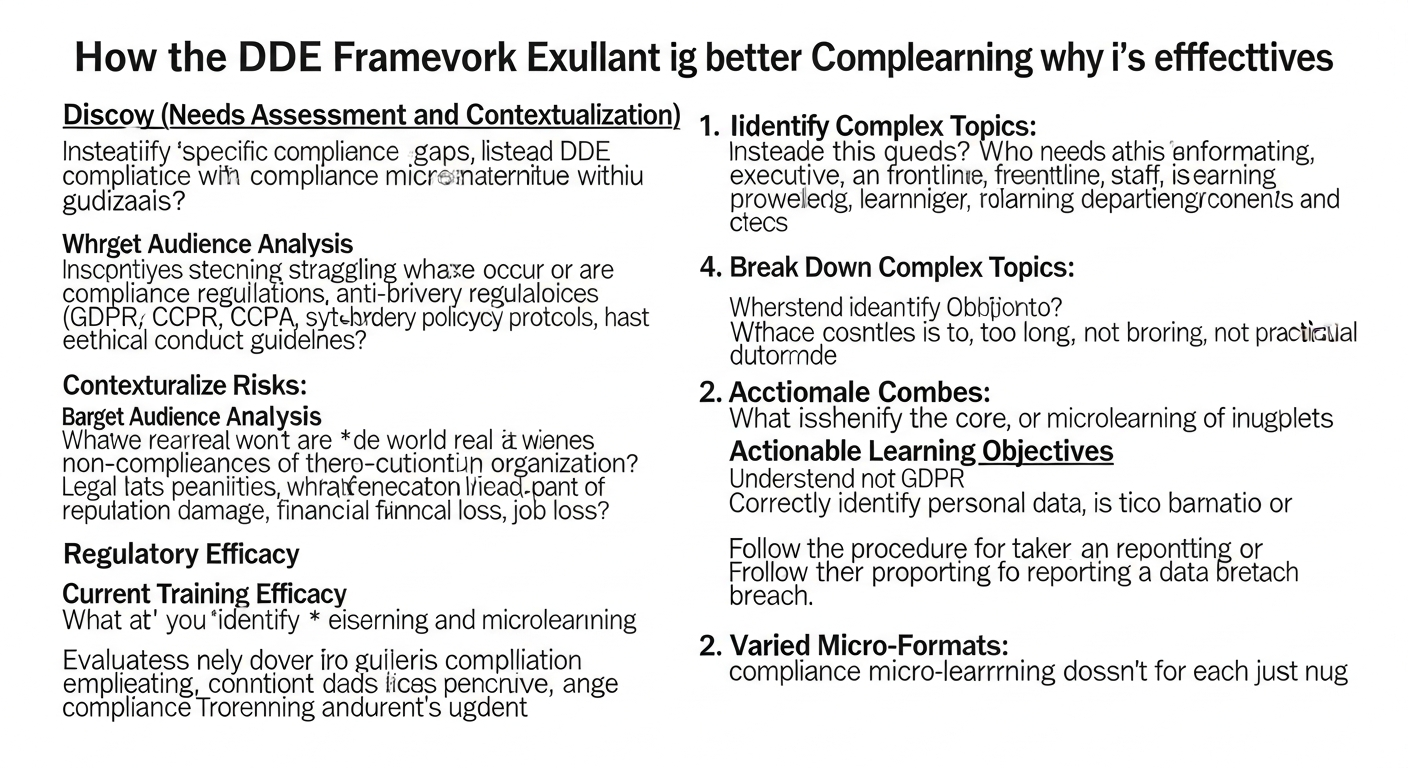
Leveraging the DDE Framework for Superior Compliance Microlearning
In today’s rapidly evolving regulatory landscape, ensuring organizational compliance isn't just a box-ticking exercise; it’s a strategic imperative. For Vice Presidents, Directors, and Managers in Learning & Development, the challenge lies in delivering effective, engaging, and impactful compliance training that truly resonates with a diverse workforce across industries like banking, finance, insurance, retail, pharma, healthcare, and beyond. Traditional, lengthy compliance courses often fall short, leading to disengagement and knowledge retention issues. This is where the powerful combination of compliance Microlearning LMS and the Discover, Design, Evaluate (DDE) framework offers a transformative solution.
The DDE framework, a structured approach to learning development, provides a robust blueprint for creating highly targeted and effective educational experiences. When applied to compliance microlearning, it empowers L&D leaders to move beyond generic content, developing succinct, relevant, and impactful modules that address specific risks and knowledge gaps, ultimately fostering a culture of adherence and accountability.
Understanding the DDE Framework
What is DDE?
DDE stands for Discover, Design, and Evaluate. It's an iterative and learner-centric model that emphasizes a continuous improvement cycle:
- Discover: Thoroughly understand the learning needs, objectives, target audience, and existing knowledge gaps.
- Design: Develop learning solutions that are tailored to the discovered needs, focusing on engaging content, appropriate delivery methods, and clear learning outcomes.
- Evaluate: Assess the effectiveness of the learning solution, measure its impact, and gather feedback for continuous refinement.
Unlike more linear models, DDE encourages flexibility and ongoing adaptation, making it particularly suitable for the dynamic nature of compliance training, where regulations and best practices are constantly changing.
Why DDE for Compliance Training?
Compliance training often suffers from being perceived as tedious or irrelevant. The DDE framework, however, forces a strategic approach that can revitalize it:
- Relevance: By starting with "Discover," L&D teams can pinpoint the exact compliance knowledge gaps and *risk-focused training* areas that demand attention.
- Engagement: The "Design" phase encourages creativity and the use of modern eLearning techniques like gamification and adaptive paths, ensuring modules are captivating.
- Effectiveness: The "Evaluate" phase provides critical data to prove the ROI of training, demonstrating its impact on behavior change and regulatory adherence.
Applying DDE to Compliance Microlearning
Discover: Unearthing Compliance Needs
The first step is arguably the most crucial. Instead of assuming what your workforce needs, a deep dive into organizational data, incidents, and employee feedback is essential. This involves:
- Performance Data Analysis: Reviewing audit reports, incident logs, violation records, and customer complaints to identify recurring compliance breaches or areas of high risk.
- Stakeholder Interviews: Engaging with legal, HR, operations, and leadership to understand specific regulatory requirements, internal policies, and business challenges.
- Learner Surveys & Assessments: Directly asking employees about their perceived knowledge gaps or conducting pre-assessments to gauge baseline understanding of critical compliance topics.
- Regulatory Scans: Staying abreast of new laws, amendments, and industry best practices to proactively address upcoming training needs.
The outcome of this "Discover" phase should be a clear, prioritized list of microlearning topics, each addressing a specific compliance behavior or knowledge deficiency, focusing on Risk-focused Training to mitigate potential organizational vulnerabilities.
Design: Crafting Engaging Micro-Modules
With a clear understanding of needs, the "Design" phase focuses on creating compelling content. For compliance microlearning, this means brevity, clarity, and interactivity are paramount:
- Bite-Sized Content: Each module should focus on a single learning objective, taking no more than 5-10 minutes to complete. Examples include a 2-minute video on conflict of interest, a 3-minute interactive scenario on data privacy, or a 5-minute quiz on anti-money laundering.
- Diverse Formats: Move beyond text-heavy slides. Utilize short videos, animated explainers, interactive quizzes, drag-and-drop exercises, decision-making scenarios, and infographics to keep learners engaged. Consider leveraging a Gamified LMS to introduce points, badges, and leaderboards, making compliance learning more enjoyable.
- Real-World Relevance: Use scenarios and examples directly applicable to the learner’s job role and industry. This makes the content immediately valuable and memorable. An Adaptive Learning approach can further personalize content based on individual performance and job function.
- Accessibility: Ensure modules are accessible on various devices (desktop, tablet, mobile) and cater to diverse learning styles.
- Leverage AI: Utilize an AI Powered Authoring Tool to quickly generate initial content drafts, summarize complex regulations, or suggest interactive elements, accelerating the design process and ensuring high-quality, relevant output.
Evaluate: Measuring Impact and Iterating
The final, but continuous, phase involves assessing the effectiveness of the microlearning modules and using insights to refine them. This goes beyond simple completion rates:
- Knowledge Checks & Assessments: Measure understanding immediately after modules and periodically thereafter to gauge retention.
- Behavioral Change Monitoring: Observe and measure actual changes in employee behavior related to the compliance topics. This might involve incident rate reduction, improved audit scores, or feedback from managers.
- Learner Feedback: Collect qualitative feedback through surveys or focus groups to understand learner perceptions, engagement levels, and suggestions for improvement.
- Business Impact: Ultimately, link compliance training to business outcomes. Are regulatory fines reduced? Is employee misconduct decreasing? Is the organization's reputation strengthened?
The data gathered during evaluation feeds directly back into the "Discover" phase, initiating a new cycle of improvement. This ensures that compliance microlearning remains relevant, effective, and continuously optimized.
The Synergy: DDE and Microlearning Benefits for L&D
The combination of DDE and microlearning offers compelling advantages for L&D leaders striving to elevate their compliance programs:
- Improved Engagement & Retention: Short, relevant modules keep learners focused, and the iterative DDE process ensures content stays fresh and engaging.
- Agility & Responsiveness: Microlearning allows for rapid updates and deployment of new content in response to regulatory changes, while DDE provides the framework to quickly identify and design these updates.
- Measurable Impact: The "Evaluate" phase provides concrete data on knowledge acquisition and behavioral change, demonstrating clear ROI to stakeholders.
- Reduced Training Fatigue: Eliminates the dread associated with long, monotonous compliance courses, leading to higher completion rates and a more positive learning culture.
- Cost-Effectiveness: While initial setup for a robust Microlearning LMS and DDE implementation requires investment, the long-term benefits of reduced non-compliance incidents, lower training hours, and increased efficiency can be substantial.
AI-Driven Insights for Compliance Learning
As L&D leaders look to the future, artificial intelligence presents unprecedented opportunities to enhance the DDE framework for compliance microlearning.
How can intelligent algorithms help pinpoint specific compliance knowledge gaps across a global workforce?
Advanced AI can analyze vast datasets, including learner performance across various modules, common queries directed to help desks, and even internal audit findings. By identifying patterns and anomalies, it can highlight precise areas where individuals or teams within specific organizational units or geographical regions consistently struggle. This level of granular insight allows L&D to prioritize the creation of highly targeted microlearning content, ensuring resources are allocated effectively to address critical weaknesses.
What role can advanced computational tools play in personalizing compliance modules for diverse roles and locations?
Smart learning platforms, often integrated into a sophisticated learning management system, can leverage AI to dynamically tailor content delivery. Based on a learner's specific role, past performance, preferred language, and regulatory requirements pertinent to their location, AI can present customized microlearning paths. This ensures that a sales professional in one country receives compliance training focused on their local regulations and relevant ethical scenarios, while a finance expert in another region gets content tailored to financial fraud prevention applicable to their context. This adaptive approach significantly enhances relevance and engagement.
How do smart analytics contribute to understanding the true impact of compliance microlearning initiatives?
AI-powered analytics go beyond basic completion rates. They can track intricate learner interactions, analyze assessment results for deeper insights into conceptual understanding versus rote memorization, and even correlate learning data with real-world outcomes such as a decrease in policy violations or an improvement in audit scores. By providing sophisticated dashboards and predictive modeling, AI helps L&D leaders understand not just who completed what, but whether the training effectively changed behavior and improved overall organizational compliance posture, enabling continuous optimization of learning strategies.
Overcoming Challenges
While the benefits are clear, implementing DDE with microlearning for compliance does come with considerations. Initial investment in a suitable LMS and content development tools, along with the cultural shift from lengthy courses to bite-sized learning, are common hurdles. However, the long-term gains in employee engagement, compliance effectiveness, and risk mitigation far outweigh these initial challenges. A phased approach, starting with high-risk compliance areas, can help manage the transition effectively.
The DDE framework offers a strategic, iterative, and highly effective approach to building better compliance microlearning. By meticulously discovering needs, creatively designing engaging content, and rigorously evaluating impact, L&D leaders can transform compliance training from a dreaded chore into a powerful tool for organizational resilience and ethical conduct. Embrace DDE, and unlock the full potential of your compliance learning initiatives.


Comments
Post a Comment