4 Ways Personalization Speeds Up Corporate Technical Training
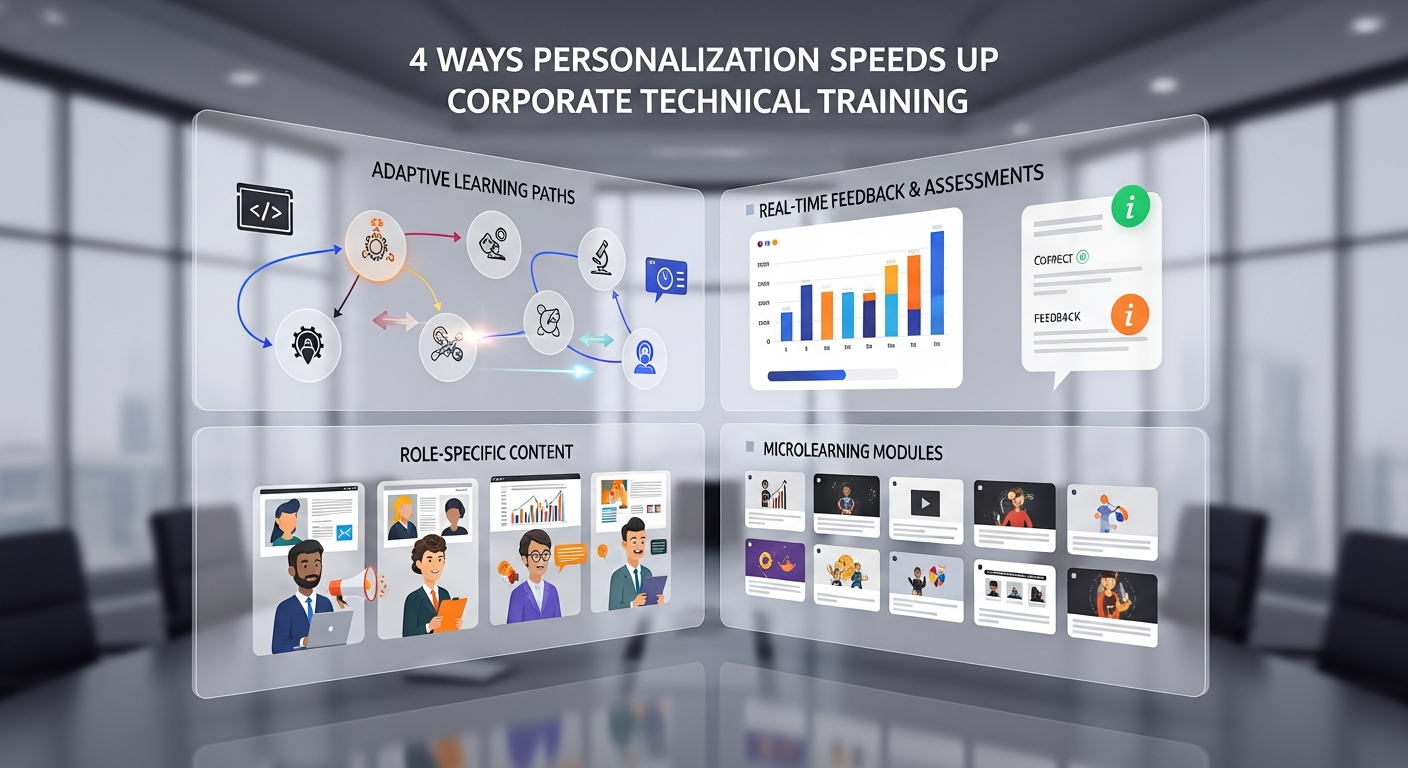
4 Ways Personalization Speeds Up Corporate Technical Training
In today's fast-paced corporate world, effective technical training isn't just a compliance checkbox; it's a strategic imperative. For L&D Vice Presidents, Directors, and Managers across industries like banking, healthcare, retail, and manufacturing, the challenge is clear: how to equip employees with critical technical skills rapidly and efficiently. Traditional, one-size-fits-all training models often fall short, leading to disengagement, wasted time on irrelevant content, and slow skill acquisition. The solution lies in personalization – a powerful approach that tailors the learning experience to individual needs, drastically accelerating the path to proficiency.
Imagine a scenario where your sales team in the pharmaceutical sector can quickly grasp complex product knowledge, or your finance professionals can swiftly master new compliance regulations. This isn't a pipe dream; it's the reality when personalization is at the core of your corporate technical training. By focusing on the learner, not just the content, organizations can significantly speed up skill development, enhance knowledge retention, and ultimately drive business growth. Let's explore four pivotal ways personalization transforms the speed and impact of technical training.
1. Tailored Learning Paths Reduce Irrelevant Content
One of the biggest time sinks in corporate training is forcing learners through material they already know or don't need for their specific role. This "spray and pray" approach not only wastes valuable employee time but also fosters disengagement. Personalization addresses this head-on by creating dynamic, tailored learning paths.
Eliminating Redundancy for Faster Progress
A sophisticated Microlearning LMS leverages initial assessments, job role analysis, and even past performance data to identify specific knowledge gaps. Instead of a generic 40-hour course, a personalized path might present only the 10 hours of content truly relevant to an individual's development needs. This targeted approach ensures every moment spent in training is productive, allowing employees to achieve competency much faster. For a large enterprise, this efficiency translates into significant cost savings and faster time-to-competency across the board.
How an advanced system can pinpoint individual skill gaps and prescribe relevant modules efficiently?
Modern LMS platforms leverage machine learning algorithms to analyze a learner's pre-assessment results, past performance, job role, and even interaction patterns within the system. This allows the Adaptive Learning engine to dynamically create a personalized learning path, ensuring that only the most critical content is presented. This significantly reduces time spent on redundant information, directly accelerating the path to proficiency, whether for new hires in banking or upskilling technicians in oil and gas. A robust learning management system, particularly a cloud based learning management system, is essential for this level of customization and scalability.
2. Just-in-Time & Microlearning for Immediate Application
Technical skills often require immediate application. Waiting for a scheduled full-day workshop or sifting through lengthy manuals is inefficient and detrimental to productivity. Personalized training, especially through microlearning, enables just-in-time access to crucial information, dramatically speeding up practical application.
On-Demand Knowledge When It Matters Most
Imagine a retail associate needing to quickly understand a new POS system feature, or a healthcare professional needing to recall a specific safety protocol during an emergency. A personalized Microlearning LMS delivers bite-sized, highly targeted content precisely when and where it's needed. This could be a 3-minute video, an interactive infographic, or a quick quiz accessible via a mobile device. This immediate access to relevant knowledge eliminates delays, allowing employees to apply new skills instantly, reducing errors, and increasing operational efficiency. It’s an integral part of any modern learning management software.
For a globally distributed workforce, how can an intelligent platform ensure that just-in-time training is delivered consistently and effectively across diverse teams?
An intelligent lms learning management system can be configured to consider user roles, language preferences, regional compliance variations, and even device types to deliver highly localized and relevant microlearning modules. This means a sales team member in London receives the same quality and relevant content as a counterpart in Tokyo, tailored to their local context, but presented in a consistent, on-demand format. The power of a MaxLearn LMS lies in its ability to adapt content delivery based on a multitude of real-time factors, ensuring rapid deployment and understanding globally.
3. Engaging & Gamified Experiences Boost Retention & Speed
Dry, passive learning experiences are notorious for slow knowledge acquisition and poor retention. When technical training is personalized to be interactive, engaging, and even fun, learners process information faster and retain it longer, leading to quicker mastery.
Accelerated Comprehension Through Interaction
Personalization allows for adaptive challenges, scenario-based learning relevant to a user's specific job function (e.g., a specific risk scenario for compliance training in finance), and progress-based feedback. A Gamified LMS, for example, can introduce points, badges, leaderboards, and interactive simulations that respond to individual performance. This not only makes learning enjoyable but also provides immediate feedback, allowing learners to correct misunderstandings on the fly. This active engagement accelerates the comprehension process and solidifies learning, moving employees from novice to proficient at an accelerated pace within your enterprise learning management strategy.
Beyond simple scores, what deeper insights can an intelligent system provide into learner engagement and motivation, helping to accelerate proficiency across various roles?
An advanced learning content management system (LCMS) goes beyond basic completion rates. It tracks intricate user interactions, time spent on specific content, common errors, repeated attempts, and even emotional responses to certain modules (e.g., through sentiment analysis if available). These granular insights allow L&D teams to understand not just what learners know, but how they learn best and what motivates them. This enables continuous refinement of personalized, engaging content, ensuring faster and more effective skill transfer across diverse technical roles, from pharma to hospitality.
4. Data-Driven Insights for Continuous Optimization
Personalization isn't just about initial delivery; it's a continuous feedback loop. Modern learning platforms collect vast amounts of data on learner behavior, performance, and preferences. Analyzing this data allows L&D teams to continually refine and optimize training programs, ensuring maximum speed and effectiveness.
Refining Training for Peak Performance
With a personalized approach, you gain insights into exactly which modules are most effective, where learners typically struggle, and how different content types impact learning speed. This data empowers L&D leaders to make informed decisions – whether it's updating outdated content with an AI Powered Authoring Tool, redesigning challenging sections, or allocating resources to specific training needs. This iterative optimization process ensures that technical training programs are always evolving to be faster, more relevant, and more impactful, directly supporting Risk-focused Training objectives.
What kind of predictive analytics can an intelligent learning platform offer to proactively identify potential training failures or emerging skill requirements, allowing L&D teams to optimize resources before issues arise?
A sophisticated learning management solutions system, like MaxLearn LMS, can use historical data and current performance trends to predict which learners might be at risk of falling behind, or which technical areas might become critical in the near future. For instance, in the mining industry, it could forecast the need for specific safety training based on equipment upgrade schedules, or in insurance, predict skill gaps related to upcoming regulatory changes. This foresight allows L&D to proactively develop and deploy targeted interventions and training modules, optimizing resource allocation and preventing skill deficiencies before they impact operations.
Conclusion
For L&D leaders striving to keep pace with rapid technological advancements and evolving skill requirements, personalization is not a luxury – it's a necessity. By embracing tailored learning paths, just-in-time microlearning, engaging experiences, and data-driven optimization, organizations can dramatically accelerate corporate technical training. This leads to a more skilled, adaptable, and productive workforce, ready to tackle the challenges of today and tomorrow across any industry. Invest in personalized learning, and watch your teams reach proficiency faster than ever before, turning training into a true competitive advantage.


Comments
Post a Comment