How to Transition from Annual Mandatory Training to Continuous Compliance
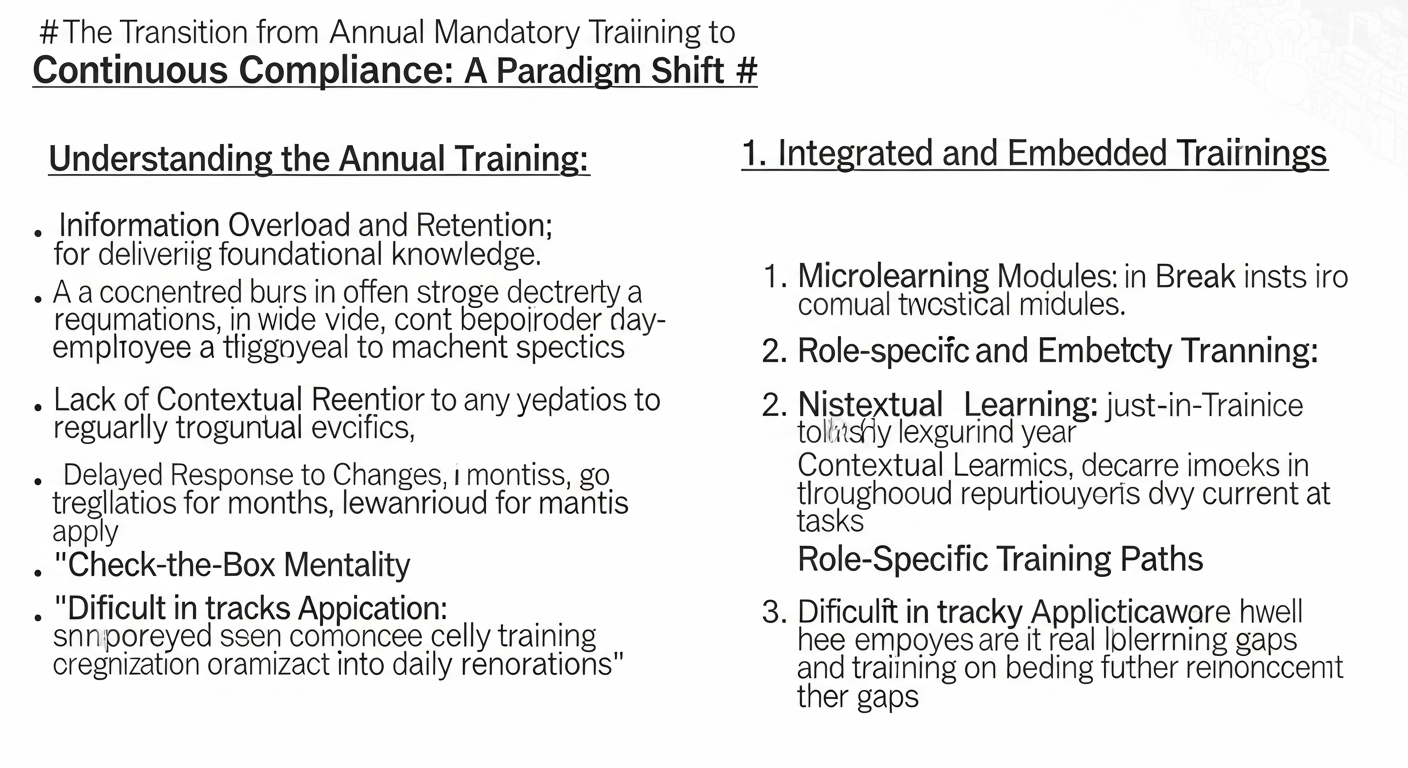
From Annual Drills to Agile Discipline: The Continuous Compliance Revolution for L&D Leaders
For decades, mandatory annual compliance training has been a familiar, if often dreaded, fixture in organizations across every industry. From finance and healthcare to retail and oil & gas, the ritual of an all-day session or a lengthy online module was considered the gold standard. Yet, as the pace of business accelerates and regulatory landscapes shift with dizzying speed, L&D leaders at the VP, Director, and Senior Manager levels are increasingly questioning its efficacy. The traditional model, characterized by information overload, low retention, and a reactive approach to risk, is simply no longer sufficient. It's time to transition from a static, event-based model to one of dynamic, continuous compliance.
The imperative is clear: to cultivate a culture where compliance is an ongoing conversation, deeply embedded in daily operations, rather than a yearly chore. This article will explore the limitations of the old paradigm and lay out a strategic roadmap for adopting a continuous compliance framework, powered by cutting-edge Microlearning LMS and intelligent technologies.
The Cracks in the Annual Training Foundation
The traditional "set it and forget it" approach to compliance training suffers from several inherent flaws:
-
Information Overload & Poor Retention: Dumping a year's worth of critical information in a single sitting often leads to cognitive overload. Employees forget key details long before they need to apply them, rendering the training largely ineffective.
-
Lack of Contextual Relevance: Generic, broad-stroke training rarely addresses the specific compliance challenges faced by individuals in their day-to-day roles. A sales professional needs different insights than someone in HR or finance.
-
Reactive, Not Proactive: Annual training is inherently reactive, designed to meet regulatory requirements rather than proactively mitigate emerging risks or adapt to real-time changes.
-
Engagement Deficit: The repetitive, often dry nature of annual modules leads to disengagement, with employees rushing through the content rather than internalizing it.
-
Administrative Burden: Tracking, scheduling, and ensuring completion for vast workforces consumes significant L&D resources annually.
The Case for Continuous Compliance
Continuous compliance shifts the focus from sporadic learning events to an ongoing process of knowledge reinforcement, skill development, and behavioral shaping. It's about embedding compliance into the organizational DNA, making it a natural extension of work, not a disruption.
Key Pillars of Continuous Compliance
-
Agility & Responsiveness: The ability to rapidly update training in response to new regulations, emerging threats, or internal policy changes.
-
Personalization: Delivering targeted, role-specific content that resonates with individual employees, enhancing relevance and engagement.
-
Engagement & Retention: Utilizing modern learning methodologies and technologies to make compliance learning engaging, memorable, and impactful.
-
Proactive Risk Mitigation: Moving beyond just meeting minimum requirements to actively anticipating and preventing compliance breaches.
Leveraging Technology for a Seamless Transition
The transition to continuous compliance is not merely a philosophical shift; it requires robust technological infrastructure. This is where an advanced LMS becomes indispensable.
The Role of an Advanced Learning Management System
An effective learning management system is the backbone of continuous compliance. It orchestrates content delivery, tracks progress, and provides invaluable insights. A modern learning management system, particularly a cloud based learning management system, offers the flexibility and scalability needed for enterprise-wide implementation.
-
Microlearning Delivery: A Microlearning LMS excels at delivering bite-sized, focused training modules that are easily digestible and can be accessed on demand. This fits seamlessly into an employee's workflow, making learning a continuous process rather than a scheduled event.
-
Personalized Learning Paths: Advanced Adaptive Learning capabilities within an enterprise learning management solution can tailor learning paths based on an individual's role, performance, and compliance history. This ensures that a sales representative receives targeted training on ethical sales practices, while a banking professional focuses on anti-money laundering regulations.
-
Gamification and Engagement: A Gamified LMS can transform dull compliance topics into engaging experiences. Leaderboards, badges, points, and interactive scenarios boost motivation and completion rates, making compliance learning enjoyable.
-
Robust Analytics: A comprehensive learning management software provides detailed analytics on completion rates, knowledge retention, and areas of weakness, allowing L&D to pinpoint risks and optimize content. This data-driven approach is crucial for any LCMS.
-
Content Management: A good learning content management system or lms learning management system streamlines the creation, updating, and distribution of compliance materials, ensuring employees always have access to the latest information.
Leading platforms like MaxLearn LMS offer robust learning management solutions designed to facilitate this exact transition.
AI's Transformative Power in Compliance
Artificial intelligence is a game-changer for continuous compliance, moving beyond simple automation to intelligent optimization.
-
How can advanced algorithms ensure that compliance training is highly relevant to each employee's specific role, past performance, and even geographical location?
Intelligent algorithms analyze an employee's job function, historical training data, performance metrics, and even local regulatory requirements to recommend or deliver hyper-personalized training modules. This dynamic targeting minimizes time spent on irrelevant content and maximizes the impact of each learning interaction. -
Can intelligent systems help L&D teams keep pace with rapidly evolving regulations and internal policies?
Absolutely. Machine learning models can be trained to monitor regulatory bodies, legal publications, and internal documentation for updates. Upon detecting changes, these systems can instantly flag relevant training modules for review, suggest modifications, or even leverage an AI Powered Authoring Tool to generate new microlearning content, ensuring training is always current. -
Is there a way for sophisticated analytics to proactively identify potential compliance gaps or areas of heightened risk before they manifest as actual issues?
Yes. By analyzing vast datasets – including incident reports, audit findings, employee quiz results, and even sentiment analysis from internal communications – AI can predict patterns and identify cohorts or departments at higher risk of non-compliance. This foresight enables L&D to deploy targeted, Risk-focused Training interventions precisely where they are needed most, preventing costly breaches.
Implementing the Shift: A Strategic Roadmap
Transitioning to continuous compliance requires a methodical approach:
Step-by-Step Transition
-
Audit Current State: Assess existing compliance training, identifying gaps, inefficiencies, and areas of high risk. Understand regulatory requirements and organizational vulnerabilities.
-
Define Core Principles: Establish what continuous compliance means for your organization, including key performance indicators (KPIs) for success.
-
Technology Selection: Invest in a robust LMS and explore AI capabilities. Prioritize features like Adaptive Learning, Gamified LMS functionalities, and Microlearning LMS delivery.
-
Content Transformation: Break down lengthy annual modules into smaller, digestible microlearning units. Focus on scenario-based learning and real-world application. Utilize an AI Powered Authoring Tool to expedite this process.
-
Pilot Program: Roll out continuous compliance in a specific department or high-risk area. Gather feedback and iterate before a broader launch.
-
Integrate into Workflow: Make compliance learning easily accessible at the point of need. This might involve embedding short modules within relevant business applications or offering quick refreshers before critical tasks.
-
Continuous Monitoring & Optimization: Regularly analyze data from your learning management system to identify areas for improvement. Use insights to refine content, personalize learning paths, and address emerging risks with Risk-focused Training.
Overcoming Challenges
The transition won't be without hurdles. Resistance to change, initial investment costs, and the complexity of integrating new technologies are common. L&D leaders must champion the vision, articulate the long-term benefits (reduced risk, improved employee performance, enhanced culture), and secure executive buy-in. Phased implementation and clear communication are key to success.
The Future of Compliance Training
The future of compliance training is dynamic, personalized, and deeply integrated into the flow of work. It’s a future where an LMS is not just a repository but an intelligent learning partner, continuously adapting to both individual needs and the external regulatory environment. For L&D professionals, this shift represents an exciting opportunity to elevate their role from administrators of mandatory training to strategic partners in organizational resilience and success.
By embracing continuous compliance, organizations can move beyond merely checking boxes to genuinely fostering an ethical, compliant, and high-performing workforce. The time to revolutionize compliance training is now.


Comments
Post a Comment