How to Eliminate Memory Decay in Compliance Training Using Diverse Media
How to Eliminate Memory Decay in Compliance Training Using Diverse Media
For Learning & Development (L&D) leaders – VPs, Directors, and Managers – the battle against memory decay in compliance training is a persistent one. It's not enough to simply deliver information; the true challenge lies in ensuring that critical regulatory knowledge sticks, is accessible when needed, and translates into compliant behavior. The consequences of forgetting aren't just about failed quizzes; they manifest as reputational damage, hefty fines, and operational disruptions. Traditional, often monotonous, training methods have proven largely ineffective in cementing long-term retention. However, by strategically deploying a diverse range of media formats, L&D professionals can dramatically enhance engagement, improve recall, and build a truly resilient compliance culture.
The Pervasive Challenge of Forgetting in Compliance
Compliance training often suffers from being perceived as a checkbox exercise. Dense text, lengthy lectures, and generic presentations lead to information overload, disengagement, and, inevitably, memory decay. Employees might pass an initial assessment, but within weeks or months, much of that learned material fades into the background, leaving organizations vulnerable. The cost of this "forgetting curve" is substantial, impacting everything from operational efficiency to legal liabilities.
Many L&D leaders frequently ponder: "What are the most effective strategies to ensure compliance knowledge is not just temporarily absorbed, but deeply ingrained and readily recalled when situations demand it?" The answer lies in moving beyond static content and embracing a dynamic, multi-modal approach that caters to diverse learning styles and reinforces information over time.
The Power of Diverse Media: A Multi-Sensory Approach
Leveraging a variety of media types tackles memory decay by engaging multiple senses, breaking monotony, and providing varied contexts for information processing. This approach aligns with cognitive science principles that emphasize spaced repetition, active recall, and contextual learning for superior retention.
Video-Based Learning
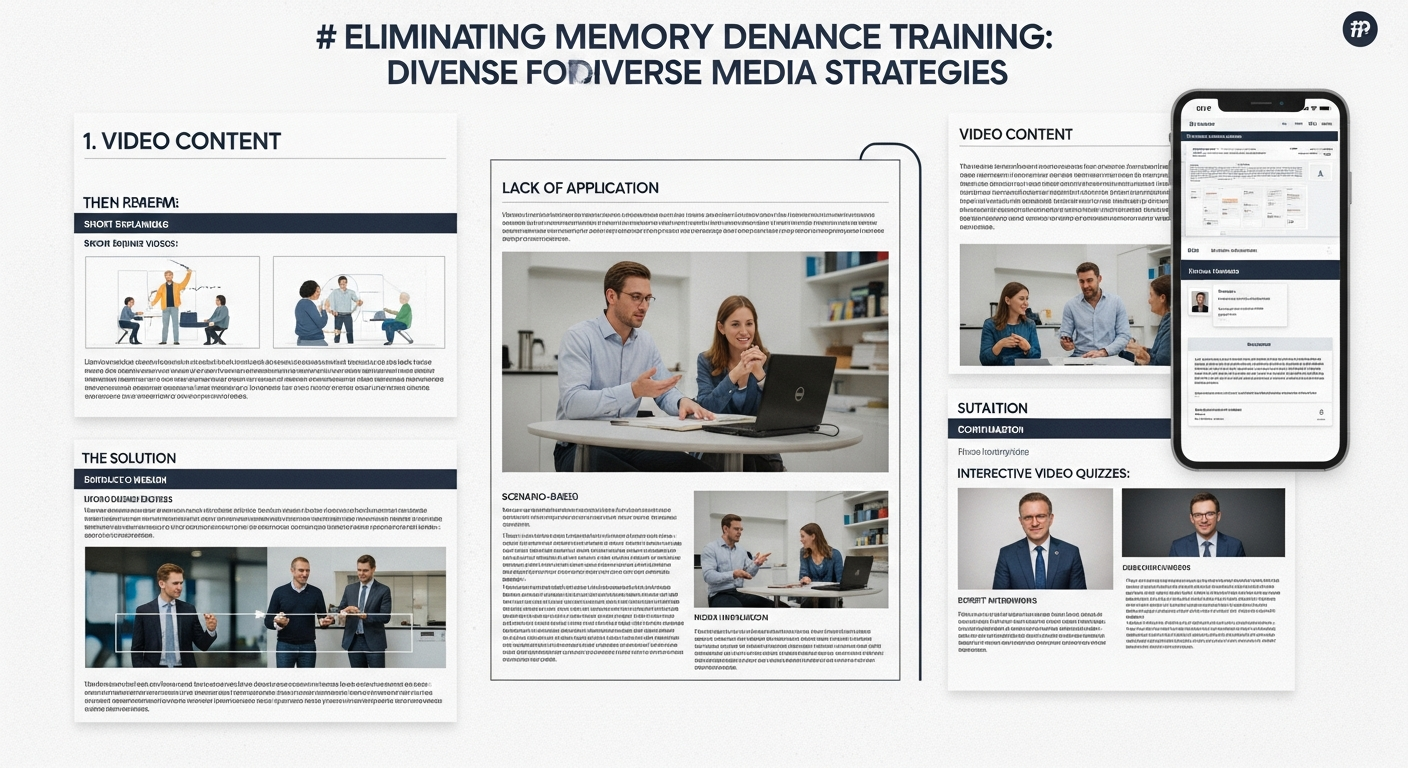
Videos transform complex compliance topics into digestible, engaging narratives. Explainer videos, animated scenarios, or expert interviews can illustrate abstract concepts and real-world implications far more effectively than text alone. They grab attention, convey emotion, and offer visual cues that aid recall. Short, focused video segments are particularly effective for conveying crucial policy updates or demonstrating correct procedures.
Interactive Simulations & Scenario-Based Training
Allowing learners to "experience" compliance challenges in a safe, simulated environment is invaluable. Interactive scenarios and simulations force learners to apply knowledge, make decisions, and see the consequences of their choices. This active engagement creates stronger memory traces and helps bridge the gap between theoretical knowledge and practical application. For instance, a simulation might put an employee in a customer interaction requiring data privacy adherence, allowing them to practice correct protocols.
Podcasts & Audio Snippets
Audio learning provides flexibility, enabling employees to reinforce knowledge on the go, during commutes, or while performing routine tasks. Short podcasts or audio summaries can revisit key compliance principles, offer expert insights, or present case studies. This format is excellent for spaced repetition and passively reinforcing information without requiring dedicated screen time.
Infographics & Visual Guides
Complex regulations can be daunting. Infographics, flowcharts, and visual guides simplify intricate information, making it easier to understand and remember. They provide a quick reference for employees, serving as invaluable job aids that reinforce learning long after a training session has ended. Visual learners particularly benefit from these clear, concise representations of data and processes.
Gamification
Turning compliance training into a game can dramatically boost engagement and motivation. Leaderboards, badges, points, and challenges introduce an element of healthy competition and make learning enjoyable. A Gamified LMS can transform dull modules into exciting quests, encouraging repeated interaction with the content and promoting active recall through quizzes and interactive puzzles. This repeated exposure, driven by intrinsic motivation, significantly combats memory decay.
Microlearning Modules
Breaking down lengthy courses into bite-sized, focused modules is a cornerstone of combating memory decay. Microlearning LMS platforms deliver short bursts of information, often just 3-5 minutes long, that are easier to consume, retain, and fit into busy schedules. These modules can utilize any of the diverse media types mentioned above, delivering a specific learning objective efficiently. Regular, short exposures, spaced over time, are far more effective for long-term retention than a single, lengthy training session.
Leveraging Technology for Seamless Integration and Impact
Implementing a diverse media strategy requires robust technological infrastructure. An advanced LMS (Learning Management System) is the backbone that enables content delivery, tracking, and management. A sophisticated learning content management system allows L&D teams to host a variety of media types, organize them into coherent learning paths, and deploy them across an organization effectively.
Many L&D leaders are asking: "How can cutting-edge technology enhance and personalize compliance training, ensuring that it's not just effective, but also scalable and impactful?" Modern learning management software, such as an enterprise learning management system, offers features that move beyond simple content delivery.
For instance, Adaptive Learning paths can dynamically adjust content based on a learner's performance and preferences, ensuring that each employee receives the most relevant and challenging material. This personalization maximizes engagement and retention by focusing on areas where an individual needs more reinforcement.
Furthermore, an AI Powered Authoring Tool can significantly streamline the creation and updating of diverse media content. These tools can help convert existing text-based policies into interactive quizzes, video scripts, or infographic outlines, dramatically reducing the time and resources required for content development. This allows L&D teams to quickly respond to new regulations and maintain up-to-date, engaging materials.
A cloud based learning management system provides the flexibility and scalability needed for global organizations, ensuring that all employees, regardless of location, have access to high-quality, diverse compliance training. A powerful learning management system, such as MaxLearn LMS, integrates these capabilities, offering a comprehensive LCMS solution that empowers L&D professionals to manage their entire learning ecosystem efficiently.
Implementing a Diverse Media Strategy for Lasting Impact
Transitioning to a diverse media strategy for compliance training requires thoughtful planning:
- Content Audit: Identify current compliance topics and assess which media types would best convey each concept.
- Modularization: Break down lengthy topics into microlearning modules.
- Mix and Match: Don't rely on just one new format. Combine videos with quizzes, simulations with infographics, and audio summaries for reinforcement.
- Spaced Repetition: Schedule regular, short refreshers using different media. A quick video reminder, an interactive scenario, or a gamified quiz can keep knowledge fresh.
- Performance Support: Provide easy-to-access job aids like visual guides or short audio clips for real-time reference.
When considering the global rollout of training, a prevalent question for L&D leaders is: "What's the most effective and efficient approach to deliver consistent, yet localized, diverse media compliance training to a geographically dispersed workforce?" The answer lies in a robust lms learning management system that supports multi-language content, offers flexible access, and tracks progress across diverse teams. By focusing on Risk-focused Training, organizations can prioritize which compliance areas require the most intensive and diverse media application, ensuring resources are allocated where they have the greatest impact on mitigating potential risks.
Conclusion
Memory decay in compliance training is a serious threat to organizational integrity and efficiency. However, it's a challenge that can be overcome by embracing a dynamic and diverse media strategy. By moving beyond traditional, passive learning and leveraging the power of videos, simulations, gamification, microlearning, and other engaging formats, L&D leaders can create training experiences that not only educate but truly embed knowledge. Supported by a powerful learning management solution, this approach transforms compliance from a burdensome obligation into an engaging, effective, and ultimately, memory-resistant learning journey, safeguarding your organization's future.


Comments
Post a Comment