Why Your Current Microlearning Strategy Fails Kinesthetic Learners (And How to Fix It)
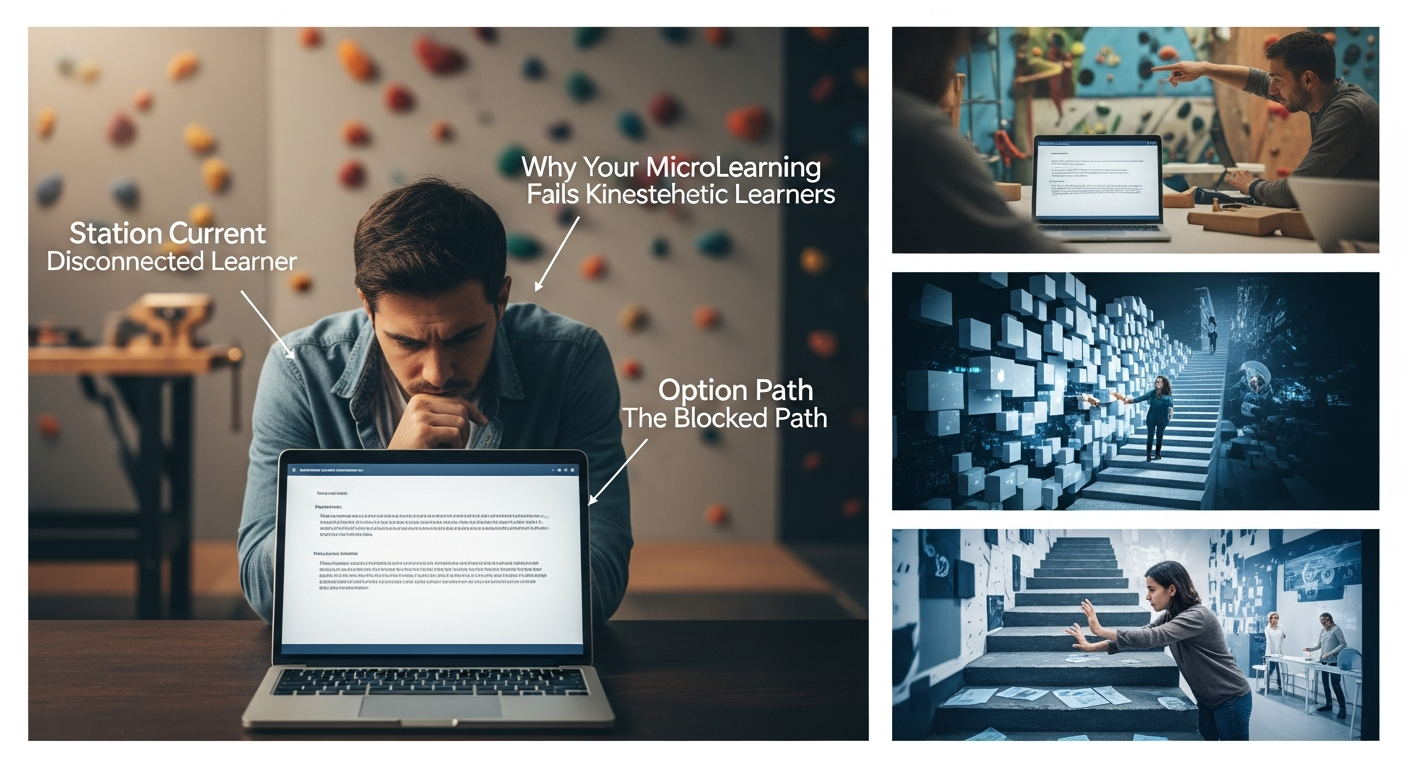
Why Your Current Microlearning Strategy Fails Kinesthetic Learners (And How to Fix It)
As leaders in Learning & Development, you understand the imperative of efficient, effective training. Microlearning, with its bite-sized, accessible content, has risen as a popular solution for rapid upskilling and continuous professional development across diverse industries, from compliance and sales to banking and healthcare. However, while often praised for its flexibility and immediate application, a critical flaw often undermines its potential: a fundamental misunderstanding, or oversight, of how kinesthetic learners truly absorb information.
For L&D VPs, Directors, Senior Managers, and Managers, recognizing and addressing this gap isn't just about inclusion; it's about optimizing your entire training ecosystem, ensuring maximum ROI, and fostering a truly skilled, adaptable workforce. This article will delve into why your current microlearning approach might be missing the mark for your 'doers' and, more importantly, how to pivot towards a strategy that empowers every learner to thrive.
Understanding the Kinesthetic Learner in a Digital Age
Kinesthetic learners, often referred to as 'tactile' or 'hands-on' learners, make up a significant portion of any workforce. They learn best by doing, experiencing, and interacting with their environment. Unlike visual learners who thrive on diagrams and videos, or auditory learners who excel with lectures and discussions, kinesthetic learners need to physically engage with the material to truly grasp and internalize it. Think of a sales professional practicing a pitch, a bank teller operating new software, or a healthcare worker simulating a procedure.
The inherent challenge with many microlearning implementations is their reliance on passive digital consumption. While short videos, infographics, and quick quizzes offer convenience, they often fall short of providing the active, experiential learning that kinesthetic individuals crave. Without a tangible connection to the content, these learners struggle to convert information into practical knowledge and skills, leading to superficial understanding and poor retention.
How can organizations boost employee engagement in financial training?
The Pitfalls: Why Current Microlearning Falls Short
Many existing microlearning strategies, while well-intentioned, inadvertently alienate kinesthetic learners through several common missteps:
- Over-reliance on Passive Content: If your micro-lessons primarily consist of short videos to watch, slides to read, or audio clips to listen to, you're catering to visual and auditory learners, leaving kinesthetic learners feeling disengaged and often frustrated. They might complete the module, but the learning won't stick.
- Lack of Interactive Simulation: True kinesthetic learning requires a sandbox environment where mistakes can be made safely. Without opportunities to try, fail, and re-try, the abstract concepts presented in micro-modules remain just that – abstract.
- Absence of Immediate Application: Kinesthetic learners need to connect theory to practice instantly. If there's a disconnect between completing a module and applying its lessons in a real or simulated work context, the value is lost. This is particularly crucial in industries like compliance and pharma, where practical application of knowledge is paramount to mitigate Risk-focused Training.
- Insufficient Experiential Feedback: Feedback is vital for all learners, but for kinesthetic learners, it needs to be tied directly to their actions. Telling them they answered a question incorrectly isn't as impactful as showing them the consequence of a wrong action within a simulated environment.
What are the top strategies for effective compliance training across different regions?
Re-engineering Microlearning for the Kinesthetic Mind
The good news is that microlearning, with its inherent flexibility, can be powerfully adapted to serve kinesthetic learners. It’s not about abandoning microlearning, but about evolving your approach. Here’s how to fix it:
1. Embrace Interactive Simulations & Role-Playing
Break down complex procedures or scenarios into micro-simulations. For a sales team, this could be a virtual role-play on handling a specific objection. For a banking professional, it might be navigating a new software interface in a sandbox. These short, focused simulations allow kinesthetic learners to actively practice and make decisions without real-world consequences, consolidating learning on the spot.
2. Integrate Gamification Deeply
Gamified LMS elements go beyond leaderboards and badges. Think about puzzle-solving scenarios, interactive quests that require learners to perform actions, or challenge-based modules where physical input (like drag-and-drop, sequencing, or clicking in a specific order) drives progress. This transforms passive consumption into active participation, tapping into the kinesthetic need for physical interaction and achievement.
3. Leverage Augmented and Virtual Reality (AR/VR) Snippets
While full-blown AR/VR experiences can be extensive, microlearning can incorporate short, focused AR/VR snippets. Imagine a healthcare learner using AR to identify specific organs on a 3D model, or a retail employee using VR to practice merchandising a new display. These immersive micro-experiences provide unparalleled hands-on engagement.
4. Design for Action-Oriented Feedback
Instead of just providing text-based feedback, design micro-modules where the feedback is a direct consequence of the learner's action. If they perform a step incorrectly, the simulation should visibly show the negative outcome, prompting them to try again. This immediate, experiential feedback is highly effective for kinesthetic understanding.
5. Promote Peer-to-Peer Practical Application
Microlearning doesn't have to be solitary. Integrate micro-challenges that encourage learners to apply a concept with a peer or in a team setting and then report back or demonstrate. For example, after a module on a new customer service protocol, pair employees to practice the script, fostering practical application and immediate discussion.
What innovative tools support practical learning for diverse workforces?
The Role of Advanced Learning Technology
Implementing these solutions at scale requires robust, modern learning technology. A sophisticated Microlearning LMS is no longer just a content repository; it's a dynamic environment that facilitates active learning.
Look for a learning management system that supports diverse content types and advanced functionalities:
- Interactive Content Authoring: An AI Powered Authoring Tool can significantly speed up the creation of interactive simulations, drag-and-drop exercises, and scenario-based learning modules, allowing your L&D teams to focus on instructional design rather than technical development.
- Personalized and Adaptive Learning Paths: For kinesthetic learners, an LMS that adapts to their performance and preferences can guide them towards more hands-on activities or provide additional practice opportunities where needed. This ensures that every learner gets the most relevant and impactful content.
- Robust Analytics: A comprehensive Microlearning LMS should offer deep insights into learner engagement with interactive elements, identifying areas where kinesthetic learners might be excelling or struggling, allowing for continuous optimization of the learning content.
- Integration Capabilities: Your chosen learning management software should seamlessly integrate with other enterprise learning management tools, including an LCMS (Learning Content Management System), ensuring a cohesive and powerful learning ecosystem.
When selecting a learning management system, consider a cloud based learning management system like MaxLearn LMS that offers the flexibility and scalability required to deliver an engaging lms learning management system experience for all learning styles.
Conclusion
The efficacy of your microlearning strategy hinges on its ability to resonate with all learning styles, especially the often-underserved kinesthetic learner. By moving beyond passive content and embracing interactive simulations, gamification, and advanced Microlearning LMS technologies, L&D leaders can transform their training programs into truly engaging, practical, and impactful experiences. This strategic shift not only boosts retention and performance but also creates a more inclusive and effective learning culture across your organization, driving real business outcomes in a competitive landscape.


Comments
Post a Comment