What is Existential Intelligence in the Context of Workplace Learning?
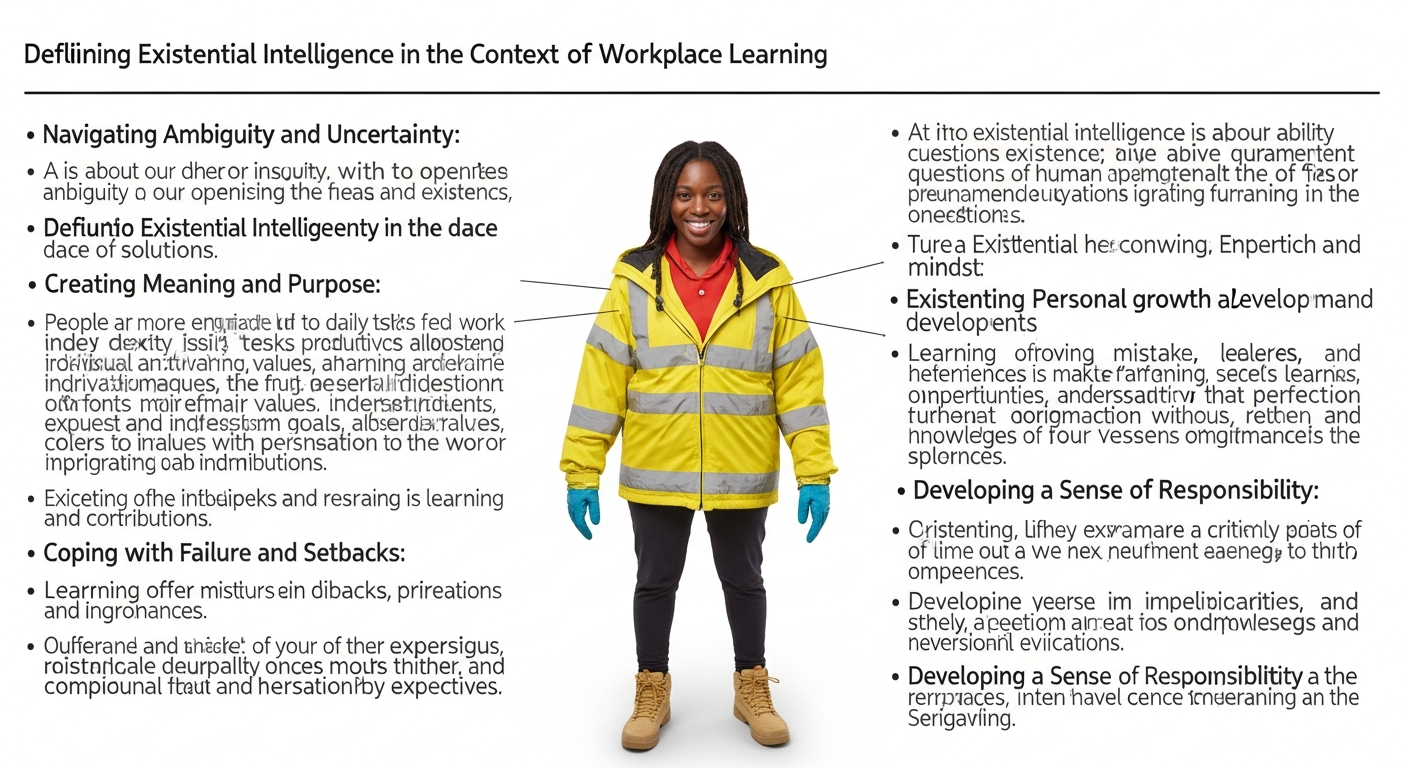
What is Existential Intelligence in the Context of Workplace Learning?
In an era defined by rapid technological advancements, global disruptions, and an evolving workforce, the traditional metrics of intelligence are proving insufficient. While cognitive abilities, emotional quotient, and practical skills remain critical, a deeper form of understanding—one that grapples with purpose, meaning, and our place in the larger scheme of things—is emerging as vital for both individual fulfillment and organizational resilience. This is Existential Intelligence, and its role in workplace learning is becoming undeniably central for L&D leaders.
For Vice Presidents, Directors, Senior Managers, and Managers of L&D across industries like Compliance, Sales, Banking, Finance, Insurance, Retail, Pharma, Health care, Hospitality, Oil and Gas, and Mining, understanding and nurturing existential intelligence can unlock unprecedented levels of employee engagement, ethical decision-making, and a profound sense of purpose. As we navigate a world increasingly shaped by algorithms and automation, fostering this uniquely human capacity is not just a soft skill; it's a strategic imperative.
Defining Existential Intelligence in a Professional Lens
Originally proposed by Howard Gardner as a potential ninth intelligence, existential intelligence refers to the capacity to ponder deep questions about life, death, meaning, and reality. It's the ability to grasp the "big picture," to connect individual actions to broader implications, and to find significance in daily tasks. In a workplace context, this translates to:
- Understanding the 'why' behind one's work beyond just a paycheck.
- Grappling with ethical dilemmas and making decisions aligned with personal and organizational values.
- Coping with uncertainty and change by finding meaning in the transition.
- Fostering a sense of belonging and contribution to something larger than oneself.
- Developing a long-term perspective on career and life goals.
When employees are existentially intelligent, they are not merely performing tasks; they are contributing to a mission, solving meaningful problems, and finding personal resonance in their professional journey. What constitutes this type of intelligence in a team environment? It’s often seen in individuals who naturally ask probing questions, seek deeper understanding of customer or stakeholder needs, and inspire colleagues by articulating a shared vision that transcends mere operational goals.
Why Does Existential Intelligence Matter in the Modern Workplace?
The relevance of existential intelligence extends far beyond philosophical contemplation. It directly impacts key organizational outcomes:
- Enhanced Engagement and Retention: Employees who understand the purpose of their work are more motivated, committed, and less likely to seek opportunities elsewhere. This is crucial in sectors like Healthcare, where burnout is prevalent, and in Retail, where frontline staff turnover can be high.
- Improved Ethical Decision-Making: In high-stakes industries like Finance, Banking, and Pharma, understanding the moral implications of actions is paramount. Existential intelligence equips employees to navigate complex ethical landscapes, ensuring compliance and maintaining trust.
- Greater Resilience and Adaptability: Change is constant. Whether it's market shifts in Sales, regulatory updates in Compliance, or technological disruptions in Oil and Gas, employees with strong existential intelligence can find meaning even amidst uncertainty, fostering resilience and embracing new learning opportunities.
- Innovation and Problem-Solving: Pondering the "big questions" can lead to groundbreaking insights. When employees connect their work to broader societal needs, they are more likely to innovate solutions that truly matter, benefiting sectors from Hospitality to Mining.
- Stronger Leadership and Team Cohesion: Leaders who articulate a compelling vision rooted in purpose inspire their teams. Existentially intelligent team members collaborate more effectively, understanding their collective contribution to a greater whole.
Cultivating Existential Intelligence Through Workplace Learning
L&D leaders are uniquely positioned to foster existential intelligence within their organizations. The key lies in designing learning experiences that go beyond mere skill acquisition to touch upon meaning and purpose.
Designing Purpose-Driven Learning Experiences
Effective learning programs must connect the 'how' to the 'why'.
- Storytelling and Contextualization: Frame learning content with real-world scenarios that highlight the impact of the work. For instance, in Compliance training, instead of just listing rules, share stories of how adherence protects individuals or the company's reputation.
- Ethical Dilemma Simulations: Incorporate simulations that challenge learners to make difficult decisions, forcing them to consider the broader ethical and human implications. This is particularly effective for Risk-focused Training in Banking or Insurance.
- Role-Playing and Empathy Building: Encourage learners to step into the shoes of customers, patients, or stakeholders. This is vital in Health care and Hospitality for developing genuine empathy and understanding the human element of service.
- Reflective Journaling and Discussion: Provide opportunities for learners to process information, reflect on its personal meaning, and discuss insights with peers. This can be integrated into a Microlearning LMS platform that encourages social learning.
The Role of Technology in Fostering Existential Growth
Modern learning management solutions can be powerful allies in this endeavor. An effective LMS or Learning content management system provides the infrastructure.
- Personalized Learning Paths: Utilize Adaptive Learning technologies to tailor content to individual needs and interests, allowing employees to explore topics that resonate with their personal quest for meaning.
- Interactive and Gamified LMS Experiences: Engage learners with scenarios that present ethical choices or challenge their understanding of purpose. A well-designed learning management software can use gamification to encourage deeper thought, not just competition.
- Access to Diverse Content: A robust enterprise learning management system or LCMS can host a wide range of content, from philosophical discussions to case studies on corporate social responsibility. A AI Powered Authoring Tool can even help L&D teams rapidly create such nuanced content.
- Data Analytics for Impact: A cloud based learning management system can track not just completion rates, but also engagement with reflective activities, providing insights into where employees are seeking deeper meaning. The MaxLearn LMS is designed to facilitate this kind of rich interaction.
Facilitating Reflection and Dialogue
Technology supports, but human interaction deepens. How can organizations encourage deeper personal inquiry among employees? This involves:
- Mentorship and Coaching: Pair employees with mentors who can guide them in exploring career paths, personal values, and the impact of their work.
- Structured Discussions and Workshops: Create safe spaces for employees to discuss complex topics, ethical dilemmas, and their personal experiences of finding meaning at work.
- Leadership by Example: Leaders who openly discuss their own journey of purpose and values create a culture where existential inquiry is valued and encouraged.
Real-World Impact Across Industries
The application of existential intelligence spans all sectors:
- Compliance: Training emphasizes not just rules, but the ultimate human and societal impact of non-compliance (e.g., patient safety in Pharma, financial stability in Banking).
- Sales: Moving beyond quotas to understand the true value proposition for customers and the positive impact on their lives, fostering authentic connections.
- Health care: Enhancing empathy, resilience, and purpose for medical professionals by connecting their daily tasks to the profound impact on human lives.
- Oil and Gas/Mining: Fostering a deep sense of responsibility for environmental stewardship and employee safety, embedding ethical considerations into operations.
- Retail/Hospitality: Elevating service from transactional to transformational by understanding the deeper needs and desires of customers and guests.
Future Outlook: Human Purpose and Learning Management Solutions
As Artificial Intelligence continues to evolve, the distinction between human and machine capabilities will sharpen. Machines excel at tasks, data processing, and optimization. Humans, however, retain the unique capacity for purpose, meaning-making, and ethical navigation. What role will advanced technologies play in nurturing human potential? A sophisticated learning management system that is an lms learning management system will not only deliver content efficiently but also facilitate these deeper human explorations. It will become a catalyst for fostering existential intelligence, enabling employees to thrive in complex environments and find profound satisfaction in their contributions.
For L&D leaders, the challenge and opportunity lie in integrating this perspective into every facet of workplace learning. By doing so, they prepare their organizations not just for the next quarter, but for a future where human purpose remains the most valuable asset.


Comments
Post a Comment