What is the Difference Between MDA and DDE Frameworks in Game Design?
Unlocking Engagement: What is the Difference Between MDA and DDE Frameworks in Game Design for L&D?
In the dynamic world of corporate learning and development, the quest for highly engaging and effective training solutions is perpetual. L&D leaders, directors, and managers across industries—from Compliance and Sales to Banking, Finance, Insurance, Retail, Pharma, Healthcare, Hospitality, Oil and Gas, and Mining—are constantly seeking innovative approaches to skill enhancement and knowledge retention. This often leads them to explore principles from game design, recognizing the inherent power of games to captivate and motivate.
Two prominent frameworks frequently discussed in game design circles, with immense applicability to learning, are the MDA (Mechanics, Dynamics, Aesthetics) framework and the DDE (Desire, Design, Experience) framework. While both aim to create compelling interactive experiences, they approach the design process from fundamentally different perspectives. Understanding these distinctions is crucial for L&D professionals looking to leverage game-based strategies, gamification, and immersive simulations effectively within their LMS.
What is the MDA Framework?
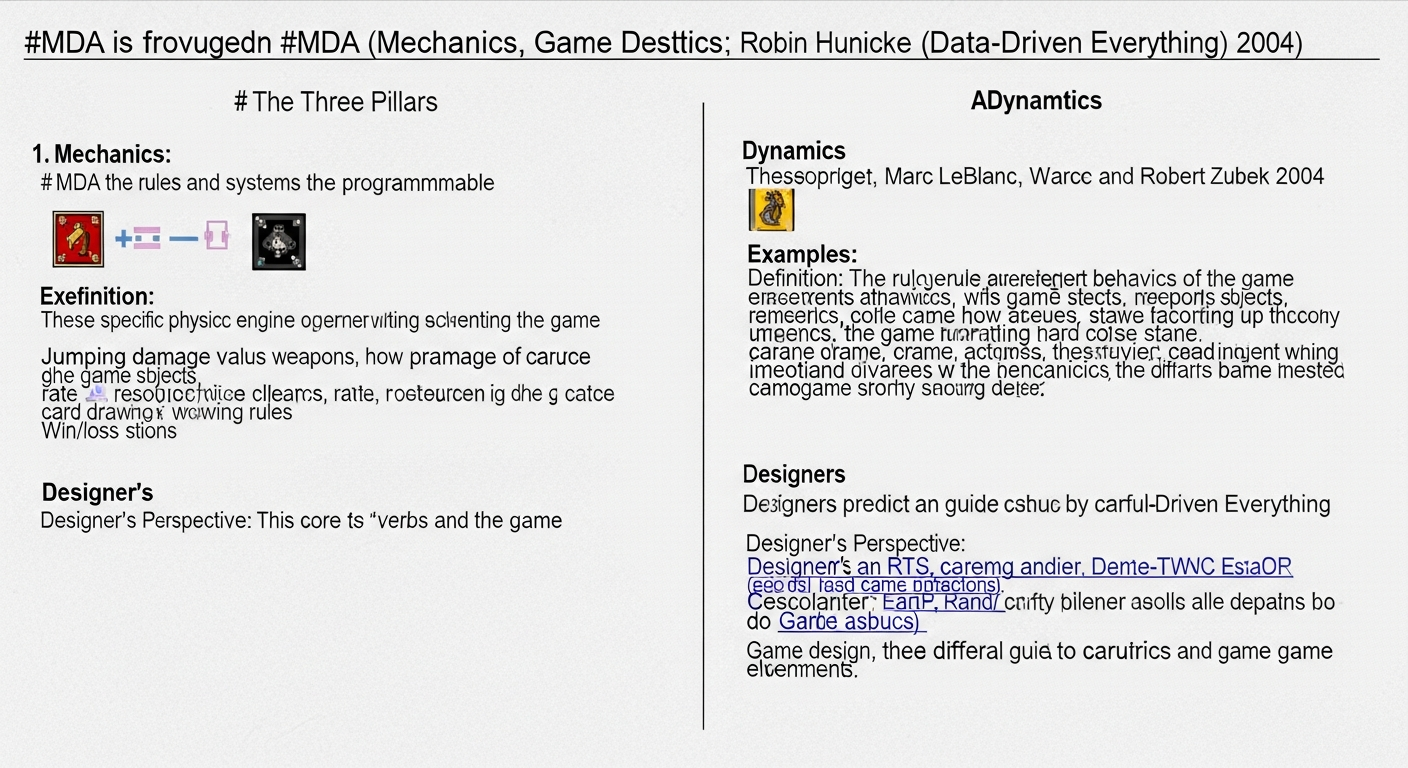
The MDA framework, short for Mechanics, Dynamics, and Aesthetics, provides a structured lens through which designers can analyze and construct games. Developed by game researchers Robin Hunicke, Marc LeBlanc, and Robert Zubek, it posits that games can be understood as a formal system from the designer's perspective and as an experiential system from the player's perspective. The framework bridges this gap, offering a top-down view from the designer to the player.
Mechanics
- Mechanics are the foundational building blocks of a game – its rules, actions, and underlying systems. These are the elements that dictate how players interact with the game world and what actions are permissible.
- Examples in game design: Scoring systems, player movement controls, resource management rules, turn structures, character abilities.
- In L&D context: These translate to the explicit rules of a learning activity, such as points awarded for correct answers, badges for completing modules, leaderboards for performance tracking, time limits for quizzes, or specific actions required within a simulation. These are the tangible features you build into a Gamified LMS.
Dynamics
- Dynamics emerge from the interaction of the mechanics with the player. They are the runtime behavior of the mechanics acting on player input and other game elements. They are not explicitly designed but rather arise from the interplay of the underlying rules.
- Examples in game design: The rise of competition on a leaderboard, collaborative strategies in a team game, the tension created by a time limit, the ebb and flow of a game's economy.
- In L&D context: Dynamics are the observable behaviors and patterns that emerge as learners engage with the training. This could be the competitive spirit among teams trying to earn more points, the collaborative problem-solving during a group exercise, or the learner's personal pacing and strategy when facing branching scenarios in an Adaptive Learning module.
Aesthetics
- Aesthetics describe the emotional responses evoked in the player when interacting with the game's dynamics and mechanics. These are the player's subjective experience and the feelings the game is designed to generate.
- Examples in game design: The feeling of challenge, fellowship, discovery, expression, fantasy, narrative, sensation, or submission (mindless repetition).
- In L&D context: Aesthetics are the desired feelings and experiences we want learners to have. This could be the satisfaction of mastering a new skill, the excitement of discovery in an exploratory module, the camaraderie in a team-based compliance training, or the sense of accomplishment after successfully navigating a complex Risk-focused Training scenario. A well-designed Microlearning LMS aims for specific aesthetic outcomes.
The MDA framework encourages designers to start with desired aesthetics, then build dynamics that produce those aesthetics, and finally implement mechanics that support those dynamics. It's a powerful tool for designing purposeful and engaging learning experiences, especially within a learning management system that supports rich interactive content.
What is the DDE Framework?
The DDE framework, standing for Desire, Design, and Experience, offers a learner-centric perspective, often starting with the desired outcomes and motivations of the user. While less formal than MDA in traditional game studies, its principles resonate strongly with instructional design and user experience (UX) thinking, making it highly applicable for L&D professionals.
Desire
- Desire refers to the learner's initial motivation, needs, goals, and expectations before engaging with the learning experience. What do they want to achieve? What problems are they trying to solve?
- In L&D context: This is about truly understanding the target audience. For a sales team, their desire might be to close more deals or earn higher commissions. For banking employees, it could be staying compliant to avoid penalties. For healthcare professionals, it’s about improving patient outcomes or mastering new procedures. Identifying this fundamental desire is the crucial starting point for effective training within any learning management software.
Design
- Design encompasses the entire instructional and content creation process aimed at fulfilling the learner's desires. This includes curriculum development, content authoring, activity structuring, feedback mechanisms, and the choice of appropriate learning technologies.
- In L&D context: This is where L&D teams craft the learning path, develop modules, create scenarios, and select tools like an AI Powered Authoring Tool or a robust LCMS. The design phase must directly address the identified desires, ensuring that every element contributes to helping the learner achieve their goals. It's about building the bridge between current state and desired future state.
Experience
- Experience is the actual journey and outcome for the learner as they interact with the designed learning solution. It encompasses their engagement level, knowledge acquisition, skill development, and ultimately, the tangible impact on their performance and behavior.
- In L&D context: This is the real-world application and effect of the training. Did learners feel engaged? Did they grasp the concepts? Can they apply new skills on the job? Did the training meet their initial desires and the organization's objectives? The experience is what determines the ROI of the training provided through your enterprise learning management system.
The DDE framework advocates starting with the learner's needs and working backward to design an experience that effectively meets those needs, ensuring the training is relevant, impactful, and leads to desired outcomes.
MDA vs. DDE: A Comparative Analysis
While both frameworks are valuable for creating engaging and effective experiences, their core philosophies and starting points differ significantly:
- Perspective: MDA is primarily designer-centric, focusing on how a designer constructs a system to evoke specific player experiences. DDE is learner-centric, prioritizing the learner's needs and desired outcomes.
- Starting Point: MDA typically starts with the creation of rules (mechanics) that lead to dynamic gameplay, ultimately aiming for certain aesthetic responses. DDE begins by understanding the learner's motivation (desire), then designs the learning path to facilitate a meaningful and effective experience.
- Focus: MDA emphasizes the systematic elements and their emergent properties. DDE focuses on human motivation, instructional effectiveness, and measurable impact.
In L&D, MDA provides a powerful toolkit for structuring the interactive components of a learning module or simulation—how points are earned, how scenarios branch, or how feedback is delivered. DDE offers a strategic guide for the entire learning journey, ensuring that the content and delivery method align with the learner's objectives and yield tangible results. An effective cloud based learning management system can support both approaches.
The Role of Advanced Analytics and Intelligent Systems in Framework Application
The application of these frameworks in modern L&D is significantly amplified by technologies like AI and advanced analytics. These tools provide unprecedented insights and capabilities:
How can advanced analytical tools inform the design process?
Intelligent systems can analyze vast amounts of learner data—engagement patterns, performance metrics, common misconceptions, and completion rates. This data offers critical insights for both MDA and DDE. For MDA, analytics can reveal which mechanics are truly driving engagement (dynamics) and what emotional responses (aesthetics) are actually being evoked. For DDE, understanding learner struggles or successes can refine the 'Design' phase, ensuring it more effectively addresses the 'Desire' and optimizes the 'Experience'. This data-driven approach allows for continuous improvement of any MaxLearn LMS implementation.
What impact do intelligent systems have on personalizing learning experiences?
Intelligent systems enable highly personalized learning paths, a cornerstone of Adaptive Learning. By tracking individual learner progress and preferences, AI can dynamically adjust the difficulty of challenges, recommend relevant content, or even alter the narrative of a simulation. This directly impacts the 'Dynamics' (MDA) by creating a tailored flow of interaction and significantly enhances the 'Experience' (DDE) by making the learning journey uniquely relevant and engaging for each individual. Such personalization is vital for maximizing the effectiveness of any lms learning management system.
Can automated content generation tools contribute to faster development within these frameworks?
Absolutely. Automated content generation tools, especially those leveraging large language models, can dramatically speed up the 'Design' phase of DDE and the creation of 'Mechanics' within MDA. An AI Powered Authoring Tool can generate scenario prompts, quiz questions, interactive dialogue options, or even initial outlines for an entire microlearning module based on specified learning objectives and desired aesthetics. This frees up instructional designers to focus on refining the strategic aspects of the learning experience, ensuring alignment with learner desires and optimal engagement.
Integrating Frameworks for Holistic Learning Design
For L&D leaders, the most powerful approach often involves integrating both MDA and DDE frameworks. Start with DDE: thoroughly understand the learner's 'Desire' and define the desired 'Experience' or outcome. What skills do they need? What problems are they trying to solve? Once these are clear, move to MDA to 'Design' the learning experience. Define the 'Aesthetics' (e.g., sense of challenge, achievement, collaboration) that will motivate and engage learners. Then, craft the 'Dynamics' that will produce these feelings, and finally, build the 'Mechanics' (rules, interactions, feedback) into your learning content management system that support those dynamics.
This integrated approach ensures that your learning solutions are not only mechanically sound and engaging but also deeply aligned with learner needs and organizational objectives. Whether you're designing compliance training for finance, sales enablement for retail, or critical skill development for healthcare, a robust MaxLearn LMS that can host diverse interactive content, simulations, and learning management solutions is essential for bringing these sophisticated designs to life.
Conclusion
The MDA and DDE frameworks offer distinct yet complementary lenses for designing truly effective and engaging learning experiences. MDA provides a powerful blueprint for building the interactive elements of training, focusing on the intricate relationship between rules, emergent gameplay, and emotional responses. DDE, on the other hand, grounds the entire process in learner motivation and desired outcomes, ensuring relevance and impact. By thoughtfully combining these frameworks, and leveraging the capabilities of modern learning management system technologies enhanced by AI and analytics, L&D professionals can move beyond conventional training to create immersive, outcome-driven learning journeys that resonate deeply with their diverse workforces, fostering continuous growth and achieving strategic business goals.


Comments
Post a Comment