What Are the Best Ways to Engage Kinesthetic Learners in Microlearning?
Unlocking Potential: Engaging Kinesthetic Learners with Microlearning
In the dynamic world of corporate learning and development, L&D leaders like you constantly seek innovative strategies to maximize training effectiveness and ROI. One of the most significant challenges is tailoring content to diverse learning styles. Among these, kinesthetic learners – those who learn best by doing, touching, and experiencing – often find traditional, passive learning methods unengaging. Coupled with the relentless pace of modern business, the need for agile, impactful training is paramount. This is where microlearning, a bite-sized, focused approach to content delivery, emerges as a powerful ally, especially when designed with the kinesthetic learner in mind.
This article explores the synergy between kinesthetic learning and microlearning, providing L&D Vice Presidents, Directors, and Managers with actionable strategies to create highly engaging, retention-boosting training programs across industries like Compliance, Sales, Banking, Finance, Insurance, Retail, Pharma, Health Care, Hospitality, Oil and Gas, and Mining.
Understanding the Kinesthetic Learner in the Workplace
Kinesthetic learners thrive on physical interaction. They process information best through movement, direct experience, and hands-on activities. In a corporate training context, this means they often struggle with long lectures, static presentations, or purely text-based modules. Their preference is for practical application, simulations, role-playing, and anything that allows them to physically interact with the subject matter.
Ignoring this learning style can lead to disengagement, poor retention, and ultimately, ineffective training. For a sales professional, this might mean struggling to internalize a new product's features without physically demonstrating it. For a healthcare worker, understanding a new protocol might be difficult without a simulated practice run. Recognizing and catering to kinesthetic preferences is not just good pedagogy; it's a strategic imperative for skill mastery and operational excellence.
The Agile Advantage: Microlearning's Role
Microlearning, characterized by short, focused learning bursts (typically 3-7 minutes), is inherently flexible and adaptable. Its conciseness makes it ideal for integrating into busy work schedules, providing just-in-time information when it’s most needed. But beyond convenience, microlearning's modular nature opens doors for highly interactive and experiential designs, perfectly aligning with the needs of kinesthetic learners.
When combined with an effective Microlearning LMS, L&D teams can deliver targeted, impactful content that resonates deeply. A robust learning management software ensures that these bite-sized experiences are not just accessible but also trackable, allowing managers to monitor engagement and comprehension.
Best Ways to Engage Kinesthetic Learners in Microlearning
1. Incorporate Interactive Simulations and Scenarios
Nothing appeals to a kinesthetic learner more than a chance to "do." Microlearning modules can feature short, interactive simulations where learners make decisions and see immediate consequences. For instance, a compliance microlearning module could simulate a data breach scenario, requiring the learner to follow the correct reporting protocol step-by-step. In retail, it might be a virtual customer service interaction that requires specific actions.
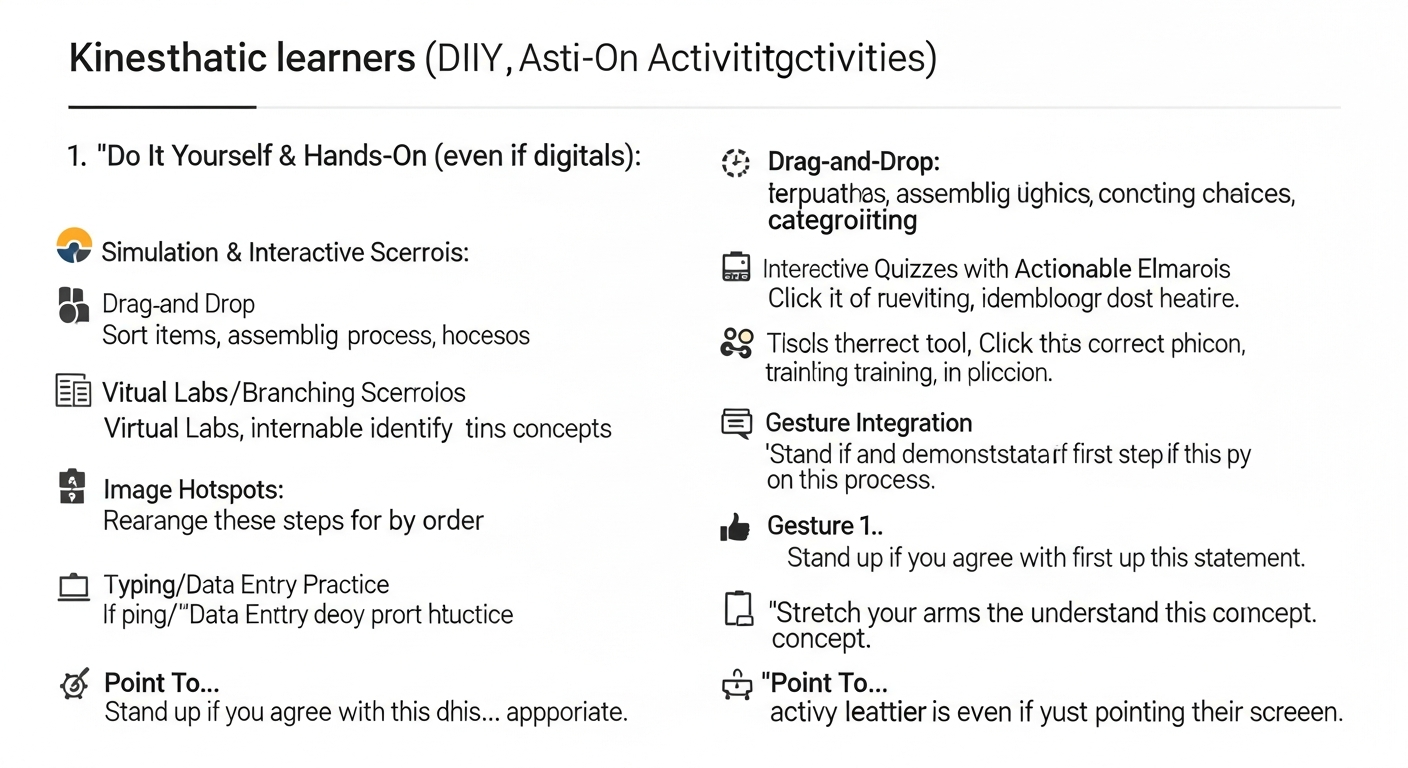
- Drag-and-Drop Exercises: Categorizing items, assembling virtual components, or matching concepts.
- Clickable Scenarios: Presenting a situation and asking the learner to click on the correct tool, button, or response.
- Virtual Walkthroughs: Navigating a new software interface or a manufacturing plant layout.
2. Leverage Gamification for Active Participation
Gamification taps into our natural desire for achievement and competition. For kinesthetic learners, the interactive nature of games provides an ideal environment for active engagement. Points, badges, leaderboards, and progress tracking transform learning into an immersive experience.
A Gamified LMS can integrate challenges, quizzes, and mini-games into microlearning paths. Imagine a banking professional earning points for correctly identifying fraudulent transactions in a series of micro-challenges, or a sales team competing to complete micro-modules on new product knowledge, with the leaderboard updated in real-time. This hands-on, playful approach solidifies learning through repeated, active participation.
3. Design Practical, Hands-On Activities (Even if Virtual)
While true physical interaction might be limited in a digital environment, microlearning can prompt learners to perform physical actions in their real-world setting. These don't have to be complex.
- "Try This Now" Prompts: After a micro-module on communication skills, prompt the learner to practice a specific active listening technique in their next meeting.
- Interactive Quizzes with Physical Elements: Instead of multiple-choice, ask learners to physically demonstrate a safety procedure (e.g., proper lifting technique) and perhaps even record a short video to upload (if feasible and private).
- "Build Your Own" Exercises: Providing virtual tools or templates in a micro-module and asking learners to construct a solution, like a project plan or a customer service script.
4. Incorporate Role-Playing and Interactive Video
Role-playing, even virtually, is a powerful tool for kinesthetic learners. Microlearning can use interactive video where learners choose dialogue options or actions, influencing the narrative. This is particularly effective for soft skills training, such as customer service in retail or sensitive patient interactions in healthcare.
Consider an Adaptive Learning system that modifies scenarios based on learner choices, providing immediate feedback and guiding them through different outcomes. This personalized, experiential approach keeps kinesthetic learners actively involved and helps them internalize best practices through simulated practice.
5. Utilize AI-Powered Authoring and Personalized Paths
The latest advancements in learning content management system technology, including AI Powered Authoring Tool, can revolutionize how we craft microlearning for kinesthetic learners. AI can analyze learner performance, identify gaps, and then dynamically suggest the most relevant, hands-on micro-modules. This means a more personalized and efficient learning journey.
An advanced LMS can leverage AI to create dynamic content. For example, in a sales training scenario, if a learner struggles with negotiation tactics, the AI might present a micro-simulation focused purely on closing techniques, rather than a generic text module. This precision is invaluable for busy professionals.
Anticipating Your Needs: AI in Kinesthetic Microlearning
Question: How can artificial intelligence enhance the engagement of kinesthetic learners within a microlearning framework?
Answer: Artificial intelligence can significantly boost engagement by personalizing the learning experience. For kinesthetic learners, AI can analyze their interaction patterns and performance data within an enterprise learning management system. It can then dynamically recommend interactive simulations, virtual role-playing scenarios, or gamified challenges tailored to their specific needs and preferred modes of interaction. This adaptive delivery ensures that each micro-module is not just relevant but also delivered in the most 'hands-on' and engaging format for that individual, optimizing skill acquisition and retention.
Question: What role can next-generation learning platforms play in delivering experiential microlearning content globally?
Answer: Next-generation learning management solutions, especially cloud based learning management system platforms, are crucial for global delivery. They enable consistent access to rich, experiential microlearning content – such as interactive simulations, 3D models, and virtual reality components – regardless of geographical location. For kinesthetic learners in diverse industries like Oil and Gas or Pharma, these platforms ensure that practical, safety-critical training, including Risk-focused Training, can be delivered uniformly and interactively to a global workforce, facilitating compliance and operational excellence while gathering valuable data on learner interaction and mastery.
Measuring Success and Future Trends
To ensure these strategies are effective, it's crucial to measure their impact. Your MaxLearn LMS or any modern LMS learning management system should provide robust analytics on completion rates, time spent, quiz scores, and learner feedback. Look for improvements in skill application, reduced errors, and overall performance metrics relevant to the training.
The future of engaging kinesthetic learners in microlearning lies in deeper integration of immersive technologies. Virtual Reality (VR) and Augmented Reality (AR) micro-experiences, allowing learners to virtually 'touch' and 'manipulate' objects or practice complex procedures in a safe environment, will become more prevalent. This blend of concise content with rich, interactive experiences holds immense promise for L&D leaders aiming for unparalleled engagement and skill development across all enterprise segments.
Conclusion
Engaging kinesthetic learners with microlearning is not merely a pedagogical best practice; it's a strategic advantage for any organization committed to effective talent development. By embracing interactive simulations, gamification, practical prompts, and AI-driven personalization within a robust LCMS, L&D leaders can transform mundane training into dynamic, hands-on experiences. This approach fosters deeper understanding, improves retention, and equips your workforce with the practical skills needed to excel in their roles, from front-line retail staff to highly specialized professionals in healthcare or mining. Invest in experiential microlearning, and watch your teams thrive through active engagement.


Comments
Post a Comment