The Evolution of L&D: Integrating Retrieval Practice with the 9 Intelligences
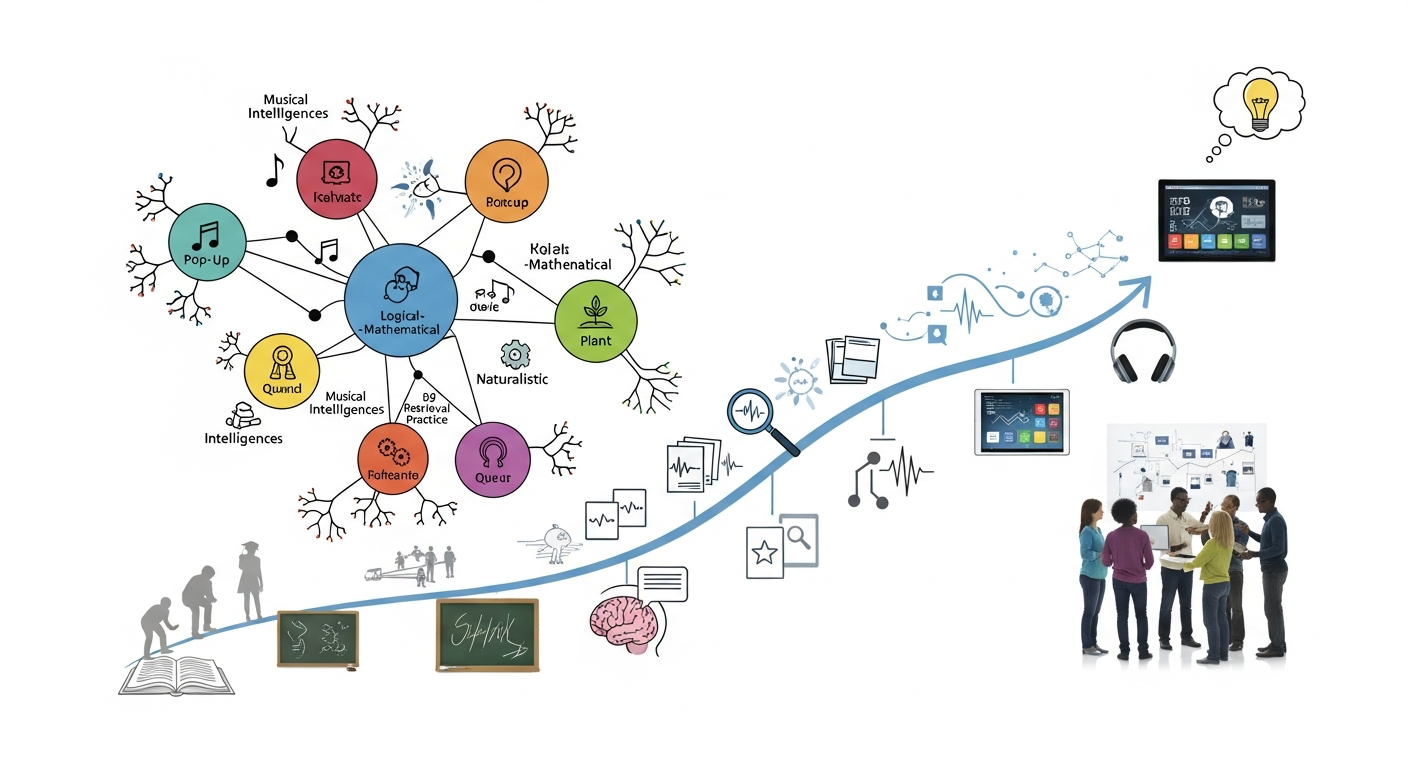
The Evolution of L&D: Integrating Retrieval Practice with the 9 Intelligences
The landscape of Learning and Development (L&D) is in constant flux, driven by technological advancements, evolving workforce needs, and a deeper understanding of human cognition. For VPs, Directors, and Managers of L&D, the challenge isn't just delivering content, but ensuring that learning sticks, translates into performance, and ultimately drives organizational success. The days of passive, one-size-fits-all training are waning, giving way to more sophisticated, evidence-based approaches. This evolution demands strategic integration of proven cognitive science with personalized learning frameworks. Enter the powerful duo: Retrieval Practice and the 9 Intelligences.
The Shifting Sands of L&D
For decades, L&D often relied on traditional methods: lengthy classroom sessions, dense manuals, and end-of-module tests that barely scratched the surface of true understanding. While well-intentioned, these approaches frequently fell short, leading to low retention, disengagement, and a significant gap between training completion and actual skill application.
Why Traditional Methods Fall Short
The core issue lies in how we traditionally perceived learning. It was often viewed as an input process – pour information in, and expect it to stay. However, modern cognitive science, alongside the practical experiences of L&D leaders, reveals that true learning is an active, often effortful, process of encoding, storing, and most crucially, retrieving information. Without robust retrieval mechanisms, knowledge remains fragile and easily forgotten.
The Power of Purposeful Recall
Retrieval practice, also known as the "testing effect," is a learning strategy where actively recalling information from memory significantly enhances retention and deepens understanding. It's not just about assessing what learners know; it's about strengthening the neural pathways associated with that knowledge. Each act of successful retrieval makes future retrieval easier and more robust.
Imagine your training content as a vast library. Simply reading books might give you an initial understanding, but actively trying to recall details from those books – even if you fail initially – is what truly helps you navigate that library with confidence. This strategy is particularly effective when embedded into an LMS, offering repeated opportunities for spaced retrieval.
Unlocking Potential with Diverse Learning Styles
While retrieval practice provides the "how" of making learning stick, understanding how individuals prefer to learn provides the "what" and "where" to apply these strategies most effectively. Howard Gardner's theory of Multiple Intelligences posits that individuals possess varying strengths across nine distinct intelligences: Linguistic, Logical-Mathematical, Spatial, Bodily-Kinesthetic, Musical, Interpersonal, Intrapersonal, Naturalistic, and Existential.
A "one-size-fits-all" approach to learning, whether for a Microlearning LMS or a comprehensive enterprise learning management system, inevitably leaves some learners behind. Recognizing these intelligences allows L&D professionals to craft experiences that resonate deeply, fostering greater engagement and more effective retrieval.
Mapping Intelligences to Training Modalities
Integrating retrieval practice with the 9 Intelligences means designing diverse opportunities for learners to recall information in ways that align with their strengths. A sophisticated learning management system can be instrumental in this:
- Linguistic: Encourage learners to write summaries, explain concepts verbally, or participate in debates about the material. Retrieval practice here could involve short answer quizzes or presenting key takeaways.
- Logical-Mathematical: Use problem-solving scenarios, data analysis tasks, or strategy games that require learners to apply principles. Quizzes based on complex logic puzzles or case studies serve as excellent retrieval tools.
- Spatial: Employ mind maps, visual metaphors, simulations, or interactive diagrams. Learners can be asked to recreate diagrams from memory or navigate virtual environments as a form of retrieval practice. An Adaptive Learning platform can adjust visual aids based on progress.
- Bodily-Kinesthetic: Incorporate role-playing, hands-on tasks, or simulations where physical action reinforces learning. Retrieval can involve performing a procedure or demonstrating a skill without prompts.
- Musical: Utilize jingles, rhythmic recall exercises, or associate concepts with specific tunes. Retrieval practice might involve recalling a jingle or a sequence of information tied to a melody.
- Interpersonal: Facilitate group projects, peer teaching, and collaborative problem-solving. Retrieval can occur through team-based quizzes or explaining concepts to a colleague. A Gamified LMS can foster healthy competition here.
- Intrapersonal: Encourage reflective journaling, self-assessment, and goal setting. Retrieval practice can involve learners reflecting on how specific information applies to their personal goals or completing self-evaluation checklists.
- Naturalistic: Apply learning to real-world patterns, categorize information, or identify trends. Retrieval might involve predicting outcomes based on observed patterns or classifying new data.
- Existential: Engage in discussions about ethical dilemmas, the purpose of a task, or the wider implications of knowledge. Retrieval can involve articulating their stance on a complex issue related to the training.
Synergizing for Superior Outcomes
The integration of retrieval practice and the 9 Intelligences leads to a holistic and profoundly effective L&D strategy. It moves beyond mere content delivery to foster deeper understanding, long-term retention, and genuine skill transfer. Organizations that embrace this synergy will see a more capable, confident, and adaptable workforce.
The Role of Technology in Integration
Modern learning management solutions are pivotal in orchestrating this complex integration. How can smart platforms enhance learning recall? A robust LMS or Microlearning LMS provides the infrastructure to deploy varied retrieval activities tailored to different intelligences. Features like spaced repetition quizzes, interactive simulations, discussion forums, and personalized learning paths become non-negotiable.
Where do advanced learning systems best apply? Across every segment! An AI Powered Authoring Tool can quickly generate diverse retrieval questions for different learning styles. A Gamified LMS can transform retrieval practice into engaging challenges, complete with leaderboards and badges, catering especially to logical-mathematical and interpersonal learners. Adaptive Learning algorithms can personalize the frequency and format of retrieval prompts based on an individual's performance and preferred intelligence strengths. A comprehensive learning content management system (LCMS) allows for the creation, storage, and dynamic deployment of content that caters to all these nuances, turning a static learning management software into a vibrant, responsive ecosystem. These cloud based learning management system options ensure accessibility and scalability across the enterprise.
What intelligent tools are revolutionizing training? Tools that leverage artificial intelligence to personalize content, automate feedback on retrieval attempts, and suggest optimal learning paths based on a learner's identified intelligences are at the forefront. MaxLearn LMS exemplifies this by offering an advanced learning management system that facilitates the seamless integration of these sophisticated methodologies.
Strategic Implementation for Key Industries
This integrated approach holds immense value across diverse sectors:
- Compliance: For industries like Banking, Finance, Insurance, and Health care, where Risk-focused Training is paramount, retrieval practice ensures critical regulations are not just understood but deeply ingrained. Diverse activities can address complex legal texts (Linguistic) and ethical dilemmas (Existential).
- Sales & Retail: Role-playing product pitches (Bodily-Kinesthetic, Interpersonal) combined with retrieval quizzes on product features (Linguistic, Logical-Mathematical) leads to confident, knowledgeable sales teams.
- Pharma & Health care: Medical procedures (Bodily-Kinesthetic), complex drug interactions (Logical-Mathematical), and patient communication (Interpersonal, Linguistic) can all benefit from tailored retrieval strategies within a robust lms learning management system.
- Hospitality: Scenario-based training (Spatial, Interpersonal) and immediate recall exercises on service standards ensure consistent, high-quality customer experiences.
- Oil and Gas & Mining: Safety protocols and operational procedures require meticulous recall. Simulations (Spatial, Bodily-Kinesthetic) and rigorous, repeated retrieval practice are essential for mitigating risk.
Conclusion
The modern L&D leader's mandate is clear: to create learning experiences that are not only engaging but demonstrably effective. By strategically integrating retrieval practice with the understanding of the 9 Intelligences, organizations can transcend traditional training limitations. This powerful combination, amplified by intelligent learning management solutions and an advanced learning content management system, paves the way for a workforce that truly retains knowledge, applies skills confidently, and drives sustainable growth. Embracing this evolution isn't just about staying current; it's about investing in the intellectual capital that will define tomorrow's successful enterprise.


Comments
Post a Comment