Step-by-Step Guide: Mapping Training Content to Gardner's 9 Intelligences
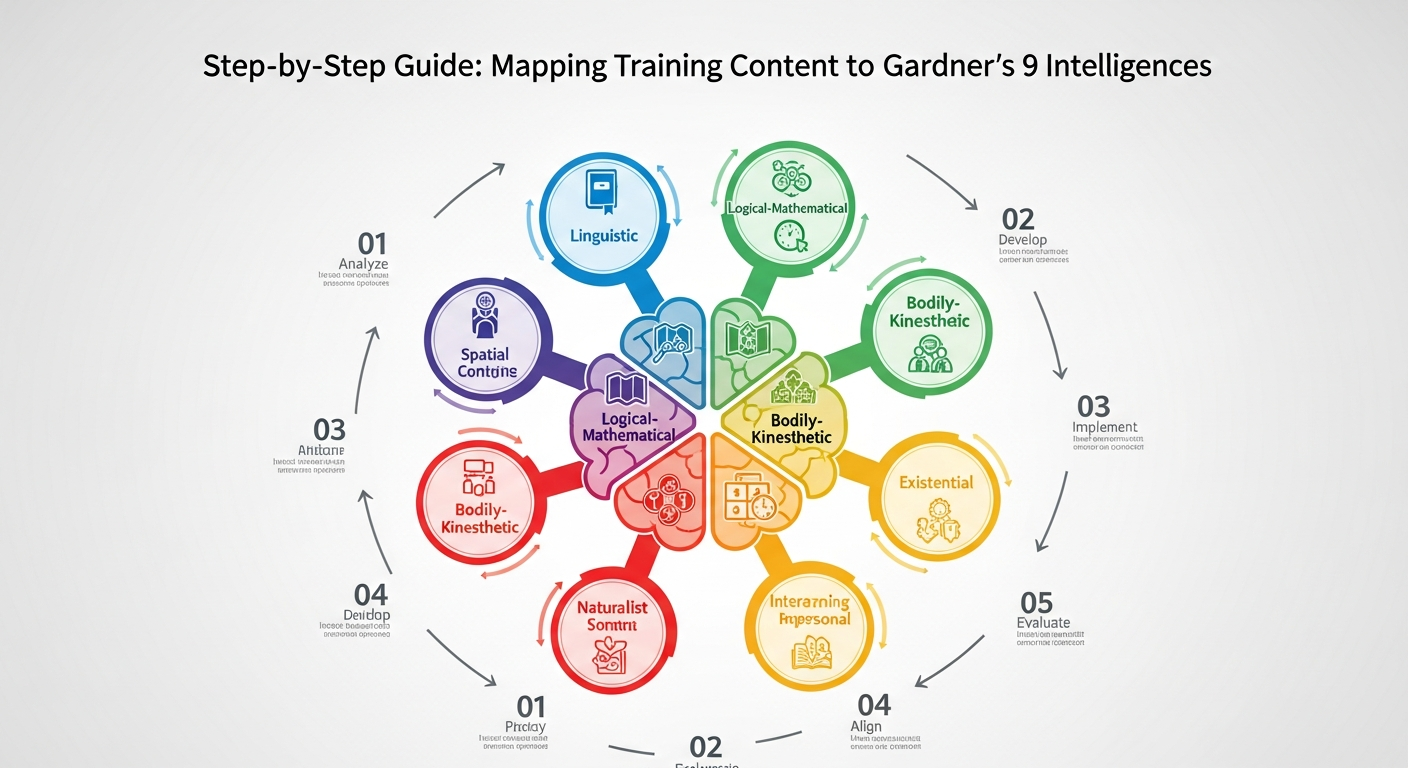
Step-by-Step Guide: Mapping Training Content to Gardner's 9 Intelligences
As leaders in Learning & Development, you understand that effective training transcends mere information delivery. It's about engagement, retention, and ultimately, measurable behavioral change and performance improvement. In today's diverse and dynamic corporate landscape, a "one-size-fits-all" approach to employee training is increasingly obsolete. This is particularly true across varied sectors like Compliance, Sales, Banking, Finance, Insurance, Retail, Pharma, Health Care, Hospitality, Oil and Gas, and Mining, where learning styles can differ vastly.
To truly unlock your workforce's potential, we must consider the inherent individuality of how people learn. This is where Dr. Howard Gardner's theory of Multiple Intelligences (MI) offers a powerful framework. By intentionally mapping your training content to these nine distinct intelligences, you can design more inclusive, engaging, and impactful learning experiences.
Understanding Gardner's 9 Intelligences for L&D
Gardner proposed that intelligence isn't a singular, monolithic entity, but rather a spectrum of distinct abilities. For L&D professionals, embracing this theory means recognizing that your learners bring different strengths and preferences to the table. Some excel with words, others with numbers, and still others with visual cues or social interaction. Catering to these diverse intelligences can significantly boost learner engagement and knowledge retention.
Here’s a brief overview of the nine intelligences and their relevance in corporate training:
- Linguistic-Verbal Intelligence: "Word Smart" individuals thrive with reading, writing, storytelling, and debates.
- Logical-Mathematical Intelligence: "Number/Reasoning Smart" learners excel at problem-solving, data analysis, and understanding complex systems.
- Spatial-Visual Intelligence: "Picture Smart" people learn best through images, diagrams, maps, and visual metaphors.
- Bodily-Kinesthetic Intelligence: "Body Smart" individuals prefer hands-on activities, role-playing, and physical interaction.
- Musical-Rhythmic Intelligence: "Music Smart" learners respond well to rhythm, sound, and patterns, often finding jingles or audio cues helpful.
- Interpersonal Intelligence: "People Smart" individuals learn effectively through group work, collaboration, and social interaction.
- Intrapersonal Intelligence: "Self Smart" learners benefit from self-reflection, journaling, and autonomous learning paths.
- Naturalistic Intelligence: "Nature Smart" individuals connect best with patterns in nature, environmental analogies, and real-world observations.
- Existential Intelligence: "Life Smart" learners engage with big-picture questions, ethical dilemmas, and understanding purpose or meaning.
The Step-by-Step Guide to Mapping Training Content
Step 1: Analyze Your Learning Objectives and Audience
Before you even think about content, clearly define what learners need to know and be able to do. What are the core competencies for that sales team in New York, or the compliance officers in London? Understanding your LMS data on previous training outcomes can provide invaluable insights. Equally important is knowing your audience. Are they primarily new hires, seasoned professionals, or a mix? Are they in a high-risk industry like Pharma or Oil and Gas, or a customer-facing role in Retail? This initial analysis forms the bedrock of your content mapping strategy.
Step 2: Deconstruct Existing or Design New Content Modules
Break down your training material into its fundamental components. Instead of a single, lengthy course, think in terms of micro-modules or learning objects. This aligns perfectly with a Microlearning LMS approach. For instance, a module on "Fraud Prevention in Banking" can be segmented into "Identifying Suspicious Transactions," "Reporting Protocols," and "Ethical Considerations." Each segment presents an opportunity to cater to different intelligences.
Step 3: Map Content Elements to Specific Intelligences
Now, let the mapping begin. For each content segment, consider multiple ways to deliver the core message, appealing to different intelligences:
- Linguistic: Offer detailed case studies, policy documents, thought-provoking essays, or interactive quizzes requiring written responses. Facilitate online discussions or debates.
- Logical-Mathematical: Incorporate problem-solving simulations, data analysis exercises (e.g., analyzing financial statements), flowcharts of processes, or decision-tree scenarios.
- Spatial-Visual: Utilize infographics, interactive diagrams, video tutorials, virtual reality (VR) simulations (especially for healthcare procedures or mining safety), and visual metaphors.
- Bodily-Kinesthetic: Implement role-playing scenarios (e.g., customer service interactions, sales pitches), hands-on equipment training, practical demonstrations, or clickable simulations within your learning content management system.
- Musical-Rhythmic: While less common, consider short, memorable jingles for key compliance rules, or using background music (with care) to set the tone for reflective modules.
- Interpersonal: Design group projects, peer review activities, collaborative problem-solving tasks, or mentorship programs managed through your cloud based learning management system.
- Intrapersonal: Include reflective journaling prompts, self-assessment tools, personalized learning paths, or independent research assignments.
- Naturalistic: Use real-world analogies from nature to explain complex systems (e.g., organizational structure likened to an ecosystem). Integrate observational tasks where applicable.
- Existential: Present ethical dilemmas, discussions on the "why" behind policies (especially critical in Compliance and Pharma), or modules focused on purpose-driven leadership.
Step 4: Leverage Technology for Diverse Delivery
Modern learning management solutions are your greatest ally in implementing this diversified approach. An advanced learning management system like MaxLearn LMS can host a rich variety of content formats, from interactive videos and simulations to discussion forums and personalized assignments. Features like a Gamified LMS can appeal to logical-mathematical and interpersonal intelligences through challenges and team competitions.
As L&D leaders, you might wonder: "How can current technological advancements help us discern the varied learning preferences present within our diverse, globally distributed workforce?" A sophisticated learning management software, particularly one with robust analytics, can track learner engagement with different content types, preferred modalities, and completion rates across various geographies and departments. This rich data empowers you to understand what resonates most effectively with specific demographic or professional groups, thereby optimizing your enterprise learning management strategy.
Furthermore, a common strategic question arises: "What innovative strategies can be employed to deliver learning content that adapts seamlessly to individual learning styles, and how can this be achieved at a large scale?" This is where Adaptive Learning shines. Platforms equipped with an AI Powered Authoring Tool can dynamically adjust the learning path, recommend additional resources, or offer alternative explanations based on a learner's interactions and performance, ensuring a personalized journey for millions.
Step 5: Evaluate and Iterate
No training strategy is complete without rigorous evaluation. Utilize the robust reporting features of your LCMS to track completion rates, assessment scores, and qualitative feedback. Are learners more engaged? Are performance metrics improving in areas targeted by Risk-focused Training? Use this data to refine your content mapping, experiment with new delivery methods, and continuously improve your programs. The goal is to create a dynamic learning ecosystem that evolves with your workforce's needs.
AI-Powered Insights for Enhanced Learning Design
Beyond content delivery, artificial intelligence plays a pivotal role in optimizing your learning architecture. You might ask: "Can we predict which specific training approaches or modules will yield the highest engagement and proficiency gains for a given team or department?" Predictive analytics, often a feature within an advanced lms learning management system, can analyze historical data – correlating content types, instructional designs, and outcomes – to forecast the most impactful learning interventions for future initiatives, helping you optimize your investment in critical programs across Banking, Insurance, and other high-stakes industries.
The Strategic Advantage for L&D Leaders
Mapping training content to Gardner's 9 Intelligences isn't just an academic exercise; it's a strategic imperative. By consciously diversifying your instructional design, you achieve:
- Increased Engagement: Learners are more likely to participate when content resonates with their natural strengths.
- Improved Retention: Information processed through preferred intelligence pathways is more deeply embedded.
- Enhanced Performance: A workforce that truly understands and applies knowledge is a more productive and compliant one.
- Inclusive Learning Culture: You signal to all employees that their unique ways of learning are valued and supported.
Embracing this holistic approach to learning design, facilitated by a comprehensive MaxLearn LMS, positions your organization at the forefront of talent development. It's about moving beyond simply training employees to truly empowering them, fostering a culture of continuous growth and excellence that drives business success across every industry you touch.


Comments
Post a Comment