How to Solve Learner Disengagement Using the VARK Model
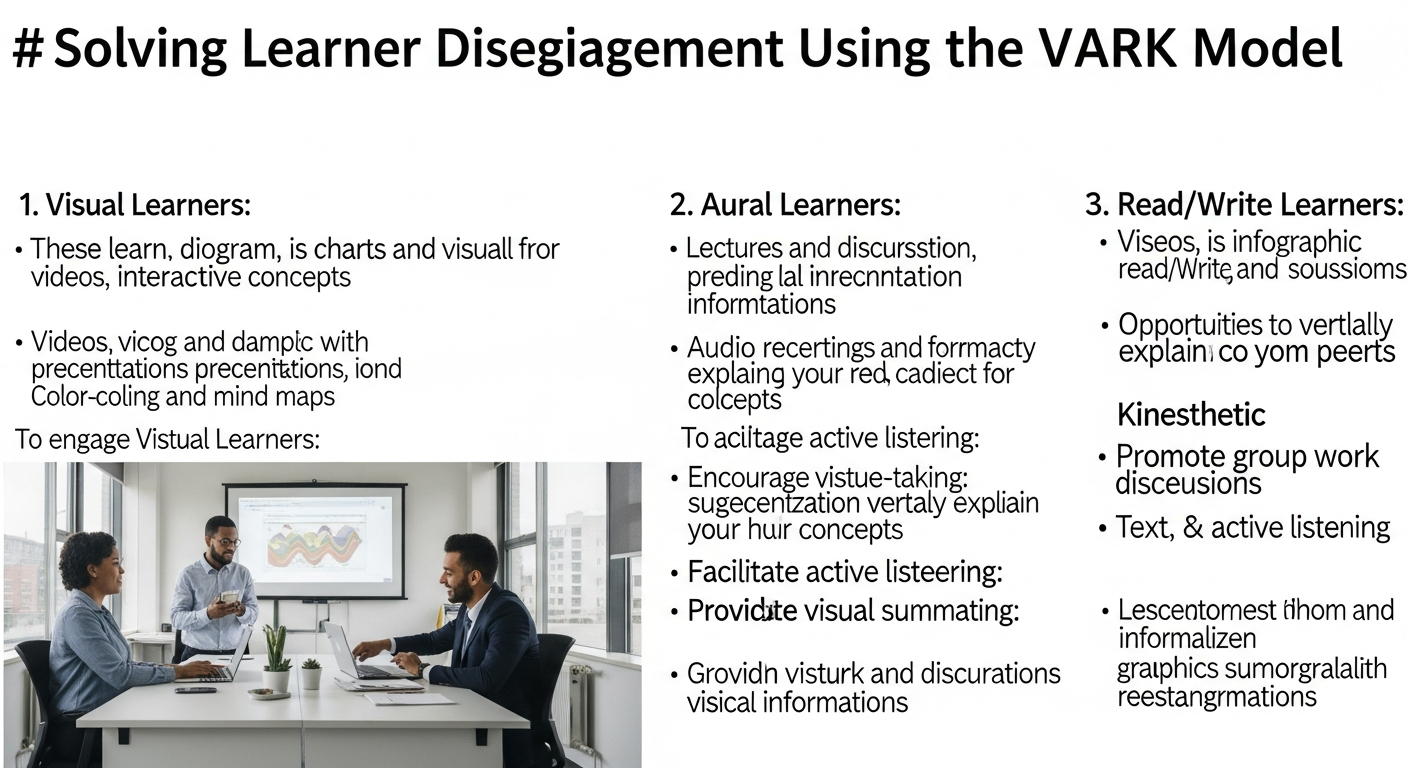
Solving Learner Disengagement: A VARK-Powered Approach for L&D Leaders
In today's fast-paced corporate landscape, where continuous learning is paramount for growth and compliance, learner disengagement remains a persistent challenge for L&D leaders across industries like Sales, Banking, Finance, Insurance, Retail, Pharma, Health care, Hospitality, Oil and Gas, and Mining. It's a silent drain on resources, often resulting in ineffective training, skill gaps, and missed opportunities. As a Vice President, Director, Senior Manager, or Manager of L&D, you understand that merely offering training isn't enough; employees must actively engage with and internalize the material. This article explores how the VARK model, when strategically applied, can be a powerful antidote to disengagement, transforming your eLearning initiatives into dynamic, results-driven experiences.
Understanding the Silent Killer: Learner Disengagement
Disengagement isn't just about learners not paying attention; it's a symptom of a deeper mismatch between content delivery and individual learning preferences. When training fails to resonate, employees may feel bored, overwhelmed, or simply perceive the content as irrelevant. This leads to poor retention, low completion rates, and ultimately, a significant return on investment loss for your LMS. For critical areas like compliance training, disengagement can even pose significant organizational risks.
The traditional "one-size-fits-all" approach to corporate training often overlooks the fundamental fact that people learn differently. A learner management system filled with static, text-heavy modules might bore a kinesthetic learner, just as a purely auditory course might frustrate a visual one. The key to unlocking engagement lies in understanding and catering to these diverse learning styles.
Introducing the VARK Model: A Framework for Engagement
The VARK model, developed by Neil Fleming, categorizes learning preferences into four distinct types: Visual, Auditory, Read/Write, and Kinesthetic. By understanding these preferences, L&D professionals can design more inclusive and effective training programs that cater to a wider audience, boosting engagement and knowledge retention.
What are the core components of effective learning personalization?
Effective learning personalization hinges on recognizing and addressing individual differences in how people absorb and process information. The VARK model provides a robust framework for this by identifying four primary modalities:
- Visual (V): Learners who prefer to see information presented graphically – through diagrams, charts, infographics, videos, and demonstrations.
- Auditory (A): Learners who prefer to hear information – through lectures, discussions, podcasts, audio recordings, and verbal instructions.
- Read/Write (R): Learners who prefer to engage with text – through reading articles, manuals, reports, and writing notes, summaries, or essays.
- Kinesthetic (K): Learners who prefer to learn by doing – through hands-on activities, simulations, role-playing, experiments, and practical application.
Applying VARK to Solve Disengagement in eLearning
Leveraging VARK means moving beyond generic content creation within your learning content management system. It's about strategically varying your delivery methods to hit multiple learning styles, ensuring no learner is left behind.
Catering to Visual Learners
Visual learners thrive on imagery. To engage them:
- Incorporate high-quality videos, animations, and explainer clips.
- Use infographics, flowcharts, and diagrams to illustrate complex processes or data.
- Employ strong branding and visually appealing slide decks.
- Provide mind maps or concept maps for outlining key ideas.
For industries like healthcare, demonstrating procedures visually is critical. In finance, illustrating market trends with charts makes complex data digestible. An lms learning management system that supports diverse media types is essential here.
Engaging Auditory Learners
Auditory learners benefit from hearing information. Consider these strategies:
- Offer podcasts or audio summaries of key modules.
- Integrate recorded lectures, expert interviews, or voice-overs in presentations.
- Facilitate virtual group discussions and Q&A sessions.
- Provide audio feedback on assignments.
For sales training, recorded role-play scenarios with expert commentary can be invaluable. In compliance, an audio explanation of legal jargon can clarify complex regulations. A robust cloud based learning management system can host these varied audio assets seamlessly.
Satisfying Read/Write Learners
These learners excel with written words. To keep them engaged:
- Provide comprehensive text-based modules, articles, and white papers.
- Encourage note-taking and summarization exercises.
- Offer downloadable transcripts of videos or audio content.
- Assign written tasks, reports, or case studies.
In banking or insurance, providing detailed policy documents and regulatory texts is crucial. For pharma, research papers and drug information sheets are vital. An LCMS that allows for easy creation and organization of diverse written materials is key.
Stimulating Kinesthetic Learners
Kinesthetic learners learn by doing. They need hands-on experiences:
- Implement interactive simulations and virtual labs.
- Develop role-playing scenarios, especially relevant for sales or customer service.
- Integrate gamified elements with challenges, leaderboards, and rewards.
- Provide practical exercises, case studies with decision-making points, or field assignments.
How can training programs adapt to individual learner preferences for better outcomes?
By integrating a variety of content formats and interactive experiences, training programs can adapt effectively. For kinesthetic learners, a Gamified LMS can transform abstract concepts into engaging challenges, driving higher completion rates and practical skill development. For example, in oil and gas, simulations of equipment operation can be critical. In retail, hands-on product training or virtual store walkthroughs are effective.
Leveraging Technology for VARK-Based Training
Modern eLearning technology makes implementing the VARK model more feasible than ever. An advanced learning management system (LMS) or learning management solutions suite empowers L&D teams to create and deliver diverse content tailored to specific learning styles.
- Microlearning LMS: Delivers bite-sized content in various formats (videos, quizzes, infographics, short articles) perfectly suited for addressing all VARK preferences without overwhelming learners. This approach is highly effective in maintaining engagement in fast-paced environments like sales or retail.
- Adaptive Learning Platforms: These intelligent systems can assess a learner's preferred style (or even identify their weaknesses) and automatically suggest or deliver content in their most effective modality. This is the epitome of personalized learning within an enterprise learning management system.
- AI Powered Authoring Tool: With artificial intelligence, L&D teams can rapidly generate varied content types—from text summaries to video scripts or interactive simulations—making it easier to cater to each VARK style without extensive manual effort. This significantly streamlines content creation for your MaxLearn LMS.
- Risk-focused Training: For sectors like finance, banking, or pharma, incorporating VARK into risk training means providing simulations (kinesthetic), case study analyses (read/write), expert interviews (auditory), and data visualizations (visual) to ensure a comprehensive understanding of critical compliance requirements.
Implementing a sophisticated learning management software that supports these features transforms your ability to combat disengagement. It moves your L&D strategy from a reactive approach to a proactive, learner-centric model.
Measuring Success and Continuous Improvement
What strategies ensure ongoing employee development remains compelling?
To ensure ongoing employee development remains compelling, L&D leaders must continuously monitor engagement metrics and adapt their strategies. Leveraging VARK is not a one-time fix but an ongoing commitment to understanding your learners. Track key indicators within your LMS:
- Completion Rates: Are learners finishing modules tailored to their styles?
- Time on Task: Are they spending adequate time engaging with the content?
- Quiz Scores & Performance Metrics: Does engagement translate into improved knowledge and skills?
- Learner Feedback: Actively solicit feedback on content formats and delivery methods.
Use this data to iterate and refine your training programs. A dynamic MaxLearn LMS offers analytics dashboards that provide these insights, enabling you to continuously optimize your learning management system for maximum impact.
Conclusion
Learner disengagement doesn't have to be an inevitable hurdle in your L&D strategy. By embracing the VARK model and leveraging modern eLearning technologies, you can craft highly engaging, personalized, and effective training experiences. From compliance in banking to sales methodologies in retail, and critical procedures in healthcare or oil and gas, understanding and catering to diverse learning styles will empower your workforce, mitigate risks, and drive organizational success. It's time to move beyond generic training and cultivate a culture of active, enthusiastic learning with the right LMS at your core.


Comments
Post a Comment