How to Create Safe-Zone Learning Scenarios Using DDE Principles
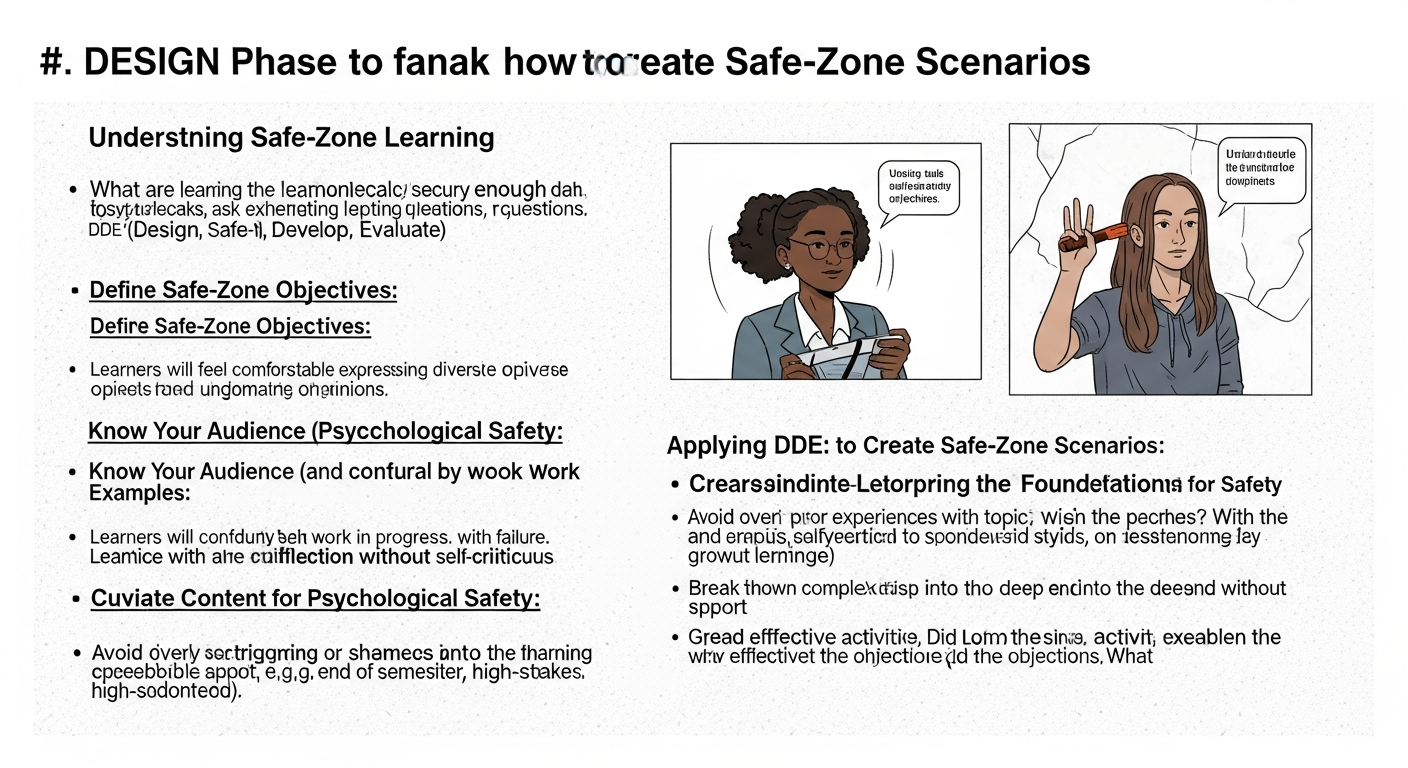
How to Create Safe-Zone Learning Scenarios Using DDE Principles for L&D Leaders
In today's rapidly evolving corporate landscape, the stakes for employee performance and compliance have never been higher. For Vice Presidents, Directors, and Managers of Learning & Development, the challenge lies in equipping teams with critical skills without exposing them to real-world risks during the learning process. This is particularly crucial across industries like Compliance, Sales, Banking, Finance, Insurance, Retail, Pharma, Healthcare, Hospitality, Oil and Gas, and Mining, where mistakes can lead to significant financial, reputational, or even safety repercussions.
Enter safe-zone learning scenarios, a powerful pedagogical approach designed to simulate real-world challenges in a consequence-free environment. By applying the Discover, Design, Evaluate (DDE) principles, L&D leaders can systematically build highly effective and impactful training programs. This article will guide you through leveraging DDE principles to craft safe-zone learning experiences that foster confidence, competence, and compliance.
Understanding the DDE Principles in L&D
The DDE framework provides a structured approach to instructional design, ensuring that learning solutions are not only engaging but also directly address organizational needs and desired outcomes:
- Discover: This initial phase involves a deep dive into organizational needs, performance gaps, and potential risks. It's about understanding what learners need to know and do, and what challenges they face.
- Design: Based on the discoveries, this phase focuses on creating the learning experience. This includes developing content, choosing methodologies (like simulations or role-plays), and defining the environment where learning will occur.
- Evaluate: The final phase measures the effectiveness of the designed learning. It assesses whether the learning objectives were met, if performance improved, and how the program can be continuously optimized.
Applying DDE to safe-zone learning means meticulously identifying scenarios where real-world risks are high, designing simulations that replicate these scenarios in a secure environment, and then evaluating how effectively learners navigate these challenges without actual consequences.
Why Safe-Zone Learning Matters for L&D Leaders
For L&D professionals at the leadership level, investing in safe-zone learning is not just about training; it's about strategic risk mitigation and business enablement. Here's why it's critical:
- Reduced Operational Risk: Employees can practice critical decision-making in high-stakes situations (e.g., a financial transaction error, a compliance violation, a sales negotiation gone wrong) without affecting real customers or company assets. This Risk-focused Training minimizes costly errors in live operations.
- Enhanced Compliance and Regulatory Adherence: Industries heavily regulated benefit immensely. Safe zones allow for repeated practice of complex regulatory procedures, ensuring staff are fully compliant before engaging with real-world requirements.
- Increased Employee Confidence and Competence: Learners develop mastery through repeated attempts and immediate feedback, building the confidence to perform effectively when faced with actual challenges.
- Improved Engagement and Retention: Experiential learning is inherently more engaging than passive methods. When integrated with a Gamified LMS, safe-zone scenarios can boost motivation and knowledge retention significantly.
- Faster Time to Proficiency: Employees can onboard and upskill more quickly, reducing the time it takes for them to become fully productive members of the team.
Implementing DDE for Safe-Zone Scenarios
Discover: Uncovering Learning Needs and Risks
The foundation of any successful safe-zone scenario is a thorough understanding of what needs to be learned and where the highest risks lie. This initial phase requires robust data analysis and stakeholder collaboration.
- Identify Critical Skill Gaps: Analyze performance reviews, incident reports, audit findings, and strategic objectives to pinpoint areas where employees struggle or where the organization faces potential vulnerabilities. In Banking, this might be identifying fraud indicators; in Healthcare, patient safety protocols; in Oil and Gas, emergency response procedures.
- Consult Subject Matter Experts (SMEs): Engage with experienced professionals to understand the nuances of high-stakes situations and the critical decisions involved.
- Leverage Data Analytics:
Question: How can advanced analytical tools help us accurately pinpoint critical learning gaps and potential organizational risks before scenario design even begins?
Discussion: Modern analytics, often powered by sophisticated algorithms, can sift through vast datasets from operational incidents, customer feedback, and past training outcomes. By identifying patterns and correlations, these tools can highlight specific areas of deficiency or emerging risks that might otherwise go unnoticed. This data-driven approach allows L&D leaders to prioritize training efforts on scenarios that will yield the greatest impact on performance and risk mitigation, ensuring that resources are allocated efficiently. An effective LMS can often provide initial data points for this discovery phase.
Design: Crafting Engaging and Secure Scenarios
Once needs are identified, the design phase focuses on building immersive and effective safe-zone experiences. This is where creativity meets instructional rigor.
- Define Clear Learning Objectives: For each scenario, explicitly state what the learner should be able to do or decide by the end.
- Create Realistic Simulations: The scenarios must feel authentic to truly prepare learners. This could involve interactive case studies, virtual role-playing, branching narratives, or augmented reality simulations.
- Incorporate Feedback Mechanisms: Immediate, constructive feedback is paramount. Learners need to understand why a choice was correct or incorrect and its potential consequences. This rapid feedback loop is a hallmark of effective Microlearning LMS platforms.
- Gradual Complexity: Start with simpler scenarios and progressively introduce more complex elements or higher stakes.
- Utilize Authoring Tools and Platforms:
Question: In what ways can artificial intelligence assist in generating diverse, highly realistic, and personalized learning scenarios that adapt to individual learner progress and industry-specific nuances?
Discussion: Advanced authoring tools integrated with intelligent capabilities can revolutionize scenario design. These systems can leverage large language models to generate text-based dialogues for role-playing, create diverse character profiles, and even simulate complex system interactions based on predefined parameters. By analyzing a learner's past performance and preferences, these intelligent systems can dynamically adjust the difficulty, context, and focus of scenarios, offering a truly personalized path to mastery. An AI Powered Authoring Tool within a robust learning content management system or learning management software can drastically reduce development time and enhance scenario relevance across different segments like Sales, Finance, or Healthcare.
Evaluate: Measuring Impact and Iterating for Improvement
The final DDE principle ensures that your safe-zone learning scenarios are continuously improving and delivering measurable results.
- Track Performance Metrics: Go beyond completion rates. Track specific decisions made, time to resolution, error rates, and the application of learned procedures within the safe zone. Many modern learning management solutions offer detailed analytics dashboards.
- Collect Learner Feedback: Post-scenario surveys or debriefs can provide valuable qualitative insights into the realism and effectiveness of the training.
- Observe Behavioral Changes: The ultimate evaluation is seeing the transfer of skills to real-world performance. While safe-zone training is not real-world, it should inform and improve real-world behavior.
- Continuous Optimization: DDE is an iterative process. Use evaluation data to refine and improve scenarios, ensuring they remain relevant and effective. This aligns with the principles of Adaptive Learning, where learning paths adjust based on performance.
- Intelligent Performance Analysis:
Question: How can intelligent systems provide real-time, actionable insights into learner performance and scenario effectiveness, enabling rapid adjustments and continuous optimization of safe-zone training programs?
Discussion: By integrating sophisticated data processing capabilities into an lms learning management system, L&D leaders can gain immediate visibility into how learners are performing within scenarios. These systems can analyze decision paths, identify common mistakes across a cohort, and even predict areas where future training might be needed. This granular data allows for prompt modifications to scenario design, content, or even the underlying instructional strategy. For an enterprise learning management system like MaxLearn LMS, such capabilities are crucial for maintaining agility and responsiveness in training initiatives. This makes the entire learning management system a powerful tool for continuous improvement, effectively transforming it into a dynamic LCMS.
Leveraging Technology for Enhanced Safe Zones
Implementing DDE principles for safe-zone learning is significantly amplified by the right technology. A robust cloud based learning management system is the backbone of such initiatives. These platforms are not just repositories for content; they are dynamic environments that enable sophisticated scenario deployment, tracking, and analysis.
A comprehensive learning management system (LMS) should offer:
- Tools for creating and deploying interactive scenarios.
- Advanced analytics to track learner progress and performance within simulations.
- Integration with AI-powered authoring and personalization features.
- Scalability to support diverse teams across multiple industries.
An effective LMS acts as the central hub for all your training, ensuring that the 'Discover,' 'Design,' and 'Evaluate' phases are seamlessly integrated and supported by data and automation. From initial needs assessment to the continuous refinement of training modules, a powerful learning management system streamlines the entire process, empowering L&D leaders to build resilient, skilled, and compliant workforces.
Conclusion
Creating safe-zone learning scenarios using DDE principles is a strategic imperative for L&D leaders in today's complex business environment. By diligently Discovering needs and risks, thoughtfully Designing engaging and realistic simulations, and rigorously Evaluating their impact, organizations can build highly competent and confident workforces. Leveraging advanced MaxLearn LMS and AI-powered tools not only streamlines this process but also elevates the effectiveness and personalization of training, ensuring that your teams are prepared for any challenge without ever facing real-world consequences in the learning phase. Embrace DDE and safe-zone learning to transform your organization's approach to skill development and risk management.


Comments
Post a Comment