How to Combine Bloom's Taxonomy with Gardner’s Multiple Intelligences Model
Unlocking Peak Performance: Combining Bloom's Taxonomy with Gardner’s Multiple Intelligences
In today's dynamic corporate landscape, where continuous upskilling and reskilling are paramount, Learning and Development (L&D) leaders face the complex challenge of designing training programs that are both effective and engaging for a diverse workforce. From compliance and sales to banking, finance, and healthcare, the demand for measurable learning outcomes is higher than ever. To meet this challenge, L&D professionals often turn to established pedagogical frameworks. Two powerful models, Bloom's Taxonomy and Gardner's Multiple Intelligences, when strategically combined, offer an unparalleled approach to crafting truly impactful learning experiences.
This article will explore how L&D VPs, Directors, Senior Managers, and Managers can integrate these two foundational theories to create robust, inclusive, and high-performing training initiatives, leading to enhanced employee engagement, deeper knowledge retention, and superior business results.
Understanding the Foundational Frameworks
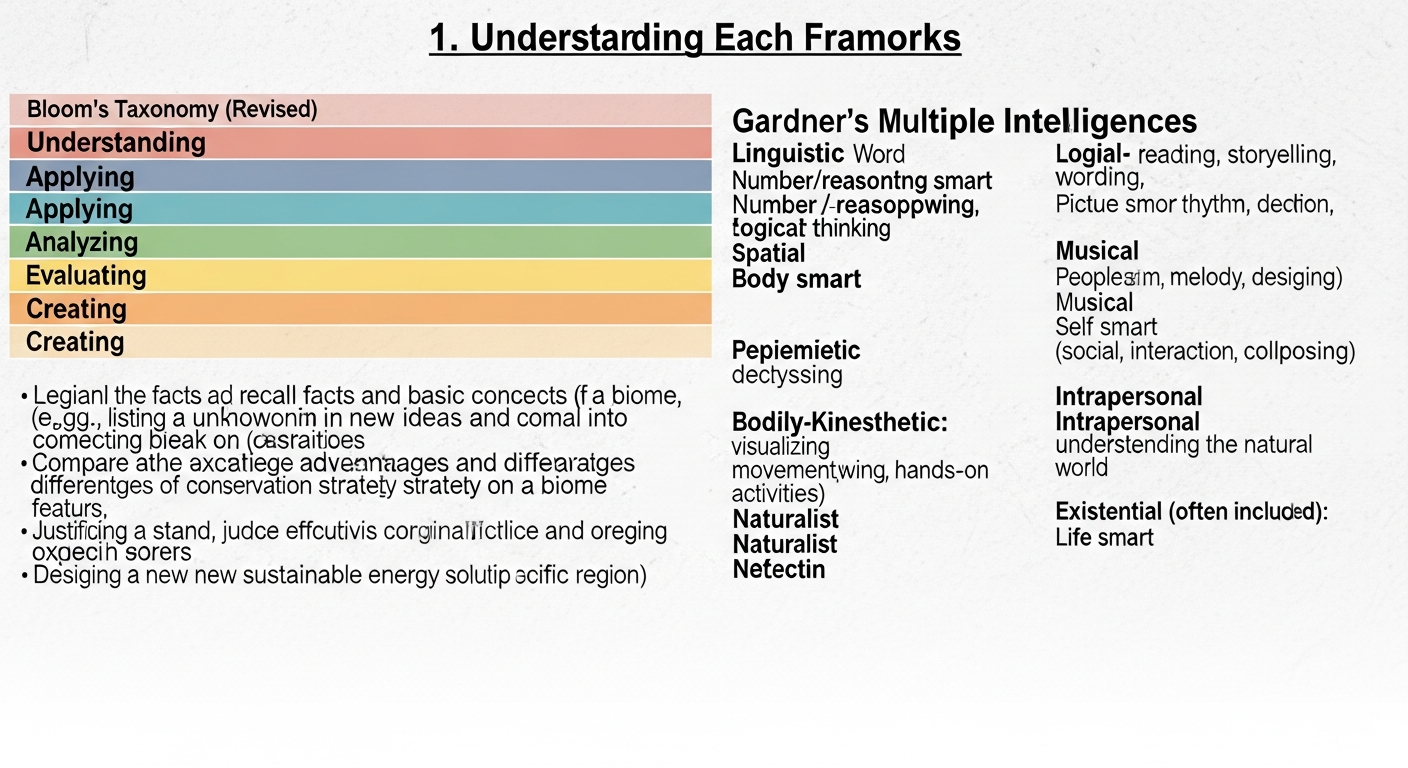
Bloom's Taxonomy Explained
Developed by educational psychologist Benjamin Bloom in the 1950s and revised in the 2000s, Bloom's Taxonomy provides a hierarchical classification of cognitive learning objectives. It outlines six levels of thinking, moving from basic recall to complex evaluation and creation:
- Remembering: Recalling facts and basic concepts (e.g., defining terms, listing procedures).
- Understanding: Explaining ideas or concepts (e.g., summarizing, interpreting data).
- Applying: Using information in new situations (e.g., executing a task, solving a problem).
- Analyzing: Breaking information into parts to explore relationships (e.g., comparing and contrasting, identifying motives).
- Evaluating: Justifying a stand or decision (e.g., critiquing, assessing effectiveness).
- Creating: Producing new or original work (e.g., designing, constructing, developing strategies).
For L&D, Bloom's Taxonomy serves as a roadmap for defining learning objectives and structuring content difficulty, ensuring learners progress from foundational knowledge to higher-order critical thinking essential for complex roles, whether in oil and gas or retail operations.
Gardner's Multiple Intelligences Unpacked
Introduced by Howard Gardner in 1983, the theory of Multiple Intelligences posits that intelligence is not a single, monolithic entity, but rather a spectrum of distinct abilities. Gardner identified several intelligences, suggesting that individuals possess varying strengths across these areas:
- Linguistic: Word smart (e.g., reading, writing, storytelling).
- Logical-Mathematical: Number/reasoning smart (e.g., problem-solving, calculations, critical thinking).
- Spatial: Picture smart (e.g., visualizing, mapping, understanding relationships).
- Bodily-Kinesthetic: Body smart (e.g., hands-on activities, movement, practical application).
- Musical: Music smart (e.g., recognizing patterns, rhythm, appreciation).
- Interpersonal: People smart (e.g., understanding others, collaboration, communication).
- Intrapersonal: Self smart (e.g., self-awareness, reflection, goal-setting).
- Naturalistic: Nature smart (e.g., understanding patterns in the natural world, classification).
- Existential (proposed): Life smart (e.g., contemplating meaning, purpose).
Recognizing these diverse intelligences allows L&D professionals to move beyond one-size-fits-all training, catering to individual learning styles and preferences across all industries, from pharma to hospitality.
The Synergy: Why Combine Them?
Combining Bloom's Taxonomy with Gardner's Multiple Intelligences creates a powerful framework for holistic learning design. Bloom's tells us what cognitive level we want learners to achieve, while Gardner's informs us how best to help them reach that level, leveraging their natural strengths. This integrated approach ensures that training programs are:
- More Engaging: By appealing to various intelligences, content becomes more relatable and enjoyable.
- More Effective: Learners grasp concepts better when taught through methods aligned with their cognitive strengths.
- More Inclusive: Addresses the needs of a diverse workforce, minimizing instances where learners feel "left behind" by a single instructional method.
- More Practical: Facilitates the development of higher-order thinking skills through varied, experiential learning.
- More Measurable: Clear objectives (Bloom's) can be assessed through methods tailored to different intelligences, providing a comprehensive view of competency.
This synergy is particularly vital for enterprise learning management systems aiming for profound skill transformation across vast organizations.
Practical Strategies for Integration
Mapping Intelligences to Cognitive Levels
Imagine designing a compliance module for a finance institution or a sales training program. Here's how to map:
- Remembering & Understanding:
- Linguistic: Readings, definitions, lectures, quizzes.
- Logical-Mathematical: Flowcharts, logical sequences, data interpretation.
- Spatial: Infographics, visual metaphors, concept maps.
- Musical: Jingles, rhythmic repetition (for memorization).
- Applying & Analyzing:
- Bodily-Kinesthetic: Role-playing sales scenarios, hands-on simulations of equipment in mining, interactive exercises.
- Interpersonal: Group projects analyzing case studies, peer feedback on performance.
- Logical-Mathematical: Data analysis tasks, budget forecasting exercises in banking, root cause analysis.
- Spatial: Creating visual models of systems, designing process workflows.
- Evaluating & Creating:
- Intrapersonal: Reflective journals on personal impact, self-assessment of leadership styles.
- Linguistic: Debates on ethical dilemmas in healthcare, writing policy recommendations.
- Naturalistic: Identifying patterns in market trends, categorizing risks in insurance.
- Logical-Mathematical: Developing new financial models, proposing optimized logistics in retail.
Designing Diverse Learning Experiences
By blending these models, L&D can build rich, multi-faceted learning paths:
- For a new product launch in sales, instead of just a lecture (Linguistic), consider:
- A competitive analysis data challenge (Logical-Mathematical, Analyzing).
- Role-playing customer objections (Bodily-Kinesthetic, Applying).
- Designing a visual sales pitch (Spatial, Creating).
- Group discussions on ethical selling practices (Interpersonal, Evaluating).
- In a critical Risk-focused Training for banking, a Microlearning LMS could offer:
- Short videos explaining regulatory updates (Linguistic, Understanding).
- Interactive simulations of fraud detection (Logical-Mathematical, Applying).
- Quizzes with immediate visual feedback (Spatial, Remembering).
- Scenario-based decision-making challenges (Interpersonal, Evaluating).
- For compliance training in pharma, moving beyond static documents:
- Gamified LMS modules with challenges and leaderboards for engaging recall (Bodily-Kinesthetic, Remembering).
- Case studies requiring analysis and ethical judgment (Logical-Mathematical, Evaluating).
- "Choose your own adventure" scenarios where decisions lead to different outcomes (Intrapersonal, Applying).
Leveraging Technology for Personalized Learning
An advanced LMS platform, such as a Microlearning LMS, can deliver highly personalized learning journeys. This includes features like Gamified LMS elements to appeal to bodily-kinesthetic and interpersonal learners, and Adaptive Learning paths that adjust to individual progress and preferred intelligence types. A robust AI Powered Authoring Tool can help L&D teams rapidly create varied content, while specialized Risk-focused Training modules can be designed to cater to logical-mathematical and intrapersonal intelligences, ensuring critical compliance knowledge is deeply embedded. An enterprise learning management system, particularly a cloud based learning management system, offers the flexibility and scalability required for global teams.
A comprehensive learning management software or learning content management system acts as the central hub. With a modern MaxLearn LMS, L&D leaders can leverage analytics to identify intelligence strengths within their workforce and then deploy a diverse range of learning management solutions. This ensures that every learner, whether they prefer a hands-on approach or reflective study, can achieve the desired cognitive outcomes. The future of training lies in smart lms learning management system solutions that embrace this tailored approach.
Advanced Insights for L&D Transformation
Question: How can intelligent algorithms enhance the discovery of relevant training content?
Answer: Advanced algorithms can analyze an individual's past learning performance, job role, demonstrated skills, and even their preferred content formats to suggest highly personalized training modules. By understanding not just what knowledge is missing (Bloom's lower levels) but also how that individual best absorbs information (Gardner's intelligences), these systems optimize content discovery. This ensures that a visual learner in sales receives engaging infographics for product updates, while a logical-mathematical learner in finance gets data-rich case studies for compliance updates, dramatically improving engagement and skill acquisition across an entire organization.
Question: What role do advanced analytics play in tailoring learning paths based on diverse learner profiles?
Answer: Data-driven insights from learner interactions within a training platform are crucial. Advanced analytics can track which types of content (videos, simulations, text-based modules, group projects) lead to the best outcomes for different individuals. This allows L&D teams to dynamically adjust learning paths, recommending specific activities that align with a learner's strengths, whether they are based in a manufacturing plant or a corporate office. For instance, if analytics show a team struggles with "evaluating" concepts through traditional text, the system can pivot to interactive scenarios or collaborative problem-solving exercises. This ensures content delivery aligns perfectly with individual learning preferences and cognitive strengths, making the learning management system a truly intelligent partner.
Question: How can smart systems foster a more engaging and effective learning experience for every individual?
Answer: Smart systems, powered by machine learning, can provide immediate, adaptive feedback, personalized coaching, and intelligent practice opportunities. By understanding both the cognitive level a learner is at and their preferred intelligence, these systems can present challenges in varied formats. For example, a learner struggling with "applying" new procedures might receive a simulated practical exercise, while another might get a reflective prompt for self-assessment. This tailored interaction maximizes knowledge retention and application, ensuring that the learning experience is not only effective in raising cognitive abilities but also highly engaging and motivating for every unique individual, fostering a culture of continuous development.
Conclusion
For L&D leaders aiming to future-proof their workforce and drive tangible business value, the strategic integration of Bloom's Taxonomy and Gardner's Multiple Intelligences is not just an academic exercise—it's a powerful methodology. By systematically defining learning objectives and then designing diverse, intelligence-aligned learning experiences, organizations can unlock the full potential of every employee. Leveraging an advanced MaxLearn LMS or a comprehensive learning management system, L&D can transform training from a mere necessity into a competitive advantage, fostering a truly skilled, adaptable, and engaged workforce across all sectors. Embrace this synergistic approach to build a learning ecosystem that thrives on individual strengths and achieves collective excellence.


Comments
Post a Comment