How Many Intelligences Are in Howard Gardner’s Cognitive Theory?
Unlocking Potential: How Many Intelligences Shape Your Learning Strategy?
In the dynamic world of Learning and Development, staying ahead means understanding the multifaceted nature of human cognition. For Vice Presidents, Directors, and Senior Managers in L&D across critical sectors like Compliance, Sales, Banking, Finance, Insurance, Retail, Pharma, Health Care, Hospitality, Oil and Gas, and Mining, the effectiveness of training directly impacts organizational success. Traditional notions of intelligence, often confined to a single IQ score, have long been challenged. Enter Dr. Howard Gardner's groundbreaking Theory of Multiple Intelligences – a framework that redefines our understanding of human capability and, more importantly, offers profound insights into designing truly impactful LMS solutions.
But precisely how many intelligences did Gardner identify, and how can leveraging this theory transform your enterprise learning management initiatives? This article delves deep into Gardner's cognitive theory, exploring its components and demonstrating its crucial relevance for modern eLearning, especially with the integration of advanced technologies like AI.
Howard Gardner's Cognitive Theory: More Than Just IQ
For decades, the concept of intelligence was largely synonymous with logical-mathematical and linguistic abilities, often measured by standardized IQ tests. While these skills are undoubtedly important, Howard Gardner, a developmental psychologist at Harvard University, proposed a radical departure from this narrow view in his 1983 book, "Frames of Mind: The Theory of Multiple Intelligences."
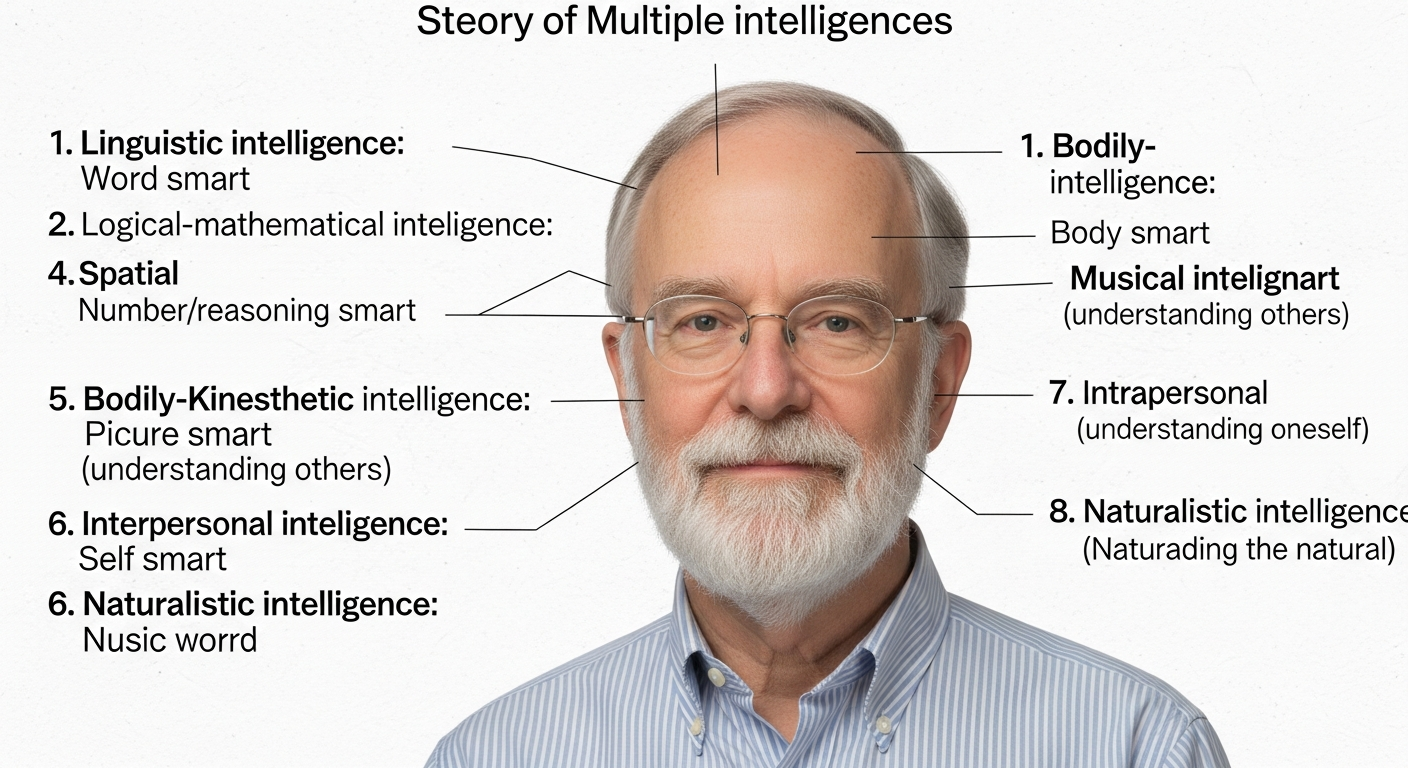
Gardner argued that rather than a single, monolithic intelligence, humans possess several distinct forms of intelligence, each operating relatively independently yet often interacting to solve complex problems. Initially, Gardner identified seven intelligences. Over time, he added an eighth, and later contemplated a ninth. For L&D professionals, understanding this broader spectrum is vital for creating inclusive and effective learning content management system experiences that resonate with every learner.
The Eight Core Intelligences
Let's explore the eight intelligences most widely accepted within Gardner's framework, and consider how they manifest in a professional learning environment:
- Linguistic Intelligence: The ability to think in words and use language to express meaning.
- L&D Relevance: Ideal for understanding complex policy documents in Compliance, mastering sales scripts, or absorbing detailed financial regulations. Traditional text-based learning, debates, and written assignments appeal to this group.
- Logical-Mathematical Intelligence: The capacity to carry out mathematical operations and critically analyze problems.
- L&D Relevance: Crucial for data analysis in Banking and Finance, understanding statistical models in Pharma, or optimizing supply chains in Retail and Oil & Gas. Problem-solving simulations, logic puzzles, and quantitative tasks are effective.
- Spatial Intelligence: The ability to think in three dimensions; to perceive the external world accurately and re-create aspects of one’s visual experience.
- L&D Relevance: Essential for understanding architectural blueprints in Hospitality, navigating complex machinery in Manufacturing or Mining, or visualizing surgical procedures in Health Care. 3D models, virtual reality training, and infographics are highly engaging.
- Bodily-Kinesthetic Intelligence: The capacity to manipulate objects and use one’s body skillfully.
- L&D Relevance: Valued in practical skills training like surgical simulations, operating heavy equipment in Mining, or demonstrating customer service techniques in Retail. Role-playing, hands-on workshops, and interactive simulations are key.
- Musical Intelligence: The capacity to discern pitch, rhythm, timbre, and tone.
- L&D Relevance: While less obvious in purely professional settings, music can aid memory and focus. Using rhythmic cues in presentations or background music in interactive modules can be subtly effective. Creating jingles for product features or compliance rules.
- Interpersonal Intelligence: The ability to understand and interact effectively with others.
- L&D Relevance: Indispensable for Sales, Customer Service in Banking and Insurance, team collaboration in Pharma, and leadership roles across all industries. Group projects, peer feedback, mentorship programs, and communication skills training thrive here.
- Intrapersonal Intelligence: The capacity to understand oneself—one’s own feelings, fears, and motivations.
- L&D Relevance: Critical for leadership development, stress management in high-pressure roles (e.g., Finance), and ethical decision-making in Compliance. Reflective journals, self-assessment tools, and goal-setting exercises are beneficial.
- Naturalist Intelligence: The ability to recognize and categorize objects and characteristics in the natural world.
- L&D Relevance: Important in fields like Environmental Compliance, sustainable practices in Oil & Gas, or understanding biological processes in Pharma. Case studies involving environmental factors or ecological impact can appeal to these learners.
Gardner also later pondered a possible ninth intelligence, Existential Intelligence, which deals with the capacity to tackle deep questions about human existence, meaning, and life. While not formally added, its consideration highlights the ongoing evolution of our understanding of human intellect.
Elevating Enterprise Learning Management with Multiple Intelligences
For L&D leaders, moving beyond a one-size-fits-all approach is no longer an option—it's a strategic imperative. When designing a learning management software strategy for large organizations, acknowledging these diverse intelligences offers a powerful competitive advantage:
- Enhanced Engagement: Learners are more engaged when content aligns with their natural cognitive strengths. This translates to better participation and reduced attrition in training programs.
- Improved Retention: Information presented through multiple modalities, tapping into various intelligences, is more likely to be understood and retained long-term.
- Broader Skill Development: By designing a comprehensive Gamified LMS or Microlearning LMS that caters to all intelligences, organizations can develop a more well-rounded workforce, addressing complex challenges from various perspectives.
- Personalized Learning Paths: The theory provides a robust foundation for building truly Adaptive Learning experiences, where individual learner profiles guide the selection of content and instructional methods.
- Compliance and Risk Mitigation: In sectors like Banking, Finance, and Pharma, understanding how different individuals process complex regulations can lead to more effective Risk-focused Training, ensuring higher adherence and reducing organizational exposure.
Designing Impactful eLearning with Cognitive Diversity in Mind
Integrating Gardner's theory into your learning management system (LMS) design is about creating a rich, multi-sensory learning environment. Here’s how:
- Variety in Content Formats: Offer videos, interactive simulations, audio podcasts, infographics, text-based modules, and gamified challenges to appeal to different strengths.
- Scenario-Based Learning: Develop realistic scenarios that require problem-solving (Logical-Mathematical), communication (Linguistic, Interpersonal), and visual interpretation (Spatial).
- Collaborative Projects: Encourage teamwork and peer learning to activate Interpersonal intelligence, crucial for industries like Sales and Hospitality.
- Self-Reflection and Journals: Incorporate elements that foster Intrapersonal intelligence, such as self-assessment quizzes or prompts for reflective thinking after modules.
- Micro-Content Delivery: Break down complex topics into bite-sized chunks suitable for diverse attention spans and learning styles, a hallmark of effective Microlearning LMS platforms.
The Future of Personalized Learning: AI and Multiple Intelligences
The true power of Gardner's theory in modern L&D is amplified exponentially by artificial intelligence. Imagine an lms learning management system that not only offers diverse content but also intelligently identifies and adapts to a learner's dominant intelligences. This is where the synergy of AI and cognitive theory transforms the landscape of enterprise learning management.
How can intelligent systems personalize learning experiences based on individual cognitive strengths?
Artificial intelligence excels at data analysis and pattern recognition. An AI-driven learning management software can:
- Assess and Profile: Through pre-assessments, ongoing interactions, and performance data, AI can infer a learner's dominant intelligences without explicit testing. It can identify if a learner grasps concepts better through visual aids (Spatial), case studies (Linguistic), or interactive simulations (Bodily-Kinesthetic).
- Recommend Tailored Paths: Based on this profile, the AI-powered cloud based learning management system can then recommend specific content formats, instructional strategies, and learning activities. For instance, a learner strong in Logical-Mathematical intelligence might be directed towards interactive problem-solving modules, while a spatially intelligent learner might receive more video tutorials or VR experiences. This is the essence of Adaptive Learning.
- Dynamic Content Adaptation: An AI Powered Authoring Tool can automatically reformat existing content (e.g., turning a lengthy text document into a summary infographic or an audio explanation) to suit different intelligence profiles, ensuring maximum impact for everyone.
What role does AI play in creating diverse and engaging learning content?
AI's generative capabilities are revolutionizing content creation within an LCMS or learning content management system:
- Automated Content Generation: AI can assist in generating diverse content formats, from writing different versions of compliance explanations (Linguistic) to drafting scenarios for role-playing (Interpersonal) or creating interactive quizzes (Logical-Mathematical).
- Multimodal Transformation: An AI Powered Authoring Tool can transform a single piece of source material into multiple formats suitable for various intelligences – text to audio, data to visualization, or static diagrams to interactive 3D models.
- Gamification Design: AI can help design sophisticated gamified experiences, identifying patterns in learner engagement to suggest optimal game mechanics and reward structures that appeal to different competitive drives and collaborative preferences, enhancing a Gamified LMS.
How can artificial intelligence optimize training outcomes across diverse organizational structures?
For organizations operating across various segments and industries, AI offers unparalleled insights into learning effectiveness:
- Performance Analytics: AI can analyze aggregated learning data from across departments (e.g., Sales, Pharma, Banking) and regions, identifying which training methodologies yield the best results for specific skills or job roles. This helps L&D leaders understand if, for example, Risk-focused Training is more effective when delivered visually in one region versus through collaborative problem-solving in another.
- Predictive Insights: By correlating learning patterns with job performance, AI can predict skill gaps and proactively suggest interventions. It can highlight if certain intelligence profiles struggle with particular training formats, allowing for early adjustments.
- Global Optimization: An AI-enhanced learning management solutions platform can compare training efficacy across global teams, recommending best practices and localized content adaptations that cater to cultural nuances and prevailing intelligence strengths within different groups, leading to a more robust global MaxLearn LMS implementation.
Redefining Excellence in L&D with a Holistic Approach
Howard Gardner’s Theory of Multiple Intelligences fundamentally shifts our perspective on learning, moving us from a monolithic view of intelligence to a richer, more nuanced understanding of human cognitive diversity. By recognizing and catering to these eight distinct intelligences, L&D professionals can design far more effective, engaging, and equitable learning experiences.
When combined with the transformative power of artificial intelligence, this theory becomes an actionable blueprint for the future of enterprise learning. AI not only helps identify and adapt to individual intelligence profiles but also assists in the creation and optimization of diverse learning content, ensuring that every learner, regardless of their cognitive strengths, can reach their full potential. Embracing this holistic approach is key to developing a highly skilled, adaptive, and resilient workforce ready to meet the challenges of tomorrow’s complex business environment.


Comments
Post a Comment