How Do You Apply the VARK Model to Microlearning Design?
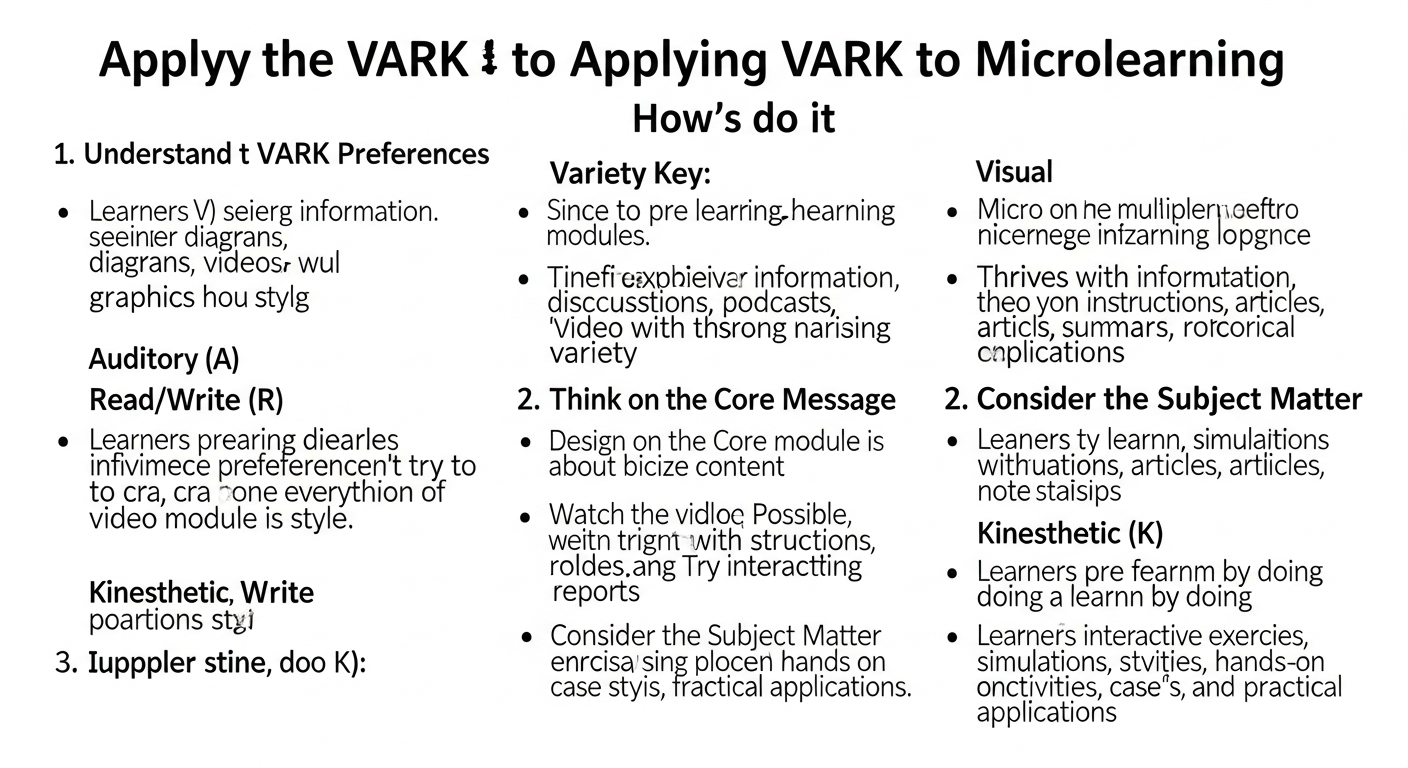
Mastering Modern Learning: Applying the VARK Model to Microlearning Design
In today's fast-paced corporate environment, effective learning and development (L&D) is not merely a perk; it's a strategic imperative. As L&D leaders, Vice Presidents, Directors, and Senior Managers, you are constantly seeking innovative methodologies to enhance employee competence, boost performance, and drive business growth across diverse sectors like Compliance, Sales, Banking, Finance, Insurance, Retail, Pharma, Health Care, Hospitality, Oil and Gas, and Mining. The challenge lies in delivering impactful training that resonates with every individual, regardless of their preferred learning style.
Enter the powerful synergy of the VARK model and microlearning design. This article delves into how combining these two approaches can revolutionize your organization's training programs, making them more engaging, retainable, and ultimately, more effective. We'll explore practical strategies for integrating VARK principles into bite-sized learning experiences, leveraging advanced learning management solutions, and addressing critical questions faced by modern L&D departments.
Understanding the Pillars: VARK and Microlearning
Before we explore their integration, let's briefly revisit the foundational concepts.
The VARK Model: Tailoring to Individual Preferences
Developed by Neil Fleming, the VARK model categorizes learning preferences into four distinct types:
- Visual (V): Learners who best absorb information when it's presented visually through graphics, charts, diagrams, infographics, and videos.
- Aural (A): Individuals who learn effectively by hearing information, such as through lectures, discussions, podcasts, and audio explanations.
- Read/Write (R): Those who prefer to learn by engaging with text – reading articles, manuals, reports, and writing notes or summaries.
- Kinesthetic (K): Experiential learners who thrive on doing, hands-on activities, simulations, role-playing, and real-world application.
Recognizing these preferences is the first step toward creating truly personalized and impactful training.
Microlearning: The Power of Bite-Sized Learning
Microlearning delivers short, focused, and easily digestible content modules designed to achieve a specific learning objective. Typically lasting anywhere from 2 to 10 minutes, these modules are ideal for busy professionals who need just-in-time information or quick skill reinforcement. Its modular nature makes it incredibly versatile, perfect for delivering crucial updates in Compliance, new product features in Sales, or safety protocols in Oil and Gas.
The Synergy: Why VARK and Microlearning Are a Perfect Match
The beauty of microlearning lies in its inherent flexibility. Unlike lengthy traditional courses, microlearning segments can be easily tailored to cater to specific VARK preferences. This adaptability transforms a generic training program into a highly personalized journey, dramatically increasing learner engagement and knowledge retention.
Imagine providing a quick compliance update in a large financial institution. Instead of a single long document, you can offer a short animated video for visual learners, a brief podcast summary for aural learners, a concise FAQ document for read/write learners, and an interactive quiz or simulation for kinesthetic learners. All cover the same core information but are presented in formats optimized for different learning styles. This approach ensures that every employee, from front-line retail staff to banking executives, receives the information in a way that resonates most effectively with them, bolstering `Risk-focused Training` across the board.
Applying VARK to Microlearning Design: Practical Strategies
Designing microlearning with VARK in mind requires a deliberate approach to content creation and delivery. Here’s how you can do it:
Designing for Visual Learners
- Infographics & Visual Summaries: Create engaging infographics that distil complex information into easily digestible visuals. Perfect for explaining new policies or market trends.
- Short Animated Videos: Produce 2-5 minute animated videos explaining concepts, demonstrating procedures, or telling a story related to the training topic. A modern Microlearning LMS can host and track these assets effectively.
- Interactive Diagrams & Flowcharts: Use tools that allow learners to click on parts of a diagram to reveal more information.
Designing for Aural Learners
- Mini-Podcasts & Audio Snippets: Record short audio explanations, expert interviews, or summaries of key points. These can be consumed on the go.
- Voice-overs in Videos: Ensure all visual microlearning content has clear, engaging voice-overs that explain concepts verbally.
- Audio-based Q&A: Present a question and then provide the answer verbally, allowing learners to process information aurally.
Designing for Read/Write Learners
- Concise Text Summaries: Provide short, well-structured articles, summaries, or bullet-point lists that cover the core learning objectives.
- Interactive Quizzes with Text Feedback: Design quizzes where detailed text explanations are provided for both correct and incorrect answers. Many AI Powered Authoring Tool platforms can facilitate this.
- Downloadable Job Aids & Checklists: Offer quick reference guides that learners can print or save for future reference, crucial for procedural training in healthcare or manufacturing.
Designing for Kinesthetic Learners
- Interactive Simulations & Scenarios: Allow learners to virtually "perform" a task, make decisions, and see the consequences. This is invaluable for sales training or handling customer service scenarios in retail.
- Drag-and-Drop Activities: Engage learners with interactive exercises where they categorize, sequence, or match elements.
- Gamified LMS Elements: Incorporate points, badges, leaderboards, and challenges into microlearning modules to make the learning process more active and competitive.
- Practical Exercises & Role-Playing Prompts: Suggest real-world tasks or discussion points that learners can apply immediately after a microlearning module.
Leveraging Technology for Personalized Microlearning
Implementing a VARK-aligned microlearning strategy at scale requires robust technology. A modern `LMS` or `learning content management system` is your central hub for delivering, managing, and tracking these diverse learning assets. A sophisticated `learning management system` like `MaxLearn LMS` can facilitate `enterprise learning management` across large organizations, ensuring consistent training for thousands of employees.
Key features to look for in your `learning management software` or `learning management solutions` include:
- Content Agnosticism: The ability to host and deliver various content formats (video, audio, text, interactive simulations).
- User-Friendly Interface: For both learners and administrators, ensuring easy access and management of microlearning modules.
- Adaptive Learning Pathways: An advanced `cloud based learning management system` can use AI to suggest microlearning modules based on a learner's past performance, preferences, and job role, creating truly personalized learning journeys.
- Robust Analytics: To track engagement, completion rates, and proficiency across different content types.
By using a comprehensive `LCMS`, L&D teams can efficiently organize, update, and distribute microlearning content, ensuring that employees in industries like Pharma and Hospitality receive up-to-date and relevant training.
Addressing Key Questions for Modern L&D Leaders
How can intelligent systems enhance personalized learning paths?
Intelligent systems, powered by artificial intelligence, can revolutionize personalized learning. They analyze learner data – including previous performance, engagement with different content types, and stated preferences – to dynamically recommend specific microlearning modules. For example, if a learner struggles with a concept presented visually, the system can automatically suggest an audio explanation or a text-based summary. An AI Powered Authoring Tool, integrated with your `lms learning management system`, can even help generate multiple content formats from a single input, drastically speeding up content creation and ensuring diverse options for all VARK styles.
What are the best practices for training a globally distributed workforce efficiently?
For multinational corporations in sectors like Oil and Gas or Finance, training a globally distributed workforce presents unique challenges. Microlearning, delivered via a scalable `cloud based learning management system`, offers a flexible solution. Best practices include providing content in multiple VARK formats to accommodate diverse learning styles and cultural preferences, ensuring mobile accessibility for on-the-go learning, and leveraging analytics to identify regional training gaps. This approach guarantees that critical `Risk-focused Training`, such as new financial regulations or safety protocols, is uniformly and effectively disseminated across all locations.
What is the most effective way for L&D leaders to demonstrate ROI for their training initiatives?
Demonstrating return on investment (ROI) is paramount for L&D leaders. By applying the VARK model to microlearning, you can show direct improvements in knowledge retention and skill application. A robust `MaxLearn LMS` allows you to track completion rates for different microlearning types, correlate training with performance metrics (e.g., increased sales, reduced compliance errors, improved customer satisfaction), and conduct pre/post-training assessments. The enhanced engagement and effectiveness driven by personalized microlearning translate into measurable improvements in employee productivity and reduced training costs, making a clear case for continued investment in your `learning management solutions`.
Benefits for Your Organization
Implementing a VARK-aligned microlearning strategy delivers tangible benefits:
- Improved Engagement: Learners are more likely to engage with content tailored to their preferred style.
- Better Knowledge Retention: Information delivered in an optimal format is easier to process and remember.
- Reduced Training Time: Efficient, targeted microlearning minimizes time away from job duties.
- Enhanced Performance: Better understanding and retention lead directly to improved job performance.
- Higher ROI: More effective training translates to better business outcomes and a clearer demonstration of value from your L&D initiatives.
Conclusion
In the dynamic landscape of modern corporate training, the fusion of the VARK model and microlearning design offers L&D leaders a potent strategy to elevate their programs. By understanding and catering to individual learning preferences within a flexible, bite-sized framework, you can create a truly inclusive and highly effective learning environment. Leveraging sophisticated `learning management solutions` and an advanced `lms learning management system` like `MaxLearn LMS` empowers you to deliver personalized, impactful training that drives engagement, performance, and ultimately, sustainable business success across every industry you serve. Embrace this methodology to build a future-ready workforce, equipped with the knowledge and skills needed to thrive.


Comments
Post a Comment