Driving Workforce Productivity Through VARK-Compliant Adaptive Delivery
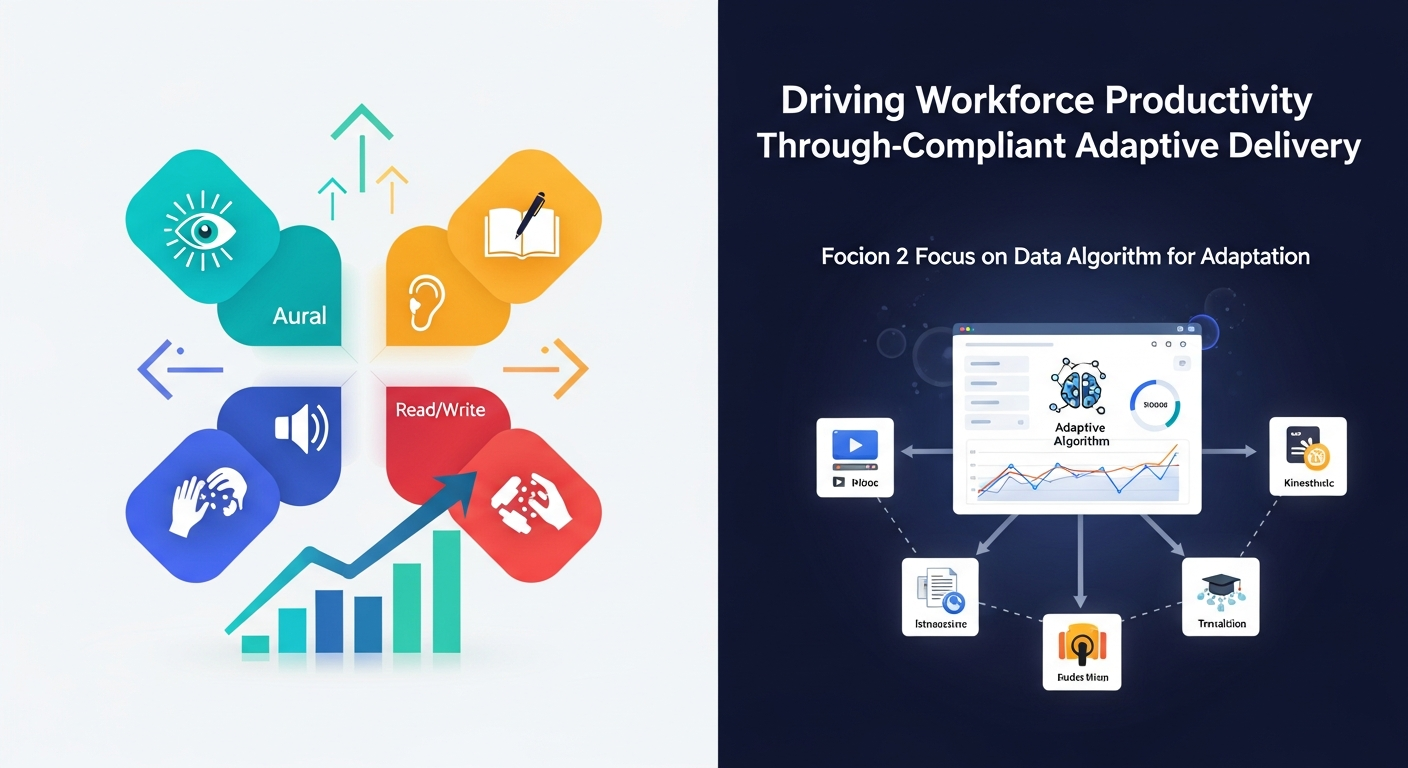
Driving Workforce Productivity Through VARK-Compliant Adaptive Delivery
In today's fast-evolving corporate landscape, the efficiency and adaptability of your workforce are paramount to sustained success. For Vice Presidents, Directors, and Managers of Learning and Development, the challenge isn't just delivering training, but ensuring that training truly resonates, is retained, and translates into tangible performance improvements. Traditional, one-size-fits-all training programs often fall short, leaving employees disengaged and skill gaps unaddressed. The key to unlocking enhanced workforce productivity lies in embracing personalized learning methodologies, specifically through VARK-compliant adaptive delivery powered by an advanced LMS.
Imagine a learning environment where every employee receives content tailored precisely to their unique learning preferences and current knowledge level. This is the promise of adaptive learning, a powerful approach that recognizes the diverse needs within any organization, from compliance-heavy sectors like banking and pharma to customer-facing roles in retail and hospitality. By integrating the VARK learning model (Visual, Auditory, Read/Write, Kinesthetic) with intelligent adaptive delivery, companies can create highly effective learning experiences that dramatically boost engagement, knowledge retention, and ultimately, productivity.
Understanding VARK and Its Impact on Learning
The VARK model, developed by Neil Fleming, categorizes learning preferences into four primary types:
- Visual (V): Learners prefer to see information presented graphically, using charts, diagrams, infographics, videos, and demonstrations.
- Auditory (A): Learners absorb information best through listening, such as lectures, discussions, podcasts, and audio explanations.
- Read/Write (R): Learners prefer text-based content, including manuals, reports, articles, lists, and the act of taking notes.
- Kinesthetic (K): Learners thrive on hands-on experiences, simulations, role-playing, practical exercises, and real-world application.
Understanding these preferences is foundational. When training material aligns with an individual's VARK style, comprehension improves, engagement soars, and the likelihood of applying new skills increases significantly. Conversely, forcing a visual learner through an audio-only course, or a kinesthetic learner through a purely text-based module, leads to frustration, disengagement, and poor learning outcomes.
The Power of Adaptive Delivery
Adaptive delivery is a dynamic, data-driven approach to learning that personalizes content, pace, and pathway based on a learner's individual performance, preferences, and goals. Unlike static courses, an adaptive system constantly assesses the learner's progress and adjusts the learning journey in real-time. This ensures that learners are always challenged appropriately – not bored by redundant information, nor overwhelmed by advanced concepts they're not ready for.
When combined with the VARK model, adaptive delivery truly shines. A sophisticated MaxLearn LMS, functioning as a robust learning content management system, can identify a learner's VARK preference (through initial assessments or inferred from their interactions) and then deliver content in the most suitable format. For an enterprise learning management system, this means efficiency and effectiveness across the entire organization, whether it’s for sales training, compliance updates, or technical skill development.
Integrating VARK with Adaptive Delivery for Enhanced Productivity
By leveraging a modern learning management system that supports adaptive delivery, organizations can cater to diverse learning styles:
- For Visual Learners: The system prioritizes video tutorials, animated explanations, interactive infographics, and visually rich presentations.
- For Auditory Learners: Content is delivered through podcasts, audio summaries, expert interviews, and opportunities for verbal discussion.
- For Read/Write Learners: The platform offers comprehensive e-books, detailed articles, downloadable reports, and prompts for written reflections or quizzes.
- For Kinesthetic Learners: The Gamified LMS provides interactive simulations, virtual labs, decision-making scenarios, and practical exercises that allow them to "do" and experience.
This targeted approach not only enhances engagement but also dramatically reduces the time employees spend on ineffective training, freeing them up for productive work. For industries like healthcare, where precise procedures are critical, or finance, where understanding complex regulations is a must, this focused learning is invaluable.
The Role of Technology: Modern LMS Solutions
Implementing VARK-compliant adaptive delivery necessitates a powerful and flexible learning management software. A modern cloud based learning management system goes beyond simple content delivery. It acts as an intelligent learning management system, capable of:
- Assessing individual learning styles and knowledge gaps.
- Curating personalized learning paths from a vast library of learning content management system resources.
- Delivering content in multiple formats to suit VARK preferences.
- Tracking progress and performance in real-time.
- Providing immediate, constructive feedback.
- Offering a Microlearning LMS approach for bite-sized, digestible content delivery, perfect for busy professionals.
These advanced learning management solutions (often referred to as an LCMS due to their content management capabilities) are indispensable tools for L&D leaders aiming to elevate their training programs.
AI-Driven Insights for Hyper-Personalization
As L&D leaders, you might wonder: How can sophisticated technology truly personalize corporate training for a workforce with diverse learning styles and prior knowledge?
The answer lies in artificial intelligence and machine learning. Modern learning platforms leverage AI to analyze vast amounts of learner data – from completion rates and quiz scores to content interactions and time spent on modules. This data helps the system infer individual learning preferences, identify specific knowledge gaps, and even predict areas where a learner might struggle. Based on these insights, the system can dynamically adjust the learning path, recommend additional resources, or present content in an alternative VARK-preferred format. This is the essence of Adaptive Learning, making every minute of training highly efficient and impactful.
Another common query from L&D professionals, especially those managing global teams, is: What advanced tools enable the creation and deployment of highly effective, customized training materials across global teams and varied operational contexts?
Here, the innovation of an AI Powered Authoring Tool becomes a game-changer. These tools can automatically generate content variations (e.g., converting text to audio, creating visual summaries from text, or suggesting interactive elements) to align with VARK preferences. This drastically reduces the instructional design effort while maximizing content relevance and engagement for diverse audiences, ensuring that training is not only personalized but also universally accessible and effective.
Finally, L&D executives frequently contemplate: Beyond merely meeting compliance standards, how does a deeply customized learning approach contribute to a more productive, adaptable, and resilient workforce in high-stakes industries?
The strategic value of personalized, VARK-compliant adaptive delivery extends far beyond ticking compliance boxes. In industries like Pharma, Finance, and Oil & Gas, where stakes are exceptionally high, errors can be catastrophic. By delivering Risk-focused Training that is precisely tailored to individual understanding and retention, adaptive systems ensure critical information is deeply ingrained. This reduces human error, improves adherence to complex protocols, and builds a workforce that is not just compliant, but genuinely competent and resilient in navigating complex operational challenges. It’s about cultivating expertise that actively prevents risks and drives sustainable growth.
Benefits Across Industries
- Compliance: In Banking, Insurance, and Pharma, adaptive delivery ensures critical regulations are understood and retained, reducing legal and financial risks.
- Sales: For Retail and Sales teams, personalized training on product knowledge and selling techniques leads to faster ramp-up times and increased revenue.
- Healthcare: Adaptive learning helps medical professionals master complex procedures and stay updated on ever-changing protocols, improving patient outcomes.
- Hospitality: Employees receive tailored training on customer service standards and operational procedures, enhancing guest satisfaction and brand reputation.
Measuring Success and ROI
The true measure of any training initiative is its impact on business outcomes. With VARK-compliant adaptive delivery through a modern lms learning management system, L&D leaders can track a range of metrics:
- Increased course completion rates and reduced dropout rates.
- Higher scores on assessments and certifications.
- Improved on-the-job performance and productivity metrics.
- Reduced training time and associated costs.
- Enhanced employee engagement and satisfaction.
These quantifiable results demonstrate a clear return on investment (ROI) for advanced learning management solutions, proving that investing in personalized, adaptive training is an investment in your workforce's productivity and your organization's future.
Conclusion
Driving workforce productivity in today’s dynamic environment demands a shift from generic training to highly personalized, engaging, and effective learning experiences. VARK-compliant adaptive delivery, powered by intelligent learning management solutions, offers L&D leaders a strategic framework to meet this demand. By understanding and catering to individual learning styles, organizations across all industries can foster a more knowledgeable, skilled, and productive workforce, ready to tackle future challenges and drive unprecedented growth. Embracing this methodology is not just an option; it's a strategic imperative for any forward-thinking enterprise.


Comments
Post a Comment