Designing Risk-Specific Training Using Fleming’s Four Sensory Modalities
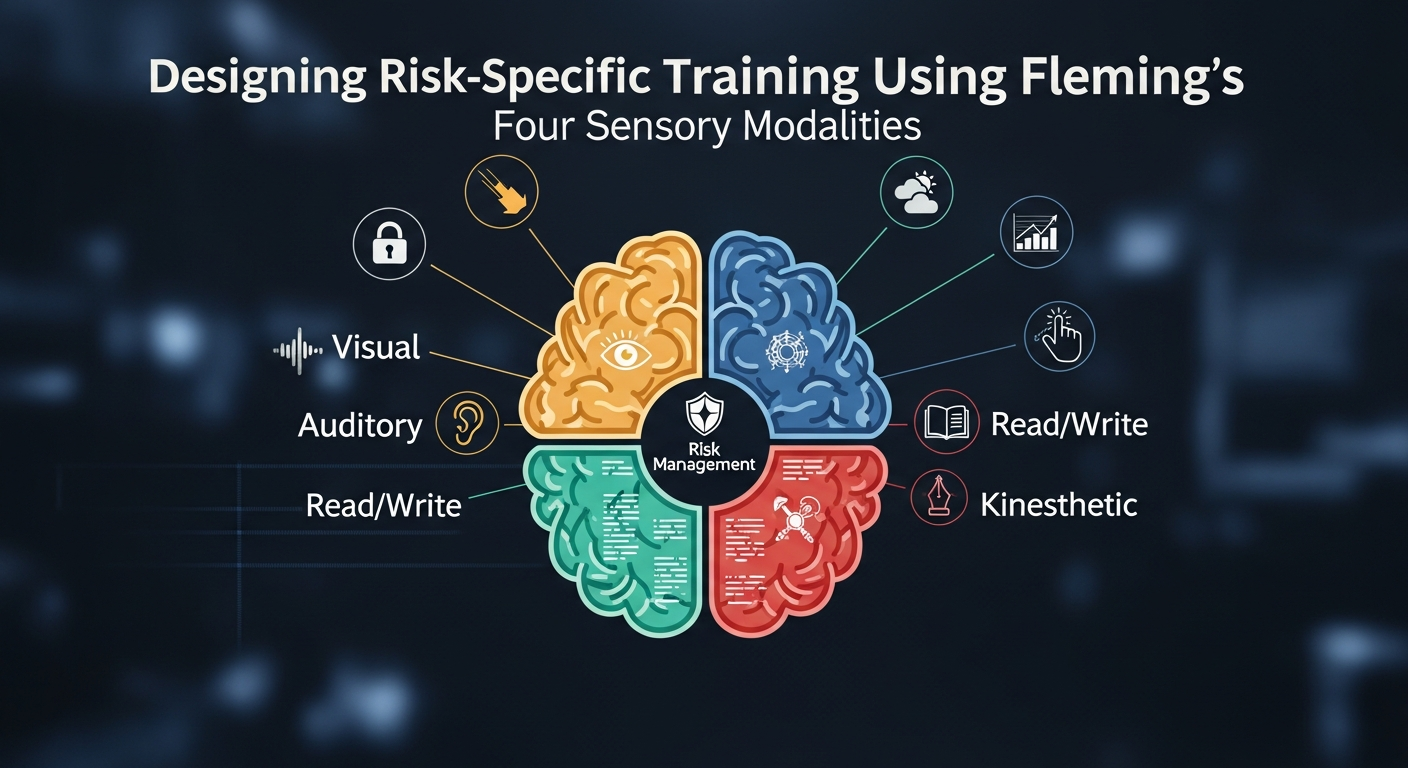
Designing Risk-Specific Training Using Fleming’s Four Sensory Modalities
For Vice Presidents, Directors, Senior Managers, and Managers in Learning & Development, the mandate is clear: training must be effective, engaging, and directly impact business outcomes. In high-stakes environments like Compliance, Sales, Banking, Finance, Insurance, Retail, Pharma, Health Care, Hospitality, Oil & Gas, and Mining, this often translates to mastering the complexities of risk. Generic, one-size-fits-all training modules, however, frequently fall short. The key to truly impactful Risk-focused Training lies in understanding how individuals learn and tailoring content to their unique preferences. This is where Fleming’s Four Sensory Modalities, often known as VARK, offers a powerful framework for designing training that sticks.
The Critical Need for Risk-Specific Training
In today's dynamic business landscape, organizations face an array of risks – from regulatory non-compliance and financial fraud to operational hazards and reputational damage. The consequences of inadequate training are severe, ranging from hefty fines and legal battles to significant financial losses and eroded customer trust. This makes targeted, specialized training not just beneficial, but absolutely essential. It's about empowering employees not only to identify risks but to proactively mitigate them within their specific roles and industry contexts.
Consider the varying risks across sectors:
- Banking & Finance: Anti-money laundering (AML), Know Your Customer (KYC), market volatility, cybersecurity threats.
- Pharma & Health Care: Patient safety protocols, regulatory compliance (FDA, HIPAA), data privacy, drug interaction risks.
- Oil & Gas & Mining: Operational safety, environmental regulations, hazard identification, emergency response.
- Sales & Retail: Ethical selling, data privacy (GDPR, CCPA), fraud prevention, customer service risk.
Each domain demands a nuanced approach, and an effective LMS can be instrumental in delivering this specialized content. Yet, even with the right content, if the delivery method doesn't resonate with the learner, its impact will be limited.
Unpacking Fleming’s Four Sensory Modalities (VARK)
Neil Fleming’s VARK model categorizes learning preferences into four primary modalities:
- Visual (V): Learners prefer seeing information. This includes charts, graphs, diagrams, infographics, videos, and demonstrations. They often visualize concepts to understand them better.
- Auditory (A): Learners prefer hearing information. This involves lectures, discussions, podcasts, audio recordings, and verbal instructions. They often learn best by listening and speaking.
- Read/Write (R): Learners prefer information displayed as text. This includes reading articles, manuals, reports, and taking detailed notes. They excel with lists, headings, and textual explanations.
- Kinesthetic (K): Learners prefer hands-on experience and practical application. This involves simulations, role-playing, case studies, experiments, and field trips. They learn by doing and experiencing.
While most individuals are multimodal, possessing a blend of these preferences, identifying a primary leaning allows L&D professionals to craft highly personalized and effective training experiences. An advanced learning content management system can often help in mapping learner preferences.
Integrating VARK into Risk-Specific Training Design
The power of VARK truly shines when applied to complex, high-stakes risk training. Here’s how to tailor your approach:
Visual Strategies for Risk Training
- Infographics & Flowcharts: Illustrate complex compliance procedures (e.g., AML transaction monitoring flowcharts, HIPAA data breach response diagrams).
- Video Case Studies: Show real-world examples of risk scenarios and their consequences (e.g., a video depicting an industrial accident in Oil & Gas due to ignored safety protocols).
- Interactive Dashboards: Visualize risk exposure metrics, regulatory change timelines, or market trend analyses for financial professionals.
Auditory Strategies for Risk Training
- Expert Interviews & Podcasts: Feature compliance officers, cybersecurity experts, or industry veterans discussing emerging threats and best practices.
- Interactive Q&A Sessions: Host live webinars or virtual forums where employees can verbally ask questions about specific risk scenarios.
- Audio Narratives: Provide spoken explanations of complex policies or legal texts, allowing learners to listen on the go.
Read/Write Strategies for Risk Training
- Detailed Policy & Procedure Documents: Provide comprehensive guides on fraud prevention, ethical guidelines, or data privacy policies.
- Risk Assessment Templates: Engage learners in completing written risk assessments for their departments or projects.
- Memo & Report Writing Exercises: Task learners with drafting incident reports or compliance summaries.
- Knowledge Bases: A robust learning management software can serve as a central repository for all textual learning materials.
Kinesthetic Strategies for Risk Training
- Simulations & Role-Playing: Conduct virtual simulations of a trading floor to manage financial risk, or role-play customer interactions in retail to practice de-escalation tactics.
- Interactive Case Studies: Present real-world dilemmas where learners must make decisions and see the immediate consequences within a simulated environment.
- Virtual Reality (VR) Training: Immerse employees in hazardous environments (e.g., an offshore drilling rig, a chemical plant) to practice safety protocols without physical risk. A Gamified LMS can provide the framework for such experiences.
Leveraging Technology for Enhanced Risk Training
Modern learning management solutions are crucial enablers for implementing VARK-based risk training. An effective lms learning management system can host diverse content types and track learner progress across modalities.
How can artificial intelligence personalize risk management training for our employees?
Artificial intelligence can analyze learner data, including their performance, role, and identified learning preferences (e.g., Visual or Kinesthetic). Based on this, an LMS can dynamically suggest personalized learning paths. For instance, if an AI detects that a sales manager consistently struggles with a particular compliance regulation and engages more with video content, it can automatically recommend a series of engaging Microlearning LMS video modules specifically addressing that compliance area, rather than directing them to a lengthy policy document.
What are the most effective strategies for deploying risk compliance training across global offices?
For organizations with a global footprint, a robust cloud based learning management system is paramount. It ensures consistent and equitable delivery of critical compliance content, irrespective of geographical location. The strategy involves utilizing a rich mix of formats – high-quality videos for visual learners, downloadable podcasts or audio commentaries for auditory learners, comprehensive digital manuals for read/write preferences, and localized interactive simulations for kinesthetic learners. This multi-modal approach, supported by an enterprise learning management solution, caters to diverse regional learning styles and varying internet infrastructure capabilities, ensuring maximum engagement and compliance adherence across all employees.
Can innovative technology improve our employees' retention of complex financial risk information?
Absolutely. Implementing an LCMS with Gamified LMS features can significantly enhance the retention of complex financial risk information. By transforming dry, abstract concepts into interactive challenges, scenarios, or simulations – where employees earn points, badges, or progress through levels – learners are actively engaged. This active engagement leads to deeper cognitive processing and much better recall. An AI Powered Authoring Tool can even accelerate the creation of these dynamic, engaging elements, making it easier to produce compelling Adaptive Learning experiences.
The Benefits of a VARK-Driven Approach to Risk Training
By designing training with Fleming’s modalities in mind, L&D leaders can achieve:
- Increased Engagement & Retention: Learners grasp complex concepts more readily when presented in their preferred style, leading to better recall and application.
- Improved Risk Mitigation: A deeper understanding of risks translates directly into proactive employee behavior and reduced incidents.
- Higher ROI on Training Investments: More effective training means less re-training, fewer errors, and a stronger compliance posture.
- Empowered Workforce: Employees feel more competent and confident in their ability to manage risks, fostering a stronger risk-aware culture.
- Flexibility and Accessibility: Offering diverse formats via a modern MaxLearn LMS ensures accessibility for all learners, regardless of their learning style or location.
Conclusion
The journey from generic risk awareness to robust risk mitigation demands a sophisticated approach to training design. By meticulously applying Fleming’s Four Sensory Modalities – Visual, Auditory, Read/Write, and Kinesthetic – L&D leaders can craft training programs that are not only comprehensive but profoundly impactful. Integrating these modalities with cutting-edge learning management system technology creates a powerful synergy, ensuring that every employee, regardless of their preferred learning style, is equipped to navigate and mitigate the specific risks of their industry. It’s time to move beyond compliance checkboxes and invest in Risk-focused Training that genuinely transforms behavior and safeguards your organization’s future.


Comments
Post a Comment