Can You Use the VARK Framework in AI-Driven Microlearning?
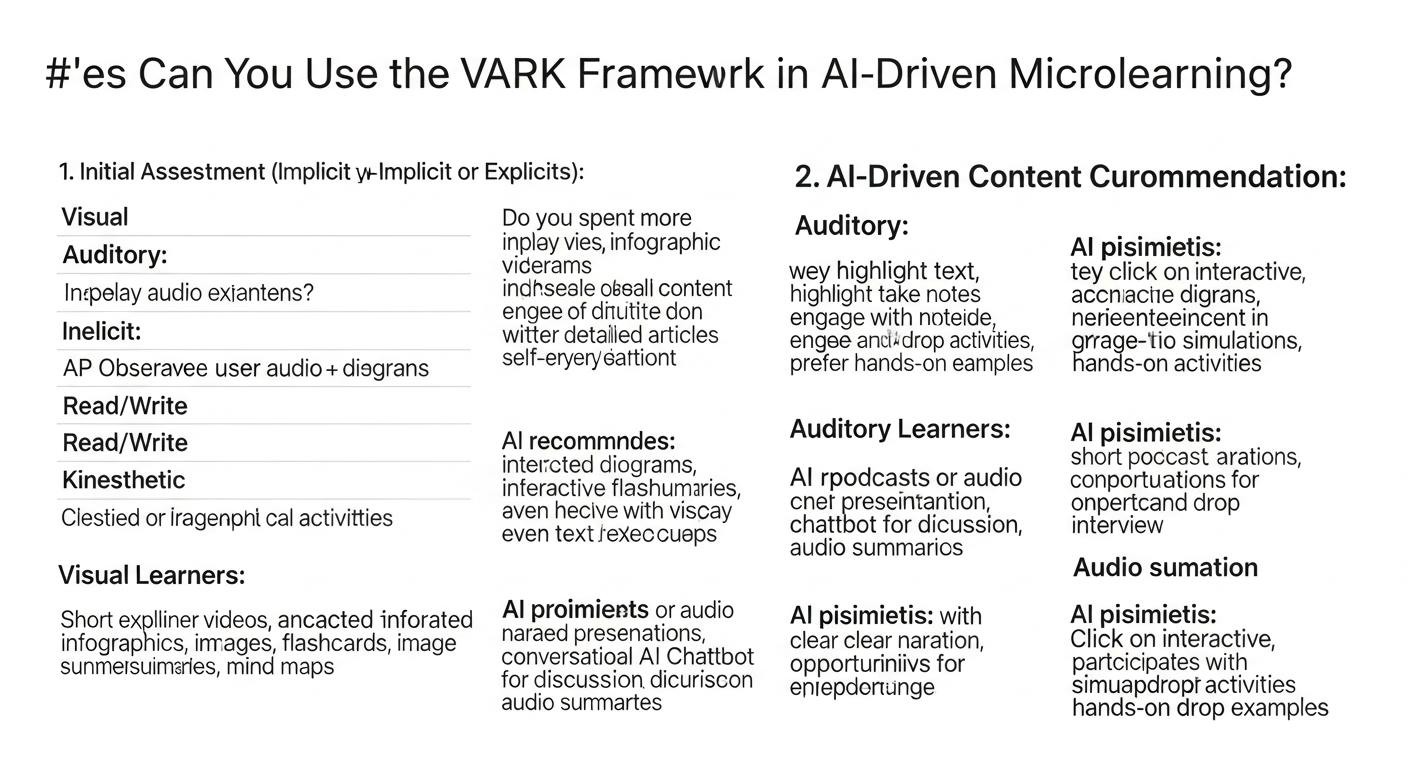
Can You Use the VARK Framework in AI-Driven Microlearning?
In today's fast-paced corporate world, learning and development leaders are constantly seeking innovative strategies to enhance employee engagement, retention, and performance. The challenge intensifies across diverse industries like Compliance, Sales, Banking, Finance, Insurance, Retail, Pharma, Healthcare, Hospitality, Oil and Gas, and Mining, where effective training can directly impact bottom-line results and regulatory adherence. Two powerful methodologies, the VARK learning framework and AI-driven microlearning, are gaining significant traction. But can these two seemingly disparate approaches truly harmonize to create a more effective and personalized learning experience?
For L&D professionals grappling with scaling personalized training, the intersection of established learning theories and cutting-edge technology offers compelling possibilities. The potential for an Microlearning LMS to adapt to individual preferences, informed by frameworks like VARK, could be a game-changer for enterprise learning management.
Understanding VARK and the Power of Microlearning
What is the VARK Framework?
The VARK model categorizes learners into four primary preferences:
- Visual (V): Learners who prefer information presented visually, through charts, graphs, diagrams, and videos.
- Auditory (A): Learners who learn best by hearing, through lectures, discussions, podcasts, and audio explanations.
- Read/Write (R): Learners who prefer information displayed as text, through manuals, reports, articles, and note-taking.
- Kinesthetic (K): Learners who learn by doing, through simulations, hands-on activities, practical exercises, and real-world application.
While often criticized for its simplicity, VARK provides a useful lens through which to consider the diversity of learning styles within any workforce. Understanding these preferences can guide content creation, making learning more accessible and impactful.
The Rise of Microlearning
Microlearning delivers short, focused bursts of information designed to achieve specific learning outcomes. Its bite-sized nature makes it highly suitable for busy professionals, allowing them to absorb critical knowledge without significant disruption to their workflow. Whether it's a quick compliance update in finance, a new product feature for a sales team, or a safety protocol in mining, microlearning ensures just-in-time and just-enough learning. A robust learning management system that supports microlearning is crucial for its effective deployment.
The AI Revolution in Personalized Learning
Artificial intelligence is rapidly transforming the landscape of corporate training. From content creation to delivery and assessment, intelligent systems are introducing unprecedented levels of personalization and efficiency. A modern Microlearning LMS leverages AI to move beyond one-size-fits-all training, enabling truly adaptive and engaging experiences. This is where the synergy with VARK becomes profoundly relevant.
Consider an organization seeking a comprehensive learning content management system. An AI-powered platform can not only host diverse content but also analyze learner interactions to infer preferences. This sophisticated learning management software moves beyond traditional tracking, allowing for more dynamic course recommendations and content adjustments. MaxLearn LMS, for instance, focuses on delivering tailored content precisely when and where it's needed, making it an ideal cloud based learning management system for today's dynamic businesses.
Aligning VARK with AI-Driven Microlearning: A Practical Approach
The core question for L&D leaders is how AI can practically identify and cater to VARK preferences within a microlearning environment. The answer lies in AI's ability to analyze data, adapt content, and deliver personalized pathways.
Catering to Visual Learners
AI can dynamically recommend and generate visual microlearning content. Think short animated explainers, interactive infographics, video snippets, or simulations. An AI Powered Authoring Tool can quickly convert textual information into visually engaging formats, ensuring visual learners receive content in their preferred style, whether it's understanding complex financial models or new pharmaceutical guidelines.
Engaging Auditory Learners
For auditory learners, AI can provide audio summaries of text-based modules, integrate podcasts, or even generate natural-sounding voiceovers for visual content. Imagine an AI-narrated summary of a new retail policy or an audio guide for a piece of healthcare equipment. A sophisticated learning management system can track consumption patterns, noting if a learner consistently opts for audio versions.
Supporting Read/Write Learners
This group often thrives on traditional text, but AI can optimize it. Short, concise articles, bullet-point summaries, interactive quizzes requiring written responses, and AI-generated study guides are all effective microlearning formats. AI can even personalize the complexity of the text or provide additional resources for deeper reading, ensuring every learner gets what they need from the learning management solutions.
Activating Kinesthetic Learners
This is where AI truly shines in delivering practical, application-based microlearning. AI can power interactive simulations, virtual reality (VR) scenarios, and Gamified LMS experiences. For a sales team, this might be an AI-driven role-play scenario; for an oil and gas worker, a virtual simulation of a hazardous task. AI can also suggest practical exercises or projects that learners can perform and document, linking theory to real-world action.
AI's Role in Adaptive Learning and Personalization
How does artificial intelligence enhance learning paths?
Artificial intelligence enhances learning paths by continuously analyzing a learner's interactions, performance, and declared preferences (if available). If a learner consistently performs well on visual quizzes and spends more time on videos, the AI-driven Microlearning LMS will prioritize visual content for future modules. Conversely, if a learner struggles with text, the system can automatically offer alternative formats. This dynamic adjustment is the essence of Adaptive Learning, making training highly relevant and efficient.
What is the global impact of intelligent tutoring systems?
Intelligent tutoring systems, powered by AI, offer a scalable solution for global training initiatives. They provide consistent, high-quality instruction across geographical boundaries, breaking down barriers of language and culture through localized content and multi-format delivery. For multinational corporations in finance or pharma, ensuring consistent compliance training across diverse regions becomes far more manageable with an advanced learning management software that can adapt to individual learner needs and local nuances. This capability supports robust enterprise learning management at a global scale.
Can advanced machine learning optimize training for specific industries?
Absolutely. Advanced machine learning algorithms can be trained on industry-specific data, optimizing microlearning content for particular sectors. For instance, in banking and finance, AI can tailor Risk-focused Training by identifying patterns in past incidents and delivering targeted micro-lessons on specific regulatory requirements or fraud detection. In healthcare, AI can personalize training on new medical procedures or patient care protocols based on a professional's role and existing knowledge gaps. An AI Powered Authoring Tool within an LCMS (Learning Content Management System) can swiftly generate and adapt content to these highly specific needs.
Challenges and Considerations for L&D Leaders
While the synergy between VARK and AI-driven microlearning is promising, L&D leaders must navigate several considerations:
- Data Privacy and Ethics: Ensuring learner data is handled responsibly and ethically, especially when AI is inferring learning styles.
- Content Quality: The effectiveness of AI-generated or recommended content is paramount. Human oversight and instructional design expertise remain critical.
- Over-reliance: Technology should augment, not replace, human connection and the deeper cognitive processes involved in learning.
- Integration: Ensuring the chosen learning management system seamlessly integrates AI capabilities and can evolve with new advancements.
Selecting the right LMS learning management system is pivotal. A platform like MaxLearn LMS is designed with these challenges in mind, offering a powerful, adaptive, and secure environment for microlearning.
The MaxLearn Advantage in AI-Driven Adaptive Microlearning
MaxLearn LMS stands at the forefront of this evolution, offering a robust platform that inherently supports the principles discussed. Our approach combines the best of microlearning with intelligent AI capabilities, providing a cloud based learning management system that empowers L&D teams. From an AI Powered Authoring Tool that streamlines content creation for various VARK styles to a Gamified LMS that engages kinesthetic learners, MaxLearn LMS offers comprehensive learning management solutions tailored for modern enterprises. We prioritize Adaptive Learning, ensuring that every learner's journey is unique and effective, whether it's for general corporate training or highly specialized Risk-focused Training.
Conclusion
The answer to whether the VARK framework can be used in AI-driven microlearning is a resounding yes. By leveraging artificial intelligence, L&D leaders can move beyond theoretical understanding of learning preferences to practical, scalable implementation. AI's ability to analyze, adapt, and deliver content in multiple formats makes it an invaluable ally in personalizing the microlearning experience according to VARK principles. This synergy not only enhances engagement and knowledge retention but also optimizes resource utilization, proving to be a strategic imperative for any forward-thinking organization. The future of enterprise learning management lies in intelligent, adaptive, and personalized solutions, and the integration of VARK within an AI-powered microlearning framework is a clear path forward.


Comments
Post a Comment