Beyond Gamification: Why Your Microlearning Needs Fleming’s VARK Model
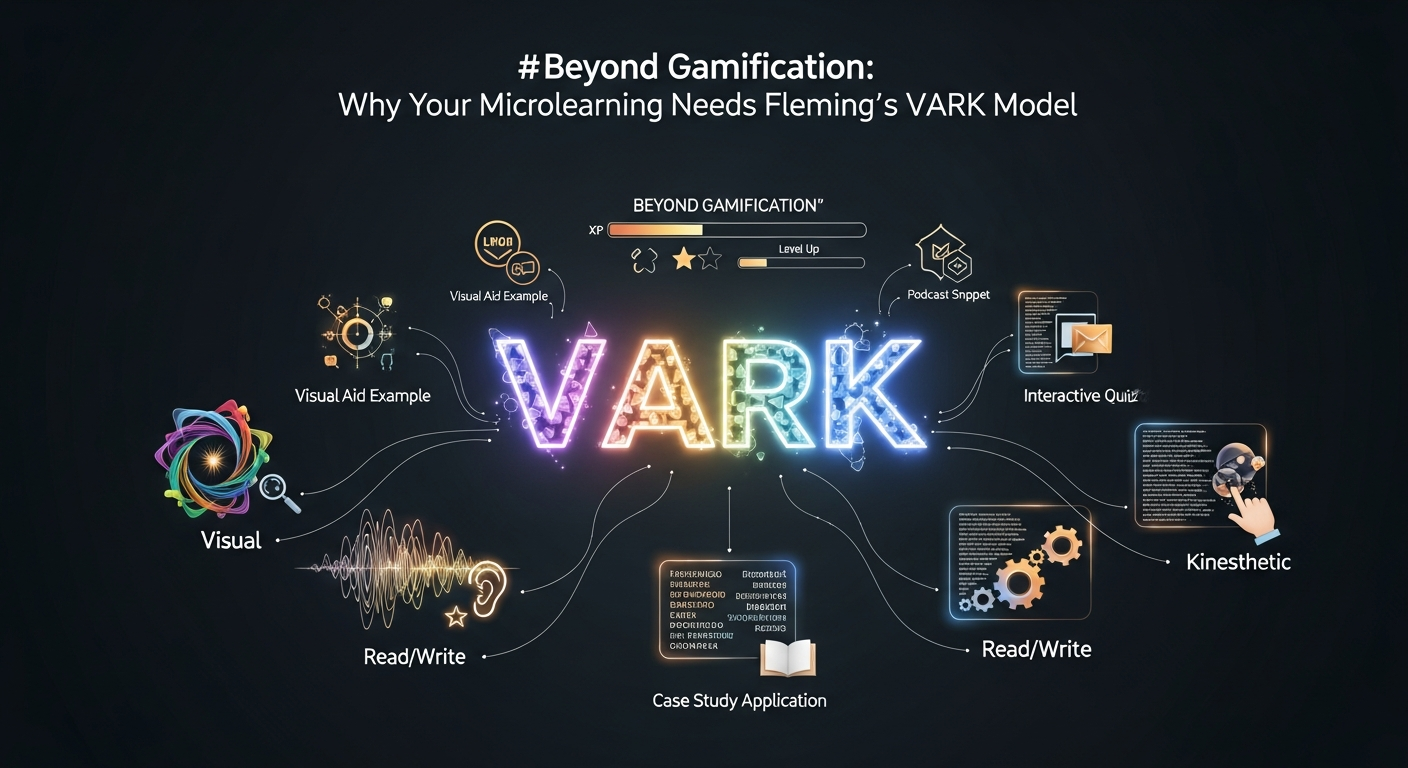
Beyond Gamification: Why Your Microlearning Needs Fleming’s VARK Model
In the dynamic landscape of corporate learning, L&D leaders, VPs, and Directors across industries like Compliance, Sales, Banking, Finance, and Healthcare constantly seek innovative ways to boost engagement, ensure retention, and drive measurable performance. While gamification has emerged as a popular strategy to inject enthusiasm into training, it often falls short of addressing the deeper, more nuanced challenge of individual learning preferences. It's time to look Beyond Gamification, and integrate a powerful framework: Fleming’s VARK Model into your microlearning strategy.
Imagine a workforce where critical information, whether it's about new financial regulations, sales product features, or patient safety protocols, isn't just consumed, but truly understood and applied. This isn't achieved through badges and leaderboards alone. It requires a more sophisticated approach that acknowledges the diverse ways people learn. This article will explore why integrating the VARK model—Visual, Aural, Read/Write, and Kinesthetic—is the essential next step for supercharging your microlearning initiatives and delivering profound impact.
The Limitations of Gamification in Isolation
Gamification, at its core, leverages game-like elements such as points, levels, and challenges to motivate learners. It has proven effective in increasing initial engagement and making learning more enjoyable. For a while, the concept of a Gamified LMS seemed like the silver bullet for low completion rates and disinterest. However, relying solely on gamification can lead to superficial engagement, where learners focus on "winning" rather than deeply internalizing the content.
- **Surface-Level Engagement:** Learners might rush through content to collect points, bypassing true comprehension.
- **Mismatch with Learning Styles:** Not everyone is motivated by competitive elements. Some learners find it stressful or distracting, hindering their ability to absorb information.
- **Lack of Transfer:** While fun, gamified elements don't inherently guarantee that knowledge is retained or can be applied in real-world scenarios, especially in complex areas like risk management in finance or compliance in pharma.
- **Diminishing Returns:** The novelty of gamification can wear off, leading to a decline in its motivational power over time.
For high-stakes environments in Banking or Oil and Gas, where precision and adherence to protocol are paramount, a strategy that only offers surface engagement poses significant risks. This is where the VARK model steps in, offering a pathway to deeper, more meaningful learning experiences within your microlearning framework.
Unpacking Fleming’s VARK Model
The VARK model, developed by Neil Fleming, categorizes learning styles into four primary preferences:
- Visual (V): Learners prefer seeing information presented graphically. They respond well to charts, graphs, diagrams, videos, and flowcharts. In a fast-paced environment like Retail or Hospitality, a quick infographic can convey complex policies effectively.
- Aural (A): These individuals learn best through hearing. Podcasts, audio recordings, discussions, and verbal instructions resonate deeply with them. For Sales professionals on the go, an audio summary of new product features can be invaluable.
- Read/Write (R): This style thrives on textual information. They prefer reading articles, manuals, bullet points, reports, and writing notes. Compliance training, for instance, often involves dense documentation, making concise written summaries crucial for these learners.
- Kinesthetic (K): Kinesthetic learners are "doers." They learn best through experience, practice, simulations, role-playing, and hands-on activities. This is particularly relevant for Health Care training, where procedural accuracy is critical, or for field workers in Mining or Oil and Gas.
It's important to remember that most individuals are a blend of these styles, often with one or two dominant preferences. The power of VARK lies not in pigeonholing learners, but in providing diverse content options that cater to these natural inclinations.
VARK: The Cornerstone of Effective Microlearning
Microlearning LMS platforms are designed for delivering bite-sized, focused content. When combined with VARK, microlearning transforms from merely being brief to being incredibly potent. By offering content in multiple VARK formats, L&D teams can:
- **Boost Retention:** When learners encounter information in their preferred style, they process it more effectively, leading to better long-term recall.
- **Enhance Comprehension:** Complex topics, common in Finance or Pharma, become more accessible when presented through diverse sensory channels.
- **Increase Application:** Understanding leads to better application. Kinesthetic micro-simulations, for example, directly translate to improved on-the-job performance.
- **Improve Learner Satisfaction:** Providing choice and catering to individual needs shows empathy and respect for the learner, fostering a more positive learning culture.
- **Reduce Training Fatigue:** Breaking down information into VARK-aligned micro-modules prevents overload and maintains engagement, especially for continuous learning in sectors like IT or Sales.
Implementing VARK in Your Microlearning Strategy
To truly leverage VARK within your microlearning framework, consider these practical applications:
- Visual Content: Create short animated explainers, infographics summarizing key policies, decision-tree diagrams for customer service scenarios, or brief video tutorials for software navigation. A robust Microlearning LMS can effectively host and deliver this rich media.
- Aural Content: Develop mini-podcasts on industry trends, audio summaries of weekly sales updates, or narrated presentations for compliance updates. These are perfect for learners during commutes or downtime.
- Read/Write Content: Design concise policy briefs, checklists for operational procedures, interactive quizzes with short answer components, or quick reference guides. A well-structured learning management software helps organize this textual content for easy access.
- Kinesthetic Content: Incorporate interactive simulations (e.g., a banking transaction simulation), virtual role-playing for difficult sales conversations, drag-and-drop exercises for identifying components, or branching scenarios that require decision-making. These hands-on experiences are vital for Risk-focused Training, ensuring learners practice critical responses.
The goal isn't to create four versions of every single microlearning module. Instead, it's about offering a variety of content formats across your curriculum that collectively cater to all VARK preferences, allowing learners to choose what resonates most or to engage with different formats for deeper understanding.
VARK, AI, and the Future of L&D
Modern L&D technologies are making it easier than ever to implement VARK-informed microlearning. An advanced learning management system (LMS) or learning content management system (LCMS) is crucial for managing and delivering this diverse content.
Advanced Learning Personalization
Question: How can L&D leaders ensure their training programs resonate with specific industry challenges in sectors like, say, the pharmaceutical sector in Europe, addressing diverse learning preferences effectively?
Answer: By focusing on contextualized microlearning modules, precisely tailored to regional regulations and professional practices, and delivered via a robust LMS that allows for localized content customization. Integrating the VARK model helps here by presenting these specific contexts and complex information in various formats – from visual process flows to aural expert interviews and interactive case studies – ensuring maximum engagement and comprehension across diverse employee populations.
Leveraging Technology for Deeper Learning
Question: What role does advanced technology play in personalizing learning experiences beyond basic quizzes and badges, truly optimizing for individual learning styles?
Answer: AI and machine learning are revolutionizing this. They can analyze learner data (completion rates, quiz scores, time spent on different content types) to infer preferred learning styles, even without explicit VARK tests. This allows an Adaptive Learning system to dynamically recommend specific microlearning formats. Furthermore, an AI Powered Authoring Tool can rapidly generate variations of content (visual summaries, audio explanations, text-based guides) for the same core topic, streamlining the creation of VARK-aligned resources. This is essential for enterprise learning management.
Optimizing for Retention in High-Stakes Environments
Question: How can organizations optimize learning pathways for maximum knowledge retention and skill transfer in high-stakes environments, such as banking compliance or health and safety training?
Answer: The key lies in leveraging data analytics and intelligent content delivery. An Adaptive Learning platform can adjust the difficulty and format of content based on individual performance and VARK preferences. For critical topics like compliance, ensuring the information is presented in ways that align with an individual’s learning style leads to deeper understanding and improved application, directly impacting success in Risk-focused Training. A comprehensive cloud based learning management system, like MaxLearn LMS, is vital for managing this diverse, personalized learning content effectively.
Conclusion
For L&D professionals seeking to move beyond mere engagement to genuine mastery, incorporating Fleming’s VARK Model into a microlearning strategy is not just beneficial—it's imperative. While a Gamified LMS adds excitement, the VARK framework ensures that learning is deeply resonant and effective across your diverse workforce. By understanding and catering to the Visual, Aural, Read/Write, and Kinesthetic preferences of your learners, you can create microlearning experiences that are not only efficient but profoundly impactful, driving real business outcomes in every industry, from Retail to Pharma, and beyond.
Embrace VARK to unlock the full potential of your Microlearning LMS, transforming training from a checkbox exercise into a powerful engine for growth and development.


Comments
Post a Comment