10 Actionable Tips for Building a VARK-Compliant Microlearning Strategy
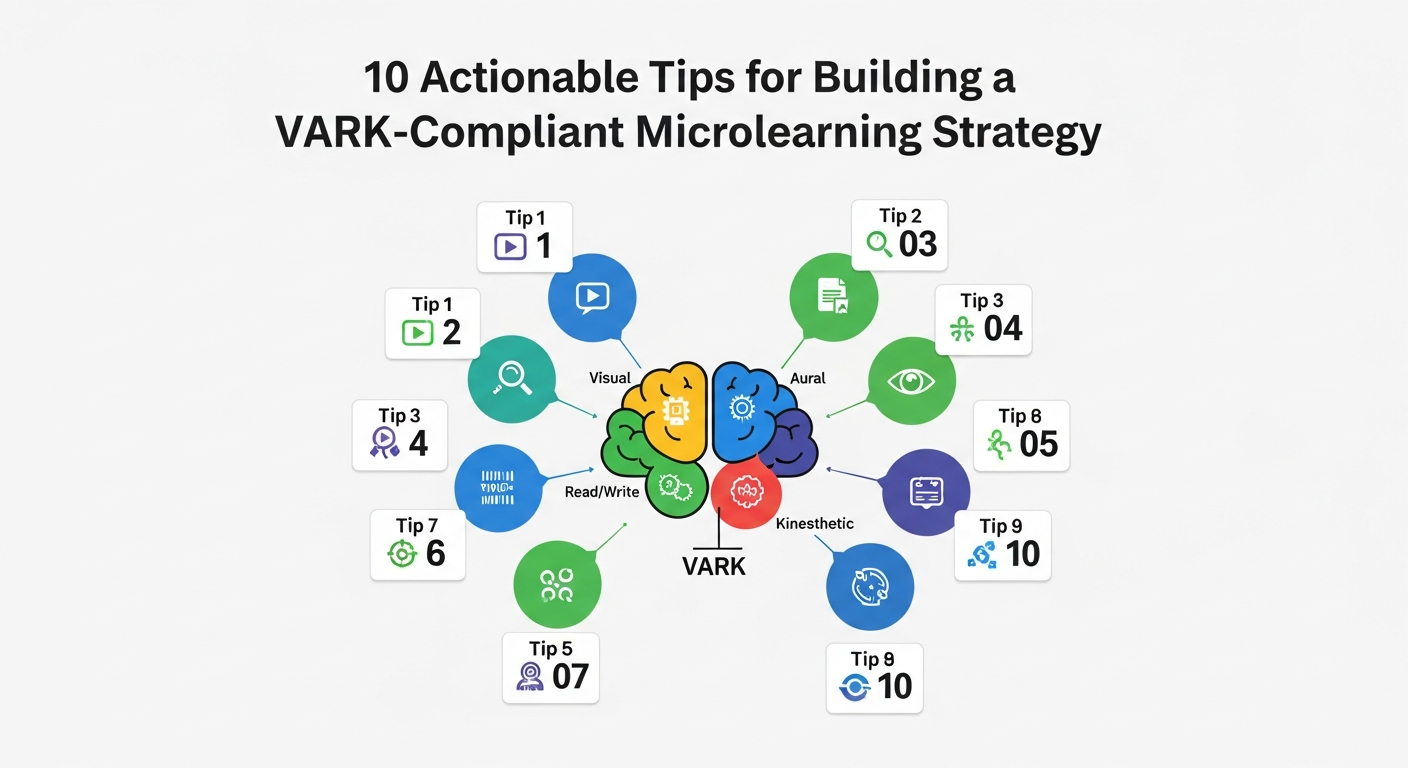
10 Actionable Tips for Building a VARK-Compliant Microlearning Strategy
As a leader in Learning & Development, you understand the paramount importance of effective training. In today's fast-paced corporate environment, Microlearning LMS has emerged as a powerful solution, offering bite-sized, digestible content that fits into busy schedules. But how do you ensure these compact learning experiences truly resonate with every employee? The answer lies in aligning your microlearning strategy with the VARK learning styles: Visual, Auditory, Read/Write, and Kinesthetic.
Understanding VARK isn't just academic; it's a strategic imperative for L&D professionals seeking to maximize engagement, retention, and ultimately, performance. A learning management system that caters to diverse learning preferences is no longer a luxury but a necessity, particularly in compliance, sales, banking, finance, insurance, retail, pharma, healthcare, hospitality, oil and gas, and mining industries where high-stakes knowledge transfer is critical. What kind of training modules truly engage my diverse team members and adapt to their preferred ways of learning?
This article provides 10 actionable tips for L&D Vice Presidents, Directors, Senior Managers, and Managers to design and implement a VARK-compliant microlearning strategy that drives real business impact. We'll also explore how modern learning management software and AI can elevate your efforts.
Understanding VARK Learning Styles for L&D Leaders
Before diving into the tips, let's quickly recap the VARK model:
- Visual (V): Learners prefer to see information presented graphically – charts, diagrams, infographics, videos.
- Auditory (A): Learners prefer to hear information – lectures, discussions, podcasts, audio recordings.
- Read/Write (R): Learners prefer to see information in text format – manuals, reports, lists, notes, articles.
- Kinesthetic (K): Learners prefer to learn by doing – simulations, hands-on activities, role-playing, practical exercises.
The goal isn't to force learners into one category but to offer a rich blend of content types within your lms learning management system that allows each individual to access information in their most effective way.
10 Actionable Tips for a VARK-Compliant Microlearning Strategy
1. Segment Content by Learning Style
Don't just create one piece of microlearning content. Instead, consider creating multiple versions or supplementary materials for a single learning objective. For instance, a policy update could have a short video (Visual), an audio summary (Auditory), a bullet-point text document (Read/Write), and an interactive quiz or scenario (Kinesthetic). This approach ensures that your enterprise learning management system provides diverse options.
2. Leverage Visual Dominance with Infographics and Videos
Visual learners thrive on imagery. Incorporate short, high-impact explainer videos, animated tutorials, infographics, and interactive diagrams into your microlearning modules. These elements can simplify complex concepts, making them ideal for areas like compliance training or product feature explanations. Can artificial intelligence assist in personalizing these learning paths and suggesting the most relevant visual assets?
3. Amplify Auditory Learning with Podcasts and Narration
For auditory learners, the spoken word is key. Provide short audio snippets, narrated presentations, podcasts, or even simple voiceovers for your visual content. These can be listened to on the go, making them perfect for busy professionals in various industries. Consider how a global workforce benefits from having audio options for learning.
4. Boost Read/Write Engagement with Concise Text and Quizzes
Read/write learners appreciate clarity and structure. Offer concise summaries, step-by-step guides, quick reference cards, and interactive text-based quizzes. Ensure your written content is easily scannable, using bullet points and clear headings. An effective Learning content management system will allow easy integration of such textual elements alongside other media.
5. Integrate Kinesthetic Experiences with Simulations and Scenarios
Kinesthetic learners learn by doing. This is where simulations, interactive decision-making scenarios, drag-and-drop exercises, and virtual role-plays become invaluable. For sales training, a simulated customer interaction is far more effective than just reading about sales techniques. How can I ensure my L&D initiatives truly resonate with all employees, particularly those who learn best through practical application?
6. Utilize a Robust Microlearning Platform
A specialized Microlearning LMS is the backbone of your strategy. It must support multiple content formats, allow for easy navigation between different learning styles, and offer robust tracking. Look for a cloud based learning management system that delivers content seamlessly across devices and regions, vital for industries like banking and healthcare with distributed workforces.
7. Personalize Learning Paths with Adaptive Technology
Modern Adaptive Learning technologies can revolutionize your microlearning. By leveraging AI, the system can assess a learner's preferred style (or even their knowledge gaps) and dynamically recommend the most suitable microlearning modules. This ensures maximum efficiency and relevance for each individual, a true game-changer for any learning management solutions implementation.
8. Incorporate Gamification Elements
Gamification appeals to all learning styles, but particularly engages kinesthetic learners through interactive challenges and a sense of achievement. Integrate points, badges, leaderboards, and progress bars into your microlearning. A Gamified LMS can transform routine compliance training into an engaging experience, boosting motivation and knowledge retention across your workforce.
9. Empower Content Creation with AI Powered Authoring Tools
Creating VARK-compliant content can be resource-intensive. An AI Powered Authoring Tool can significantly streamline this process. These tools can help convert existing text into audio summaries, generate interactive quizzes from written content, or suggest visual elements for complex topics, saving valuable time and effort for your L&D team. What role does AI play in developing VARK-sensitive content efficiently?
10. Focus on Risk-focused Training and Continuous Optimization
For industries like finance, pharma, and oil and gas, Risk-focused Training is paramount. Tailor your VARK-compliant microlearning to address critical compliance and safety procedures. Utilize analytics from your LCMS to understand which content formats lead to better comprehension and reduced errors. Continuously iterate and optimize your strategy based on data-driven insights. This ensures your microlearning is not just engaging, but also effective in mitigating risks and fostering business growth.
Conclusion
Building a VARK-compliant microlearning strategy is an investment in your organization's most valuable asset: its people. By acknowledging and catering to diverse learning preferences, L&D leaders can unlock unprecedented levels of engagement, retention, and performance. Implementing these 10 actionable tips, supported by a sophisticated MaxLearn LMS, will not only elevate your training programs but also future-proof your learning initiatives against the ever-evolving demands of the modern workplace. Embrace the power of personalized, bite-sized learning, and watch your teams thrive.


Comments
Post a Comment