What is a Player-Subject in Gamified Microlearning and Why Does It Matter?
Unlocking Potential: What is a Player-Subject in Gamified Microlearning and Why Does It Matter?
In today's fast-paced corporate environment, where employee upskilling and reskilling are paramount for sustained growth, Learning & Development (L&D) leaders face the continuous challenge of creating engaging, effective, and efficient training programs. The traditional "learner" paradigm, often passive and compliance-driven, is rapidly giving way to a more dynamic model. Enter the "player-subject" in gamified microlearning – a concept revolutionizing how organizations approach talent development across industries like Compliance, Sales, Banking, Finance, Insurance, Retail, Pharma, Health care, Hospitality, Oil and Gas, and Mining.
For Vice Presidents, Directors, Senior Managers, and Managers of L&D, understanding this shift is not merely academic; it’s strategic. It's about transforming learning from a chore into an intrinsic, motivating experience that drives measurable business outcomes. A robust Microlearning LMS serves as the backbone for such an evolution, fostering an environment where engagement thrives.
What is a Player-Subject?
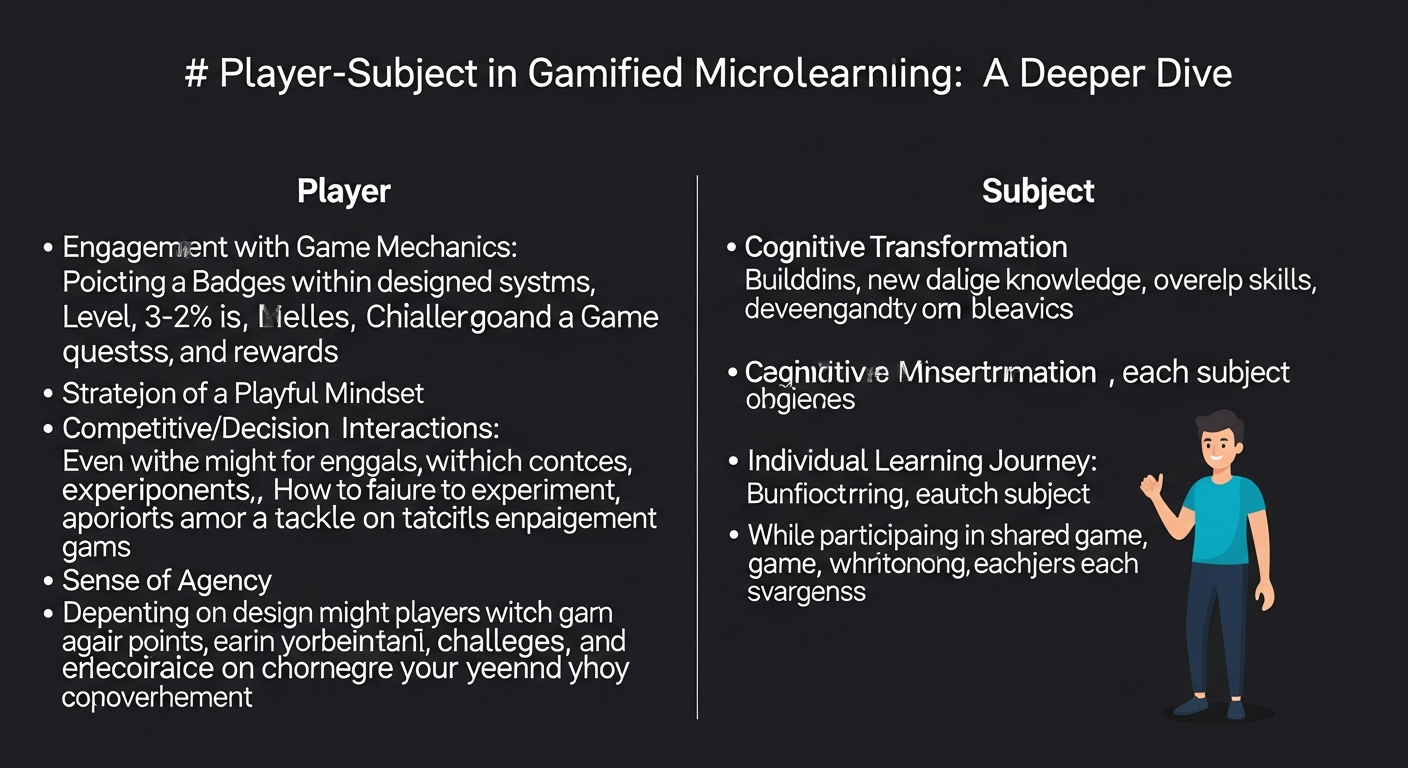
A player-subject is more than just a participant in a training module; they are an active, invested agent within a structured learning experience that leverages game mechanics and design principles. Unlike the passive "learner" who consumes information, the player-subject actively interacts, strategizes, makes choices, and experiences consequences within the learning environment. They are immersed in the narrative, motivated by progress, challenged by obstacles, and driven by the desire to achieve goals within the learning journey.
The distinction from a traditional "learner" is critical. A learner might passively read a document or watch a video. A player-subject, however, is:
- Engaged by Design: The learning content is structured with game elements like points, badges, leaderboards, levels, and quests.
- Motivated by Intrinsic Rewards: Beyond completion, there’s a drive for mastery, achievement, and social recognition.
- An Active Decision-Maker: They are constantly evaluating options, solving problems, and applying knowledge in simulated scenarios.
- Provided with Instant Feedback: Actions lead to immediate consequences or rewards, guiding their path.
- Part of a Narrative: The learning often unfolds within a story or a specific context, making it more relatable and memorable.
This paradigm shift is particularly powerful when delivered through a specialized LMS that integrates gamification seamlessly into every micro-lesson.
The "Why It Matters" – Impact on Engagement and Effectiveness
The transition to viewing employees as player-subjects holds profound implications for L&D effectiveness, directly impacting critical business metrics. This approach, facilitated by a modern learning management system, enhances various facets of the learning experience:
Enhanced Engagement and Motivation
Player-subjects are intrinsically motivated. The competitive yet collaborative nature of Gamified LMS environments taps into fundamental human desires for achievement and recognition. This sustained engagement is vital, especially for mandatory training in Compliance or complex topics in Banking and Pharma, where traditional methods often struggle with learner disinterest. A well-designed learning experience transforms mandated training into an opportunity for personal and professional growth, making employees eager to participate.
Improved Knowledge Retention
Active participation, problem-solving, and immediate feedback inherent in the player-subject model significantly boost knowledge retention. When employees actively apply concepts in simulated scenarios – whether it’s a sales pitch simulation for Retail, a risk assessment in Finance, or an emergency protocol in Health care – the learning is deeper and more lasting than passive consumption. This active recall and application cement understanding, making the knowledge readily accessible when needed on the job.
Real-world Skill Application
The core of effective corporate training is the transfer of learning to real-world performance. The player-subject model excels here by immersing individuals in relevant, context-rich challenges. For example, Oil and Gas professionals can practice safety procedures virtually, or Insurance agents can navigate complex policy scenarios. This allows for safe experimentation and mastery before applying skills in high-stakes situations, significantly reducing errors and improving operational efficiency. Utilizing a robust enterprise learning management solution ensures that these practical scenarios are consistently delivered and tracked.
Personalized Learning Paths
Modern learning platforms recognize that not all player-subjects learn at the same pace or in the same way. By embracing the player-subject concept, L&D can leverage data to offer personalized learning experiences. This is where Adaptive Learning comes into play, adjusting the difficulty and content based on individual performance and knowledge gaps. This tailored approach ensures that each player-subject receives the right content at the right time, maximizing their potential and optimizing training resources within the learning management software.
Integrating the Player-Subject Concept into Your L&D Strategy
For L&D leaders looking to harness the power of the player-subject, strategic implementation is key:
- Leveraging a Specialized LMS: Invest in a Gamified LMS that is specifically designed to support interactive, microlearning content. Such a system, often a cloud based learning management system, provides the framework for delivering engaging experiences, tracking progress, and fostering a vibrant learning community. MaxLearn LMS is an example of a platform built for this purpose.
- Developing Engaging Content: Move beyond static presentations. Utilize an AI Powered Authoring Tool to create dynamic, scenario-based modules, interactive quizzes, and short, impactful videos that align with game mechanics. This transforms passive information into active challenges for the player-subject.
- Focusing on Specific Outcomes: Design learning journeys with clear objectives and progress markers. For instance, in Hospitality, a player-subject might complete quests related to customer service scenarios, earning badges for excellence. For industries like Mining, incorporating Risk-focused Training within gamified environments can be transformative for safety adherence and operational efficiency.
- Utilizing Data Analytics: A sophisticated learning management solutions platform provides invaluable insights into player-subject behavior, performance, and areas of struggle. This data allows L&D teams to continuously refine content and tailor interventions, optimizing the learning experience and ensuring high ROI. The combination of an LCMS and an LMS learning management system can provide comprehensive data tracking for effective content and user management.
Addressing Key Questions with Advanced Insight
As L&D leaders consider adopting this transformative approach, several strategic questions often arise:
How can advanced platforms ensure consistent employee engagement across diverse global teams?
Intelligent learning systems, particularly those with a robust learning content management system, leverage data analytics to understand individual preferences and cultural nuances. They can automatically tailor content delivery, language options, and even gamification elements to resonate with different demographics. Personalized feedback loops and localized challenges within the learning journey keep every participant invested, regardless of their geographical location or role within the organization.
What are the most effective strategies for identifying and closing critical skill gaps using intelligent learning systems?
Modern platforms employ sophisticated algorithms that continuously assess a player-subject’s performance, identifying areas where they struggle or excel. This intelligence allows for the dynamic redirection of the learning path, providing targeted remediation or advanced modules as needed. By integrating Adaptive Learning capabilities, the system precisely delivers the right challenge at the right time, efficiently closing skill gaps and fostering mastery. This proactive approach saves time and resources compared to traditional, one-size-fits-all training.
How can organizations measure the tangible ROI of a dynamic learning experience on business outcomes?
The impact of a player-subject approach can be measured through comprehensive analytics offered by advanced lms learning management system solutions. Key performance indicators (KPIs) include completion rates, skill mastery scores, time-to-proficiency, and direct correlation with operational metrics such as sales figures, compliance adherence rates, safety incident reductions, and customer satisfaction scores. By linking learning activities directly to job performance and business goals, L&D leaders can demonstrate a clear, quantifiable return on investment from their talent development initiatives.
The Future of L&D: Empowering the Player-Subject
The concept of the player-subject is more than a trend; it's a fundamental shift in how we perceive and deliver corporate learning. It acknowledges the inherent human desire for purpose, progress, and interaction, transforming mundane training into an exciting, developmental journey. For L&D leaders across industries, from Compliance to Pharma, embracing this perspective is about fostering a culture of continuous learning, driving engagement, and ultimately, boosting organizational performance.
By investing in the right technologies – a powerful Gamified LMS, intelligent content creation tools like an AI Powered Authoring Tool, and a focus on Risk-focused Training where applicable – organizations can empower their employees to become active player-subjects. This leads to not just better learning outcomes, but also a more skilled, motivated, and agile workforce ready to meet the challenges of tomorrow.
The strategic imperative for L&D is clear: cultivate an environment where every employee is not just a learner, but a thriving player-subject, actively shaping their own growth and contributing meaningfully to the organization’s success. MaxLearn LMS offers the tools to make this vision a reality.


Comments
Post a Comment