What is Gamification in Corporate L&D and Does It Really Work?
What is Gamification in Corporate L&D and Does It Really Work?
In today’s rapidly evolving corporate landscape, the demand for effective and engaging learning and development (L&D) programs has never been higher. Vice Presidents, Directors, and Managers in L&D are constantly seeking innovative strategies to boost employee engagement, improve knowledge retention, and drive measurable business outcomes. One methodology that has surged in popularity is gamification. But what exactly is gamification in corporate L&D, and more importantly, does it truly deliver on its promises?
What is Gamification in Corporate L&D?
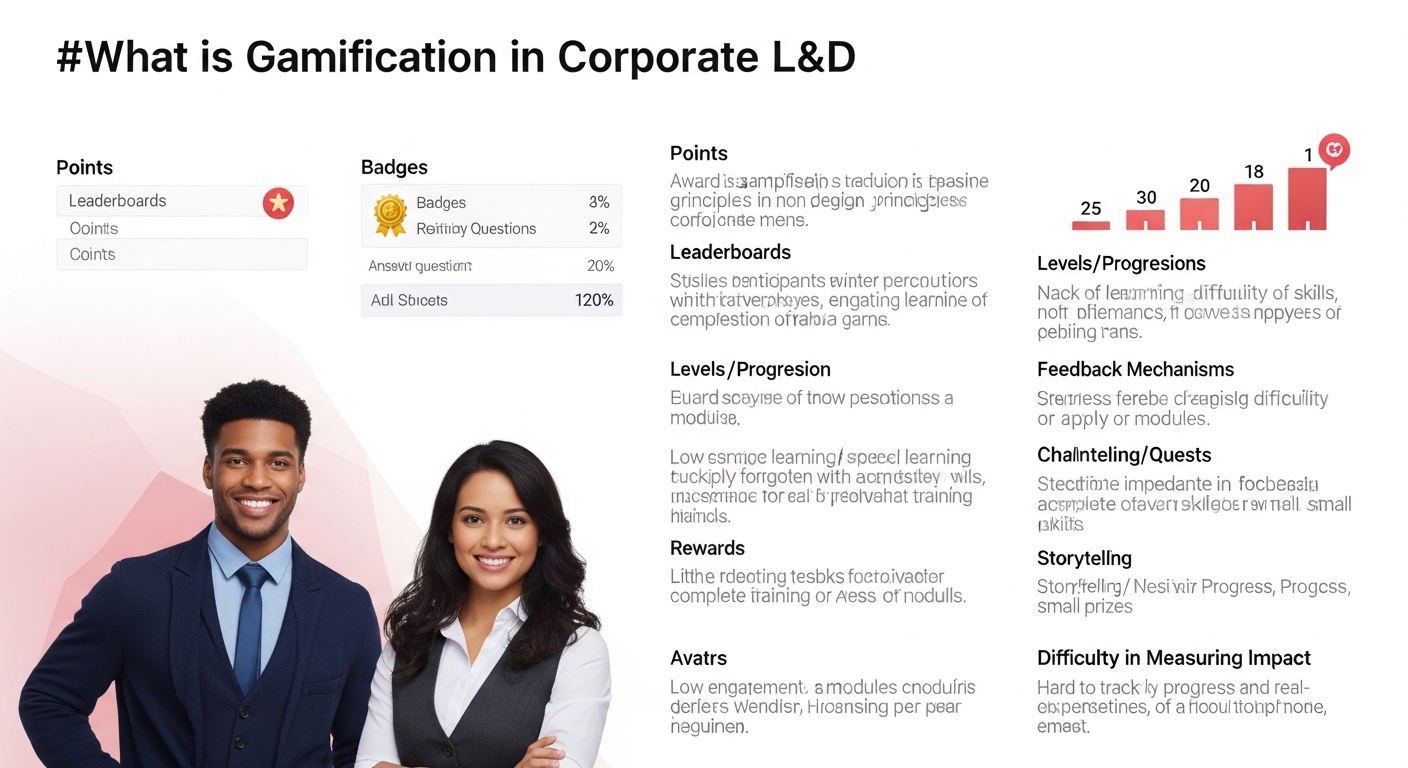
At its core, gamification is the application of game-design elements and game principles in non-game contexts. In the realm of corporate L&D, this translates to integrating elements like points, badges, leaderboards, levels, challenges, and rewards into learning programs to motivate employees, encourage participation, and make the learning process more enjoyable and effective. It's not about turning work into a game, but rather leveraging the psychological triggers that make games so compelling to enhance learning experiences.
For industries ranging from Compliance and Sales to Banking, Healthcare, and Oil and Gas, the goal is to transform potentially dry or complex training into an interactive and stimulating journey. For instance, a compliance training module could involve learners earning points for correctly identifying risks, unlocking new levels as they master regulations, or competing on a leaderboard for completing modules fastest with the highest accuracy. This approach drastically differs from traditional, passive learning methods.
A common question that arises is: What exactly does gamification entail within a corporate learning environment? It involves more than just slapping badges onto a module. Effective gamification requires thoughtful design that aligns game mechanics with specific learning objectives. It’s about creating a narrative, setting clear goals, providing immediate feedback, and fostering a sense of achievement and progression. It leverages intrinsic motivators like mastery, autonomy, and purpose, alongside extrinsic motivators like recognition and rewards, to create a holistic and engaging learning experience within an Microlearning LMS.
The "Why": Benefits of Gamification in L&D
The widespread adoption of gamification in L&D isn't just a trend; it's driven by a clear understanding of its potential benefits across various industries. L&D leaders recognize its power to address some of the most persistent challenges in corporate training.
- Enhanced Engagement: Gamification captivates learners, transforming mandatory training into an activity they actually want to participate in. This is particularly crucial for industries like Retail, Pharma, and Hospitality, where employee enthusiasm can directly impact customer experience.
- Improved Knowledge Retention: By making learning interactive and memorable, gamified modules help information stick. The active recall involved in challenges and quizzes reinforces learning pathways, leading to better long-term retention.
- Motivated Performance: The competitive and reward-based nature of gamification can spur employees to achieve higher levels of proficiency. In Sales, for example, a gamified training program can directly correlate to improved sales techniques and closing rates.
- Skill Application and Behavioral Change: Gamified simulations and scenarios provide a safe environment for employees to practice new skills and make decisions, immediately seeing the consequences (or rewards) of their actions. This is invaluable for Risk-focused Training in Banking, Finance, and Oil and Gas, where real-world mistakes can have significant repercussions.
- Instant Feedback: Learners receive immediate feedback on their performance, allowing them to correct misunderstandings and improve quickly, fostering a growth mindset.
Another crucial question for L&D leaders is: How does gamification enhance motivation in diverse corporate settings? By tapping into innate human desires for achievement, competition, collaboration, and recognition, gamification transforms learning from a passive consumption of content into an active pursuit of mastery. Whether it's a pharmaceutical rep learning new drug protocols or a bank teller mastering anti-money laundering procedures, gamification makes the process more dynamic and personally rewarding.
Does Gamification Really Work? Evidence and Impact
The ultimate question for any L&D investment is its efficacy. Does gamification truly work, and can its impact be measured? Numerous studies and real-world implementations suggest a resounding yes, when implemented strategically. Companies using gamified approaches have reported significant improvements in completion rates, learner engagement, and knowledge transfer.
For example, a major financial institution saw a substantial increase in employee understanding of complex regulatory compliance after integrating a Gamified LMS. Similarly, a global retail chain reported higher engagement in product knowledge training, leading to better-informed sales associates and improved customer satisfaction.
The effectiveness of gamification is amplified when paired with methodologies like Adaptive Learning. This combination allows for personalized learning paths where the gamified challenges and content adjust based on the individual learner's performance and needs, maximizing both engagement and efficiency. A truly effective learning content management system will offer these integrated capabilities.
From a leadership perspective, how can an organization measure the true return on investment from a gamified learning management system? Metrics typically include increased course completion rates, higher assessment scores, reduced training time, improved on-the-job performance metrics (e.g., sales numbers, compliance adherence), and positive feedback from employees. The qualitative impact, such as a more positive learning culture and improved morale, is also a significant, albeit harder to quantify, benefit.
Key Components for Successful Gamified L&D
Implementing successful gamification requires more than just adding points; it demands careful planning and execution. L&D leaders should consider the following:
- Clear Learning Objectives: Every game element must directly support a specific learning goal. Gamification is a means to an end, not an end in itself.
- Relevant and Quality Content: Even the best gamification cannot salvage poor content. The learning material must be accurate, up-to-date, and relevant to the learner's role. An AI Powered Authoring Tool can significantly streamline the creation of engaging and relevant content for various learning management solutions.
- Meaningful Rewards and Recognition: Rewards should resonate with the target audience. While points and badges are good, recognition from peers or leadership, opportunities for career advancement, or tangible incentives can be even more powerful motivators.
- Continuous Feedback Loops: Learners need to know how they are performing at every step. Real-time feedback helps guide their learning and reinforces correct behaviors.
- Progress and Mastery: Design levels or stages that provide a clear sense of progress and allow learners to feel a sense of mastery as they advance.
- Social Interaction: Features like leaderboards, team challenges, and discussion forums can foster a sense of community and healthy competition, particularly valuable in a cloud based learning management system.
Considering the technological backbone, what are the essential features an enterprise learning management system should possess to support effective gamification? A robust LMS should offer integrated gamification tools, analytics to track learner progress and engagement, flexible content delivery options, and the ability to integrate with other HR systems. A comprehensive learning management software, like MaxLearn LMS, designed with these features in mind, can be a game-changer for corporate L&D initiatives.
Implementing Gamification: Best Practices for L&D Leaders
For Vice Presidents, Directors, and Managers of L&D considering or expanding gamification, here are some best practices:
- Start Small, Pilot Programs: Begin with a specific module or department to test the waters, gather feedback, and iterate before a wider rollout.
- Align with Business Goals: Ensure that your gamified L&D initiatives are directly tied to strategic business objectives, whether it's improving sales figures, reducing compliance errors, or enhancing customer service.
- Understand Your Audience: What motivates your employees? Tailor game mechanics and rewards to their preferences and the specific culture of your organization.
- Monitor and Iterate: Gamification isn't a "set it and forget it" solution. Continuously monitor engagement, learning outcomes, and gather feedback to refine your approach. A modern LMS provides the analytics necessary for this.
- Avoid "Gamification Fatigue": Keep content fresh and challenges varied to prevent learners from losing interest over time.
Conclusion
Gamification in corporate L&D is far more than a passing fad; it's a powerful, proven methodology for creating more engaging, effective, and impactful learning experiences. For organizations across Compliance, Sales, Banking, Finance, Insurance, Retail, Pharma, Healthcare, Hospitality, Oil and Gas, and Mining, it represents a strategic investment in human capital. By thoughtfully integrating game mechanics into your learning management system, L&D leaders can significantly boost employee engagement, improve knowledge retention, and drive tangible business results.
The evidence overwhelmingly suggests that gamification, when designed and implemented correctly within a robust learning management system, does indeed work. It empowers employees, makes learning enjoyable, and ultimately contributes to a more skilled, motivated, and productive workforce. Embracing this approach is not just about staying current; it's about future-proofing your organization's most valuable asset: its people.


Comments
Post a Comment