What Are the Most Effective Strategies to Prevent Employee Knowledge Decay?
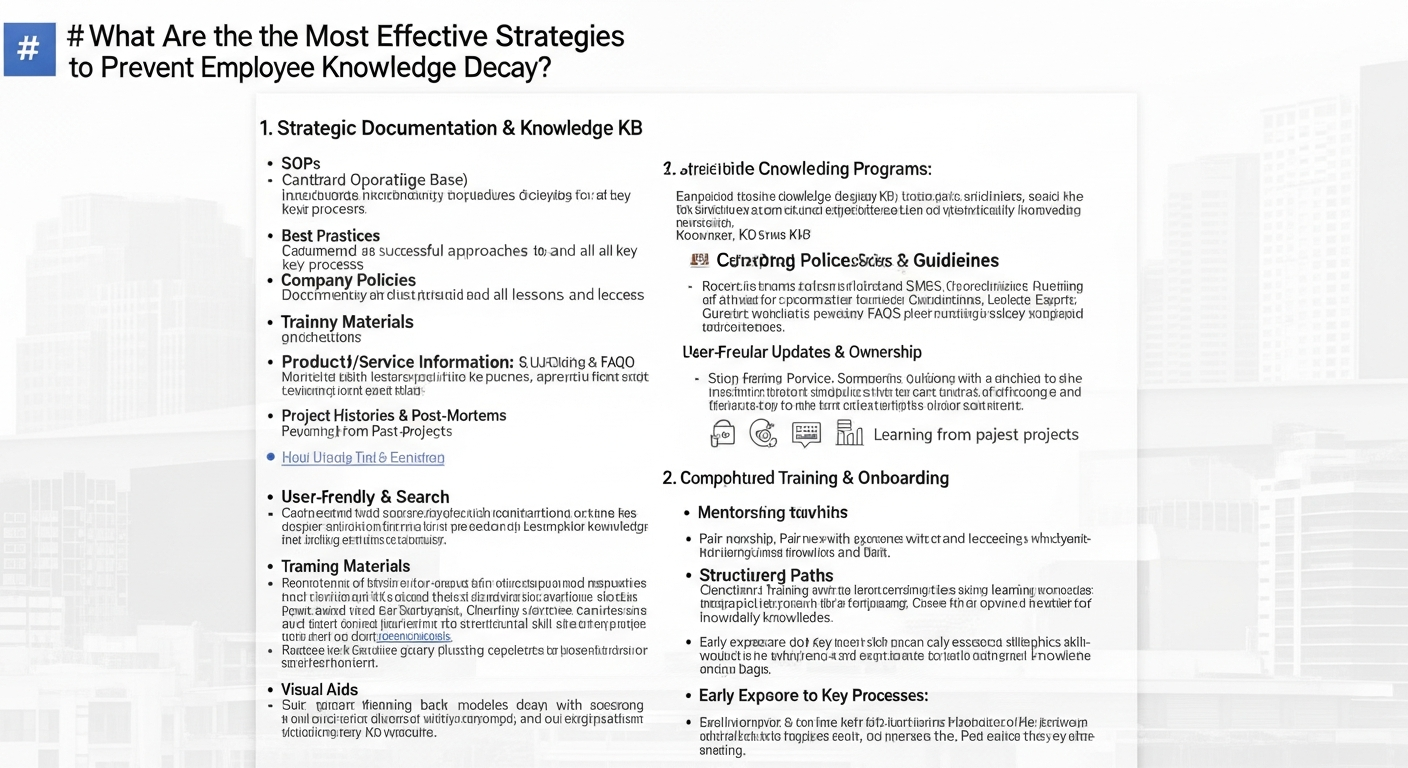
What Are the Most Effective Strategies to Prevent Employee Knowledge Decay?
In today's fast-paced corporate environment, continuous learning is not just an advantage; it's a necessity. Yet, for Vice Presidents, Directors, Senior Managers, and L&D Managers across industries like Compliance, Sales, Banking, Finance, Insurance, Retail, Pharma, Healthcare, Hospitality, Oil and Gas, and Mining, a critical challenge persists: employee knowledge decay. This phenomenon, where crucial information, skills, and expertise gradually fade from an employee's memory or practice over time, poses significant risks to productivity, compliance, innovation, and ultimately, an organization's bottom line.
Imagine the implications: a sales team forgetting product features, financial advisors misremembering regulatory details, healthcare professionals overlooking critical procedures, or compliance officers failing to recall the latest protocols. The financial and reputational costs can be staggering. The good news is that with strategic foresight and modern eLearning tools, knowledge decay is not an inevitable fate. This article explores the most effective strategies to build a resilient, knowledge-retentive workforce.
Why Employee Knowledge Decay is a Critical Concern
Employee knowledge decay isn't merely an inconvenience; it's a silent threat to organizational health. Its impact reverberates across multiple facets:
- Reduced Productivity and Efficiency: When employees forget how to perform tasks efficiently or access key information quickly, performance suffers, leading to slower processes and decreased output.
- Increased Compliance Risks: Particularly critical in regulated industries, forgotten or outdated knowledge can lead to non-compliance, resulting in hefty fines, legal repercussions, and reputational damage. Risk-focused Training is paramount to mitigate these dangers.
- Stifled Innovation: A workforce that constantly struggles with foundational knowledge has less capacity for critical thinking, problem-solving, and contributing to innovation.
- Higher Training Costs: Re-training employees on forgotten material is expensive and time-consuming, diverting resources that could be used for advanced skill development.
- Loss of Institutional Knowledge: Especially with high turnover or an aging workforce, critical institutional knowledge can be lost permanently if not actively preserved and reinforced.
Effective Strategies to Combat Knowledge Decay
Combating knowledge decay requires a multi-faceted approach, leveraging both pedagogical principles and advanced technology. Here are the leading strategies:
1. Implement Microlearning and Spaced Repetition
One of the most powerful antidotes to knowledge decay is the combination of microlearning and spaced repetition. Microlearning LMS delivers information in small, digestible chunks (2-10 minutes), making it easier for learners to process and retain. When combined with spaced repetition, where these small learning modules are revisited at increasing intervals, it dramatically reinforces memory. This method aligns with how our brains naturally consolidate information, moving it from short-term to long-term memory. A modern Microlearning LMS can automate this process, scheduling timely refreshers and quizzes based on a learner's performance.
2. Leverage Gamification for Enhanced Engagement
Engagement is key to retention. Gamification transforms routine training into an interactive and motivating experience. By incorporating elements like points, badges, leaderboards, challenges, and rewards, a Gamified LMS taps into intrinsic human motivators. This not only makes learning more enjoyable but also encourages repeated interaction with the content, thereby reinforcing knowledge and improving recall. When learning feels like a game, employees are more likely to participate willingly and actively engage with the material, reducing the chances of decay.
3. Employ Adaptive Learning Paths
Not all learners are alike, and a one-size-fits-all approach to training often falls short. Adaptive Learning systems personalize the learning journey based on an individual's existing knowledge, learning style, and performance. By identifying knowledge gaps and areas of strength, an adaptive LMS can deliver precisely the content an employee needs, when they need it. This targeted approach ensures that training time is spent effectively, reinforcing weaker areas and avoiding redundant content, leading to much stronger retention.
4. Utilize AI for Content Creation and Delivery
Artificial Intelligence is revolutionizing how we create, manage, and deliver learning content. An AI Powered Authoring Tool can swiftly generate relevant microlearning modules, quizzes, and even simulations based on existing documentation or subject matter expert input. AI can also analyze learner data to predict areas of potential decay, automatically recommending refresher courses or personalized content. This capability makes content creation faster and ensures that learning materials are always current and relevant.
5. Prioritize Risk-focused Training
In industries where errors can have severe consequences, identifying and prioritizing critical knowledge areas is essential. Risk-focused Training involves pinpointing the knowledge and skills most critical to compliance, safety, and business operations, and then designing reinforcement strategies specifically for those areas. This ensures that the most vital information is not only learned but also consistently refreshed and applied. A robust learning management system can help track proficiency in these critical areas and trigger mandatory refreshers.
6. Foster a Culture of Continuous Learning and Knowledge Sharing
Beyond formal training programs, cultivating an organizational culture that values continuous learning and knowledge sharing is paramount. This includes implementing robust Learning content management system (LCMS) platforms, facilitating peer-to-peer learning, mentoring programs, and creating accessible knowledge repositories. Encouraging employees to teach others, document best practices, and engage in social learning platforms helps embed knowledge deeply within the organization, making it less susceptible to individual decay.
Integrating Technology: The Role of an Advanced LMS
The linchpin for effectively implementing these strategies is a sophisticated LMS. An enterprise learning management system, especially a cloud based learning management system, provides the infrastructure to manage, deliver, and track all learning activities. A comprehensive learning management software offers features crucial for preventing knowledge decay:
- Centralized repository for all learning content.
- Tools for scheduling and automating spaced repetition.
- Analytics to identify knowledge gaps and training effectiveness.
- Support for various content formats, including microlearning and multimedia.
- Integration with AI for personalized and adaptive learning experiences.
Choosing the right learning management solutions is critical. A modern LMS learning management system, such as MaxLearn LMS, is designed to support these advanced strategies, transforming the way organizations approach employee development and knowledge retention.
AI-Driven Insights for Sustained Learning
For L&D leaders aiming for peak performance, artificial intelligence offers unparalleled capabilities to understand and proactively address knowledge decay. Here are common questions managers often ponder, with AI offering transformative answers:
How can we proactively identify critical knowledge areas at risk of decay across our entire workforce?
AI-powered analytics can process vast amounts of learning data, including quiz scores, course completion rates, performance metrics, and even employee feedback. By identifying trends and patterns – for example, specific modules where scores consistently drop after a certain period, or tasks where errors are more frequent – AI can pinpoint exact knowledge areas and even specific employee groups where decay is most likely to occur. This allows L&D to deploy targeted refreshers and interventions, rather than blanket training that may not be necessary for everyone.
Is it possible to deliver highly personalized training that adapts to each employee's learning style and progress?
Absolutely. AI makes truly personalized learning a reality. By analyzing an individual's past learning history, proficiency levels, role requirements, and even preferred content formats, AI can dynamically adjust the learning path. If an employee masters a concept quickly, AI can advance them to more complex material. If they struggle, it can provide additional resources, different explanations, or alternative practice scenarios. This ensures that every learner receives the most effective instruction tailored precisely to their needs, maximizing comprehension and retention.
What insights can AI provide to optimize our training programs for long-term retention and real-world impact?
AI's analytical capabilities extend beyond just identifying decay. It can correlate training completion and performance with actual on-the-job results. For instance, in sales, it can link product knowledge training to sales conversion rates; in healthcare, compliance training to incident reduction. By understanding which training methods and content lead to the best long-term outcomes, AI provides actionable insights for L&D to continuously refine and optimize program design, content, and delivery mechanisms, ensuring maximum ROI and sustained knowledge application.
How can we ensure consistent and up-to-date knowledge retention across diverse teams or global locations?
AI addresses this challenge by providing a unified, intelligent learning experience regardless of location or team. Through sophisticated algorithms, AI can ensure that all employees access the most current version of critical information. It can also adapt content for cultural nuances or local regulatory requirements while maintaining core knowledge consistency. Furthermore, by tracking collective performance metrics across departments or regions, AI can highlight disparities in knowledge retention, enabling L&D managers to deploy targeted support and standardized refreshers where they are most needed, fostering a uniformly knowledgeable workforce.
Conclusion
Preventing employee knowledge decay is a strategic imperative for any forward-thinking organization. By embracing modern eLearning strategies such as microlearning, gamification, adaptive learning, and AI Powered Authoring Tool, L&D professionals can transform their approach to training. An advanced learning management system is no longer just a repository for courses; it is a dynamic platform that actively combats forgetting, fosters continuous growth, and leverages intelligence to ensure critical knowledge is retained, applied, and optimized. Investing in these strategies through a robust MaxLearn LMS is an investment in your organization's future, ensuring a knowledgeable, compliant, and highly productive workforce capable of navigating the challenges of tomorrow.


Comments
Post a Comment