What are the Concrete ROI Metrics of Transitioning to a Sales LMS?
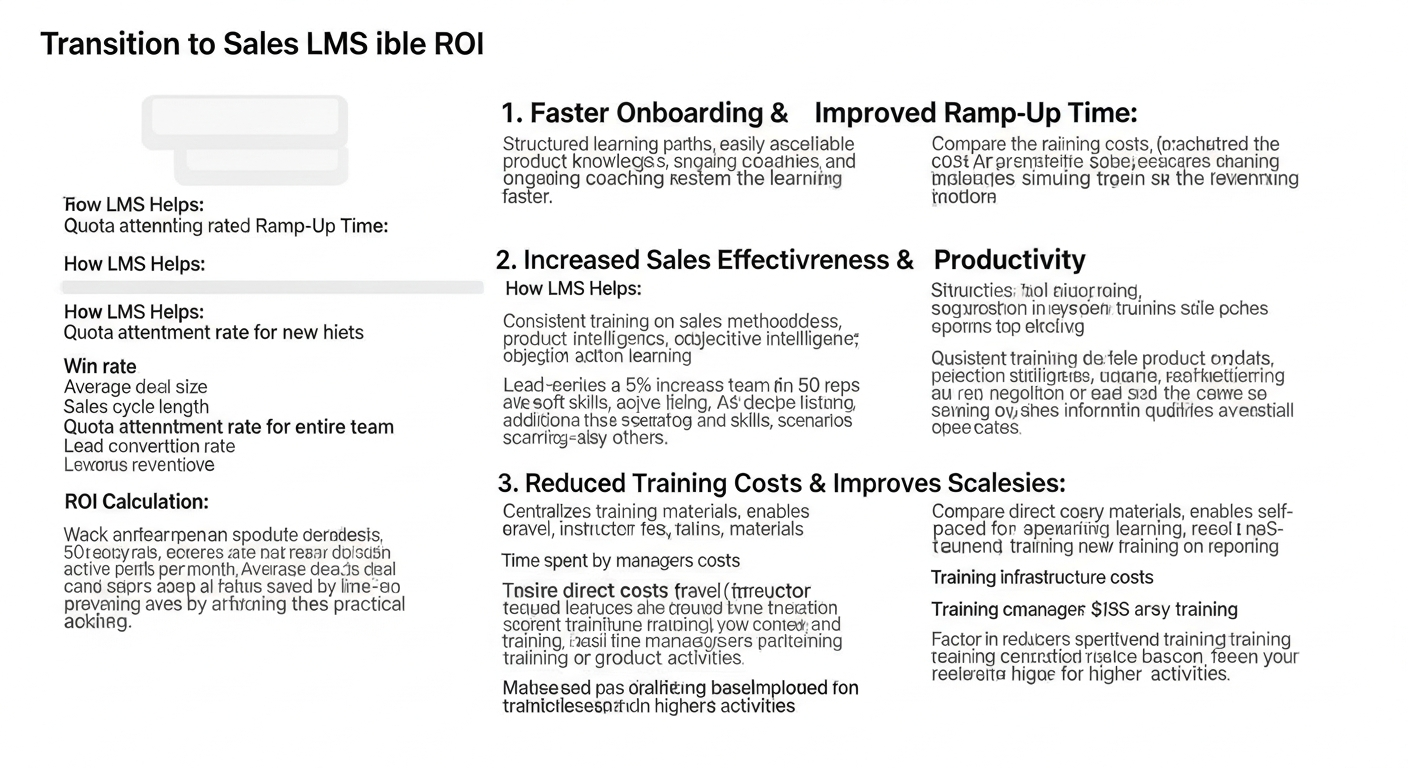
What are the Concrete ROI Metrics of Transitioning to a Sales LMS?
For Vice Presidents, Directors, and Managers of Learning & Development, the mandate is clear: empower your sales teams for peak performance. Yet, the challenge often lies in proving the tangible return on investment (ROI) for crucial training initiatives. In an era where every budget line is scrutinized, transitioning to a dedicated Sales LMS (Learning Management System) is not just a strategic move, it's an investment that demands measurable results. This article will delve into the concrete ROI metrics that L&D leaders can track and present to justify the transition to a modern Sales learning management software.
Traditional sales training often struggles with consistency, scalability, and most importantly, demonstrable impact. A specialized Sales learning management solutions, however, transforms these challenges into opportunities for growth and measurable success. It's more than just a platform for content delivery; it's a strategic tool designed to enhance every stage of the sales cycle, from onboarding to continuous professional development.
Driving Financial Performance: The Ultimate Bottom Line
The most compelling ROI metrics directly impact the company's financial health. A Sales learning management system is engineered to move these critical needles.
Increased Sales Revenue & Win Rates
-
Tracking: Monitor total sales volume, average deal size, and sales win rates before and after LMS implementation. Correlate specific training modules with improved product knowledge and successful objection handling.
-
Impact: When sales reps have immediate access to up-to-date product information, competitive insights, and best-practice selling techniques, their confidence and effectiveness soar. Forward-thinking organizations are increasingly leveraging advanced analytics to predict which training interventions will yield the highest returns, allowing for proactive adjustments to their sales enablement strategies, ensuring every training dollar directly contributes to revenue growth.
Reduced Sales Cycle Length
-
Tracking: Measure the average time from initial lead contact to deal closure. Look for reductions in various stages of the sales pipeline.
-
Impact: An LMS learning management system equipped with Microlearning LMS capabilities allows reps to quickly access just-in-time training on specific topics, streamlining their pitches and improving their ability to navigate complex sales scenarios efficiently. This reduces the time spent fumbling for information and accelerates deal progression.
Higher Customer Lifetime Value (CLTV)
-
Tracking: Analyze customer retention rates, upsell/cross-sell percentages, and overall customer satisfaction scores.
-
Impact: Well-trained sales professionals build stronger relationships, understand customer needs more deeply, and provide superior service. This leads to increased customer loyalty, repeat business, and successful expansion opportunities within existing accounts, directly boosting CLTV.
Operational Efficiency & Cost Savings: Optimizing Resources
Beyond direct revenue, a Sales cloud based learning management system delivers significant savings and operational improvements.
Reduced Training Costs
-
Tracking: Compare expenses related to travel, venues, physical materials, and instructor fees for traditional training versus the recurring costs of the enterprise learning management solution.
-
Impact: A robust online learning management software solution can seamlessly deliver consistent, high-quality training across diverse geographical locations, eliminating the logistical complexities and costs associated with traditional, in-person global rollouts. This scalability dramatically lowers per-learner training costs.
Improved Sales Productivity & Faster Time-to-Proficiency
-
Tracking: Monitor the ramp-up time for new hires to reach quota, time spent in training versus selling, and overall sales output per representative.
-
Impact: An LCMS provides structured, self-paced onboarding, allowing new reps to become productive much faster. Features like a Gamified LMS boost engagement and retention of knowledge, ensuring reps spend less time in unproductive training and more time actively selling. Tailoring learning content to individual sales reps' strengths and weaknesses, based on their performance data, ensures maximum relevance and impact, directly contributing to improved conversion rates and overall sales effectiveness.
Reduced Employee Turnover
-
Tracking: Compare sales team attrition rates before and after LMS implementation.
-
Impact: When sales professionals feel adequately trained, supported, and see a clear path for professional growth through Adaptive Learning paths, their job satisfaction and loyalty increase. Reduced turnover translates directly into savings on recruitment and re-training costs.
Compliance & Risk Mitigation: Safeguarding Your Business
For industries like Compliance, Sales, Banking, Finance, Insurance, Pharma, Healthcare, Oil and Gas, and Mining, adherence to regulations is paramount. A Sales learning management system is invaluable here.
Minimizing Compliance Breaches & Legal Exposure
-
Tracking: Monitor the incidence of non-compliance issues, fines, and legal challenges related to sales practices.
-
Impact: A Sales LMS provides a centralized, auditable record of all compliance training. It ensures that every sales professional completes mandatory modules on topics like data privacy, ethical selling, and industry-specific regulations. It ensures that sales teams consistently adhere to complex regulatory requirements across all operational territories. This proactive approach to Risk-focused Training significantly reduces the risk of costly penalties and reputational damage.
How a Modern Sales LMS Enables ROI Measurement
The true power of a contemporary Sales learning management system lies in its built-in capabilities for tracking and reporting, making ROI measurement not just possible, but straightforward.
-
Advanced Analytics Dashboards: Provide real-time data on course completion, quiz scores, skill progression, and content engagement.
-
CRM Integration: Seamlessly connect training data with actual sales performance data from your CRM, allowing for direct correlation between learning activities and sales outcomes.
-
Customizable Reporting: Generate tailored reports for different stakeholders, highlighting the metrics most relevant to their interests.
-
Personalized Learning Paths: Utilize Adaptive Learning and AI Powered Authoring Tool features to deliver highly relevant content, optimizing learning efficiency and impact. This data-driven personalization helps pinpoint exactly which learning interventions are driving performance improvements.
Concrete Steps to Measure Your Sales LMS ROI
-
Define Clear KPIs: Before implementation, identify the specific financial, operational, and compliance metrics you aim to improve.
-
Establish a Baseline: Collect pre-LMS data for all your chosen KPIs.
-
Track Post-Implementation Metrics: Consistently collect data at regular intervals after the MaxLearn LMS is live.
-
Correlate Data: Use the LMS's reporting and integration capabilities to link training participation and performance with actual sales results.
-
Regularly Review and Adjust: Use the insights gained to refine your training programs, demonstrating continuous improvement and maximized ROI.
Conclusion
Transitioning to a dedicated Sales LMS is no longer a luxury but a strategic imperative for L&D leaders aiming to deliver measurable impact. By focusing on concrete ROI metrics such as increased revenue, reduced costs, enhanced compliance, and improved sales productivity, you can unequivocally demonstrate the value of your training investments. Empowering your sales team with a cutting-edge platform like MaxLearn LMS is not just about training; it's about investing in a future of predictable growth and sustained competitive advantage. It's time to move beyond anecdotal evidence and embrace data-driven decision-making to truly unlock your sales team's potential.


Comments
Post a Comment