How to Cut Corporate Training Time in Half Without Sacrificing Quality?
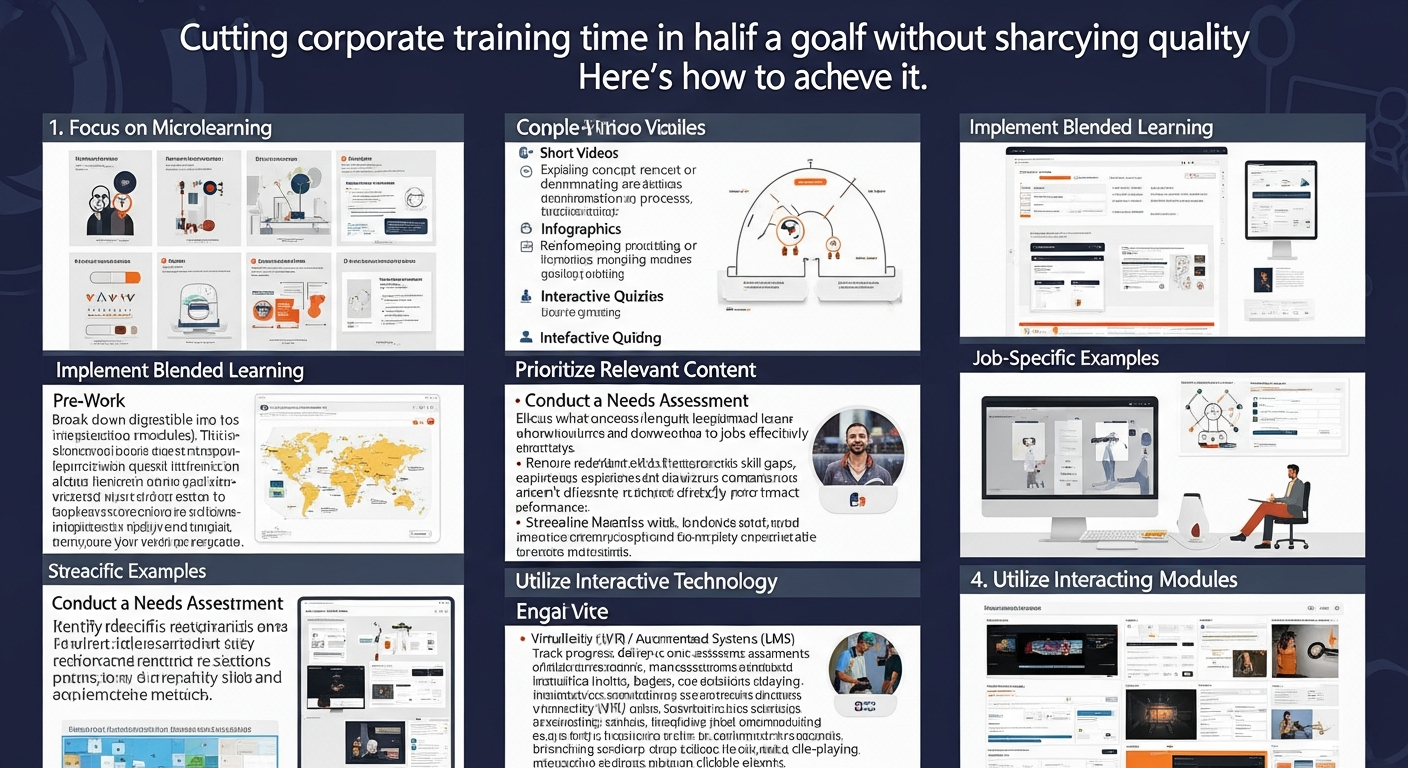
How to Cut Corporate Training Time in Half Without Sacrificing Quality?
In today's fast-paced corporate world, the pressure to upskill and reskill employees is constant, yet time remains a precious commodity. Learning & Development (L&D) leaders, from VPs to senior managers, are perpetually challenged with a critical paradox: how to deliver high-quality, impactful training while simultaneously reducing the time employees spend away from their core responsibilities. Traditional training models, often lengthy and generic, simply can't keep pace.
The good news? It's not only possible to dramatically reduce corporate training time but also to enhance its effectiveness. By embracing modern methodologies and cutting-edge technology, organizations can achieve a leaner, more agile, and ultimately more impactful learning ecosystem. This article will explore actionable strategies to help you cut corporate training time in half without sacrificing an ounce of quality.
The Imperative for Efficiency in Corporate Learning
Why is reducing training time so crucial now? Beyond the obvious cost savings in man-hours, shorter, more efficient training sessions lead to better engagement, improved knowledge retention, and faster application of skills. Long, drawn-out courses often overwhelm learners, leading to information overload and disengagement. For industries ranging from Compliance and Sales to Banking, Finance, Insurance, Retail, Pharma, Health care, Hospitality, Oil and Gas, and Mining, the ability to rapidly adapt and train employees on new regulations, products, or safety protocols is a competitive advantage.
The key lies in smart design, personalized delivery, and leveraging advanced learning technologies.
Strategic Pillars for Accelerated, High-Quality Training
1. Embrace Microlearning: Small Chunks, Big Impact
One of the most powerful shifts in modern corporate training is the adoption of microlearning. Instead of multi-hour modules, a Microlearning LMS delivers content in short, digestible bursts—typically 3-7 minutes long. This approach aligns with human attention spans and allows learners to integrate training into their workflow seamlessly.
- Enhanced Retention: Smaller chunks are easier to process and remember, improving recall.
- On-Demand Access: Learners can access specific information precisely when and where needed, facilitating just-in-time learning.
- Flexibility: Employees can complete training during short breaks or commute times, minimizing disruption to their core workdays and boosting productivity.
By breaking down complex topics into focused learning objectives, you eliminate unnecessary fluff and get straight to the point, significantly cutting down overall learning time while maximizing impact.
2. Personalize with Adaptive Learning Paths
Traditional "one-size-fits-all" training wastes time for many learners who either already know some of the material or need more in-depth coverage on specific topics. Adaptive Learning tailors the learning experience to each individual's needs, knowledge gaps, and learning style.
- Pre-assessments: Quickly identify what learners already know, allowing them to skip irrelevant modules and focus on new material.
- Dynamic Content Delivery: The system adapts based on performance, offering remedial content where needed or advancing learners who grasp concepts quickly, optimizing learning pace.
- Reduced Redundancy: Learners only consume content relevant to their specific development needs, drastically cutting down on wasted time and improving efficiency.
This intelligent personalization ensures every minute spent training is productive and impactful, leading to faster skill acquisition.
3. Drive Engagement with Gamification
Disengaged learners are slow learners. Gamification transforms routine training into an interactive and motivating experience. Incorporating game-like elements such as points, badges, leaderboards, and challenges within a Gamified LMS dramatically increases participation and knowledge retention.
- Increased Motivation: The desire to "win" or "achieve" motivates learners to complete modules faster and more efficiently, driving completion rates.
- Instant Feedback: Game mechanics often provide immediate feedback on performance, allowing learners to correct mistakes quickly and reinforce correct behaviors.
- Fun & Memorable: When learning is enjoyable, it sticks better and feels less like a chore, speeding up the entire process and improving recall.
Engaged learners are more likely to commit to and complete their training in less time, without compromising on understanding or skill mastery.
4. Leverage AI for Content Creation and Delivery
Artificial Intelligence is a game-changer for L&D, particularly in accelerating content development and optimizing delivery. An AI Powered Authoring Tool can dramatically reduce the time it takes to create high-quality training materials, making the entire content lifecycle more agile.
- Automated Content Generation: AI can assist in drafting course outlines, generating questions, summarizing existing documentation, and even creating initial content based on prompts, drastically cutting development time.
- Content Curation: AI can quickly identify and recommend relevant external resources, articles, or videos to enrich learning modules and provide diverse perspectives.
- Personalized Learning Paths: AI algorithms continuously analyze learner performance and preferences, driving adaptive learning by ensuring learners are always presented with the most relevant and effective content.
This automation frees up L&D professionals to focus on strategic design, pedagogical effectiveness, and fostering a culture of learning, rather than time-consuming manual content creation.
5. Prioritize Critical Skills with Risk-focused Training
Not all training is created equal. To maximize efficiency, L&D leaders must identify and prioritize the most critical skills and knowledge areas that directly impact business outcomes and compliance. Risk-focused Training ensures that valuable training time is allocated to areas where knowledge gaps pose the highest risk to the organization.
- Identify High-Impact Areas: Focus training efforts on compliance, safety protocols, critical sales skills, new product knowledge, or leadership development that directly affects revenue, reduces liabilities, or enhances competitive advantage.
- Streamline Non-Critical Content: For less critical or frequently changing topics, utilize brief informational resources, searchable knowledge bases, or on-demand support tools rather than extensive, mandatory courses.
- ROI-Driven Design: Every training module should have a clear, measurable objective tied to a specific business outcome, preventing wasted effort on low-value content and ensuring maximum return on investment.
This strategic focus ensures that every minute of training delivers maximum value, inherently reducing overall training time on less critical areas and concentrating resources where they matter most.
Leveraging Modern Learning Management Software for Seamless Execution
Implementing these advanced strategies requires a robust and flexible learning management system (LMS). A state-of-the-art learning content management system (LCMS) is the backbone of efficient corporate learning. Look for learning management software that offers comprehensive features that enable these modern approaches:
- Cloud-Based Accessibility: A cloud based learning management system ensures learners can access content anytime, anywhere, on any device, reducing scheduling conflicts and significantly increasing completion rates.
- Scalability: An enterprise learning management solution must be capable of catering to thousands of users across global teams, handling diverse training needs efficiently.
- Integrated Analytics: Powerful analytics tools track learner progress, identify knowledge gaps at individual and team levels, and measure the effectiveness and ROI of your training programs, allowing for continuous optimization.
- User-Friendly Interface: An intuitive lms learning management system encourages higher adoption rates and reduces the need for extensive support, streamlining the learning process.
The right learning management solutions, like MaxLearn LMS, seamlessly integrate microlearning capabilities, adaptive learning paths, gamification features, and AI functionalities, enabling you to build a truly streamlined, engaging, and impactful learning program.
Common Questions on Efficient Corporate Learning
What's the best way to make corporate training more engaging?
To make corporate training truly engaging, focus on interactivity, relevance, and learner autonomy. Implement short, targeted Microlearning LMS modules that address immediate needs and allow learners to control their pace. Incorporate gamification elements like quizzes, points, badges, and leaderboards to foster healthy competition and motivation. Use real-world scenarios and case studies pertinent to your industry, whether it's Sales, Healthcare, or Finance, to demonstrate practical application. Regular, immediate feedback and opportunities for practice also significantly boost engagement, making learning less passive and more dynamic and memorable.
Where can I find an effective system for managing learning across a global enterprise?
For global enterprises seeking an effective system for managing learning, a robust cloud based learning management system is essential. Look for platforms that offer multi-language support, regional content customization, and a secure, scalable infrastructure capable of serving diverse teams across different time zones. Such a system should provide comprehensive analytics to track global performance and compliance, support various learning modalities including blended learning, and ensure adherence to international data privacy regulations. A strong enterprise learning management solution will be your central hub for consistent, high-quality training worldwide, ensuring a unified learning experience.
How can I quickly develop compliance training materials that are still comprehensive?
Rapid development of comprehensive compliance training relies on smart tools and strategic design. Begin by leveraging an AI Powered Authoring Tool to accelerate content creation, converting lengthy regulatory documents into structured, digestible learning modules. Break down complex compliance topics into focused microlearning units, concentrating on specific rules and their practical implications. Utilize interactive elements like scenario-based questions and simulations to test understanding and application in real-world contexts. Implement Risk-focused Training to highlight the most critical compliance areas, ensuring learners grasp high-impact regulations thoroughly without spending excessive time on less critical details. This approach ensures both speed and comprehensiveness.
Conclusion: The Future of Efficient Corporate Training
Cutting corporate training time in half without sacrificing quality is not a distant dream; it's an achievable reality with the right strategies and technology. By embracing microlearning, adaptive paths, gamification, AI-powered tools, and risk-focused content, L&D leaders can transform their training programs into lean, powerful engines of skill development. The result is a more efficient, engaging, and impactful learning experience that not only saves valuable time and resources but also cultivates a highly skilled, adaptable, and agile workforce, ready to meet the dynamic challenges of tomorrow. Invest in modern learning management system solutions, and watch your organization thrive.


Comments
Post a Comment