How Does Microlearning Improve Sales Training Retention in B2B Teams?
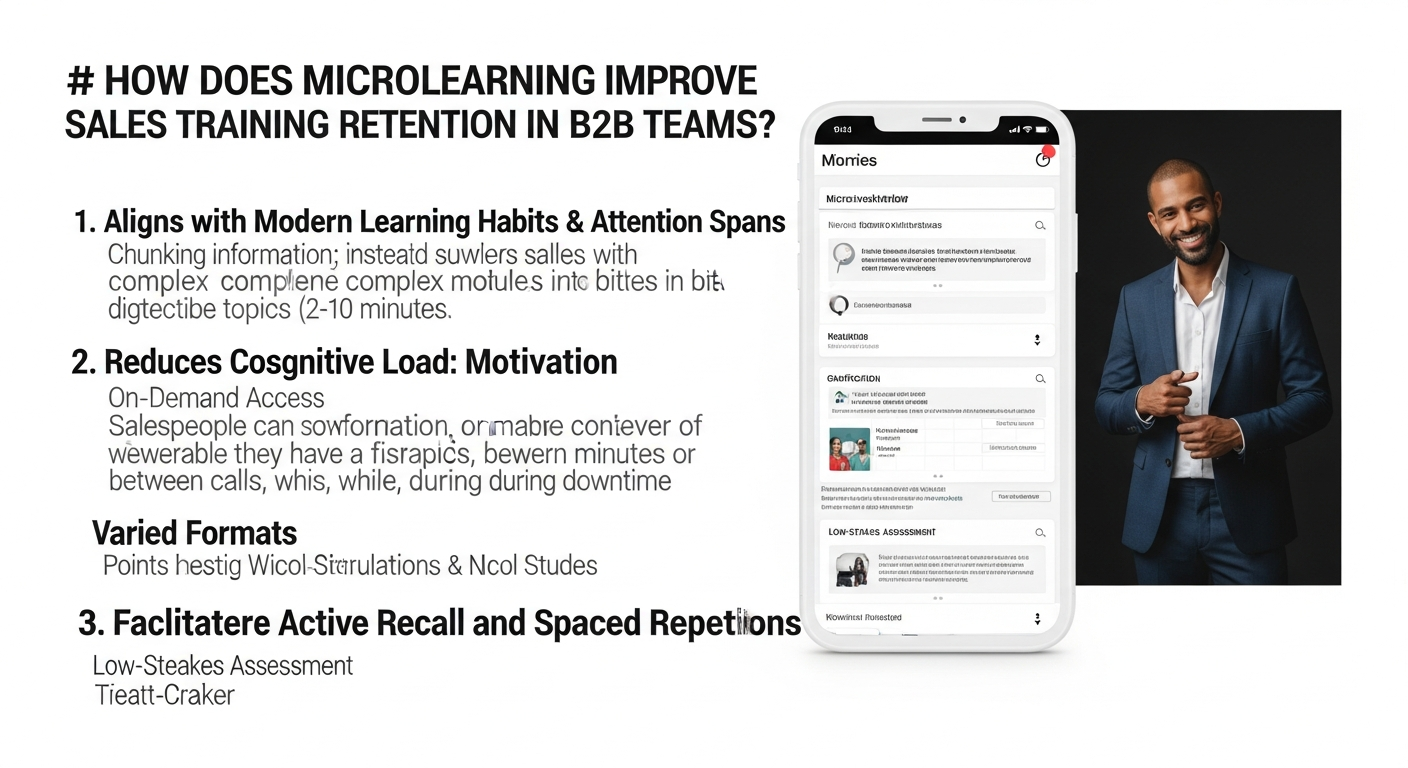
Revolutionizing B2B Sales Training: How Microlearning Boosts Retention and Performance
In the dynamic world of B2B sales, the ability of a team to consistently acquire, retain, and apply new knowledge is paramount. Yet, traditional sales training often falls short, struggling against the notorious "forgetting curve" and the demanding schedules of sales professionals. For leaders in Learning & Development across industries like Compliance, Sales, Banking, Finance, Insurance, Retail, Pharma, Health care, Hospitality, Oil and Gas, and Mining, the challenge is clear: how do we make sales training stick and drive tangible results? The answer lies in microlearning – a powerful methodology reshaping how B2B teams learn, retain, and succeed.
Effective sales training is not merely about imparting information; it’s about ensuring that critical skills, product knowledge, and compliance protocols are internalized and readily applied in high-stakes situations. When training retention is low, organizations face increased costs, diminished sales performance, and a struggle to adapt to market changes. Microlearning addresses these pain points directly, offering a flexible, engaging, and highly effective alternative to traditional long-form training programs. By breaking down complex subjects into digestible, focused modules, it ensures that your sales force remains agile, knowledgeable, and consistently performs at its peak.
The Critical Need for Enhanced B2B Sales Training Retention
B2B sales cycles are intricate, demanding a deep understanding of products, services, customer needs, and increasingly, complex regulatory landscapes. The investment in onboarding and continuous professional development for sales teams is significant. However, studies consistently show that a substantial portion of learned information is forgotten within days or weeks if not reinforced. This "forgetting curve" translates directly into lost productivity, missed sales opportunities, and the potential for non-compliance, particularly in highly regulated sectors. Imagine the impact on a financial institution where new product features or compliance updates aren't fully retained by its sales representatives, or a pharmaceutical company where detailed drug information isn't accurately conveyed. The stakes are incredibly high.
Traditional training, often delivered in lengthy classroom sessions or extensive e-learning modules, struggles to keep pace with the modern salesperson's schedule and attention span. The demands of travel, client meetings, and administrative tasks leave little room for uninterrupted, long-form learning. This is where a focused, agile approach to learning content management becomes indispensable. Organizations are actively seeking more efficient learning management solutions to ensure their teams are always up-to-date and equipped with the latest skills and information.
Microlearning: A Paradigm Shift for Sales Enablement
Microlearning is an approach to learning that delivers content in small, focused bursts, typically lasting from a few seconds to 10 minutes. Unlike lengthy courses, these bite-sized modules are designed for rapid consumption and immediate application. This methodology is perfectly aligned with the fast-paced nature of B2B sales, offering just-in-time knowledge acquisition that fits seamlessly into a salesperson's busy day. It's about providing the right information, to the right person, at the exact moment they need it.
By contrasting with traditional methods, microlearning provides a tangible solution to the problem of information overload. Instead of overwhelming learners with hours of material, it focuses on single learning objectives, making the content highly digestible and easier to remember. This strategic use of bite-sized content significantly improves the efficacy of any learning management system, transforming how enterprise learning management is conducted. A robust Microlearning LMS serves as the backbone, enabling the seamless delivery and tracking of these short, impactful lessons.
How Microlearning Enhances Sales Training Retention
The benefits of microlearning extend far beyond mere convenience. Its inherent design principles directly address the cognitive challenges of learning and memory retention:
-
Combating the Forgetting Curve with Spaced Repetition
Microlearning inherently supports spaced repetition, a scientifically proven method for memory retention. By delivering information in short, regular intervals, it reinforces learning over time, pushing knowledge from short-term to long-term memory. Instead of a single, intensive training event, sales professionals receive frequent, brief reminders and new information, which drastically reduces the impact of the forgetting curve. This continuous reinforcement is crucial for mastering complex product specifications or nuanced sales techniques, making a cloud based learning management system an ideal platform for delivery.
-
Increased Engagement and Motivation
Long training sessions can be daunting and lead to learner fatigue. Microlearning, with its short duration and immediate relevance, makes learning less intimidating and more approachable. When combined with interactive elements and instant feedback, it transforms training into an engaging experience. A Gamified LMS can further boost engagement, turning learning into a rewarding activity that sales teams look forward to, rather than dread. This fosters a positive learning culture where continuous improvement is the norm.
-
Relevance and Contextual Learning
Sales professionals often need specific information at precise moments – before a client call, during a negotiation, or while addressing an objection. Microlearning excels at providing just-in-time learning. Modules can be designed to address specific scenarios or product features, allowing sales teams to access highly relevant content exactly when they need it. This contextual learning significantly enhances application and retention, as the information is immediately put into practice, solidifying understanding. It’s a key component of effective enterprise learning management.
-
Improved Accessibility and Flexibility
Modern sales teams are mobile and often on the go. Microlearning content, delivered via a robust learning management software, is optimized for access across various devices – smartphones, tablets, and laptops. This flexibility allows sales professionals to learn during downtime, whether they're waiting for a meeting, commuting, or simply between calls. This accessibility removes significant barriers to learning, making it easier for teams to stay updated without disrupting their core selling activities. A modern LMS is essential for this.
-
Personalization and Adaptive Pathways
Not all sales professionals have the same knowledge gaps or learning preferences. Microlearning platforms can leverage data analytics to create personalized learning paths, delivering content tailored to individual needs and performance metrics. This adaptive approach ensures that each learner receives the most relevant training, maximizing efficiency and impact. Incorporating Adaptive Learning capabilities further refines this process, dynamically adjusting content based on a user's progress and mastery, making for a truly intelligent learning content management system.
-
Reinforcing Compliance and Risk Mitigation
In industries such as Banking, Finance, Insurance, and Pharma, compliance training is not just important; it's mandatory. Microlearning provides an ideal format for delivering crucial compliance updates, ethical guidelines, and regulatory changes in a digestible and easily repeatable manner. This frequent reinforcement helps embed critical Risk-focused Training, ensuring sales teams are always aware of and adhering to the latest standards, thereby minimizing organizational risk. An LCMS focused on microlearning is invaluable here.
Smart Technologies and Focused Learning: The Next Frontier
The integration of advanced technologies elevates microlearning to new heights, particularly for B2B sales training. Intelligent systems are transforming how training content is created, delivered, and consumed, making it more effective than ever.
What role does advanced technology play in optimizing sales training?
Cutting-edge technology, particularly artificial intelligence, is revolutionizing how sales training is designed and delivered. AI can analyze performance data to identify specific skill gaps, then automatically recommend the most relevant microlearning modules to address those deficiencies. It can also personalize content delivery, ensuring that each salesperson receives training tailored to their individual learning pace and style. For instance, an AI Powered Authoring Tool can dramatically speed up the creation of engaging, high-quality microlearning content, making it easier for L&D teams to keep pace with evolving training needs. This intelligence makes the learning management system a dynamic, responsive tool.
How can intelligent systems improve training efficiency across different business units?
For large organizations with diverse business units spanning various geographies and industries (like Oil and Gas, Mining, or Global Retail), intelligent learning platforms offer unparalleled efficiency. They enable centralized content management while allowing for localized customization. An intelligent system can track completion rates and performance metrics across different regions, providing L&D leaders with actionable insights to optimize training programs globally. This ensures consistency in core messaging and compliance, while also allowing for adaptation to regional market nuances. This capability transforms a traditional learning management software into a powerful enterprise solution, like MaxLearn LMS.
Are there smart tools that can help sales professionals quickly master complex product information?
Absolutely. Smart tools are incredibly effective for helping sales professionals grasp intricate product details or service offerings. Beyond traditional microlearning modules, AI-driven chatbots can provide instant answers to specific product questions, acting as a real-time knowledge base. Interactive simulations powered by intelligence can allow sales teams to practice pitching complex solutions or handling difficult objections in a safe, virtual environment. These tools provide immediate feedback and reinforcement, accelerating the mastery of even the most detailed information, making the entire lms learning management system more potent.
Implementing Microlearning for Your B2B Sales Team
Adopting microlearning requires a strategic approach. It starts with identifying core competencies and breaking them down into granular learning objectives. Content should be concise, focused, and actionable. Leveraging a specialized Microlearning LMS is crucial for efficient delivery, tracking, and management of these bite-sized modules. Measure the impact through engagement rates, completion data, and ultimately, sales performance metrics. By continuously gathering feedback and iterating on your content, you can create a vibrant, effective learning ecosystem that fosters continuous growth for your B2B sales team. This dedication to continuous improvement ensures your learning management solutions truly drive business success.
Conclusion
For L&D leaders striving to elevate B2B sales performance, microlearning offers a compelling solution to the perennial challenge of training retention. Its ability to deliver targeted, engaging, and flexible learning experiences directly combats the forgetting curve, boosts engagement, and ensures that critical knowledge and skills are consistently applied. By embracing microlearning, especially when powered by intelligent technologies, organizations across all segments – from Banking to Healthcare to Oil and Gas – can transform their sales training from a sporadic event into a continuous, impactful journey of mastery. Invest in a smart learning management system and watch your B2B sales team thrive.


Comments
Post a Comment