Deskless Workforce Training: Mobile-First Microlearning for Delivery and Retail Staff
```html
Deskless Workforce Training: Mobile-First Microlearning for Delivery and Retail Staff
In today's fast-paced economy, the backbone of many industries – from retail and hospitality to delivery, healthcare, and manufacturing – is the deskless workforce. These employees, often on the front lines, are critical to customer satisfaction, operational efficiency, and brand reputation. Yet, traditional training methods often fall short when addressing their unique needs. Long classroom sessions, desktop-centric e-learning modules, and generic content simply don't resonate with staff who are constantly on the move, working varied shifts, and needing immediate access to information. This is where the power of mobile-first microlearning steps in, offering a transformative approach to keeping your delivery and retail staff, and indeed any deskless employee, highly skilled, engaged, and compliant.
For Vice Presidents, Directors, and Senior Managers of Learning & Development, the challenge isn't just delivering training; it's delivering effective training that scales, adapts, and directly impacts business outcomes. Embracing a strategic Microlearning LMS is no longer an option but a necessity for unlocking the full potential of your distributed teams across diverse sectors like Sales, Banking, Finance, Insurance, Retail, Pharma, Health care, Hospitality, Oil and Gas, and Mining.
The Unique Challenges of the Deskless Workforce
Understanding the operational realities of deskless employees is the first step toward building an effective training strategy. These individuals face a distinct set of challenges that traditional training models struggle to overcome:
- Time Constraints: Deskless workers rarely have dedicated blocks of time for lengthy training sessions. Their schedules are often dictated by customer demand, delivery routes, or patient care, meaning learning must fit into short breaks, commutes, or during brief lulls in activity.
- Geographic Distribution & Isolation: Teams are often spread across multiple locations, branches, or even countries, making centralized, in-person training logistically difficult and prohibitively costly. Individual team members may also work in isolation, lacking immediate access to supervisors or colleagues for on-the-spot guidance.
- Diverse Roles and Skill Gaps: From a new cashier needing product knowledge to an experienced delivery driver learning new route optimization software or a healthcare provider adapting to new medical procedures, each role demands specific, often rapidly evolving, skill sets. Training must be granular and relevant.
- High Turnover Rates: Industries like retail, hospitality, and logistics frequently experience high employee turnover, necessitating continuous onboarding and upskilling cycles. This puts immense pressure on L&D teams to deliver efficient and effective initial training and ongoing development.
- Need for Immediate Application: Knowledge must be instantly applicable to real-world scenarios. Whether it's handling a difficult customer complaint, navigating a new delivery route, implementing a new compliance procedure, or operating complex machinery, the learning must stick and be actionable.
Why Mobile-First Microlearning is the Answer
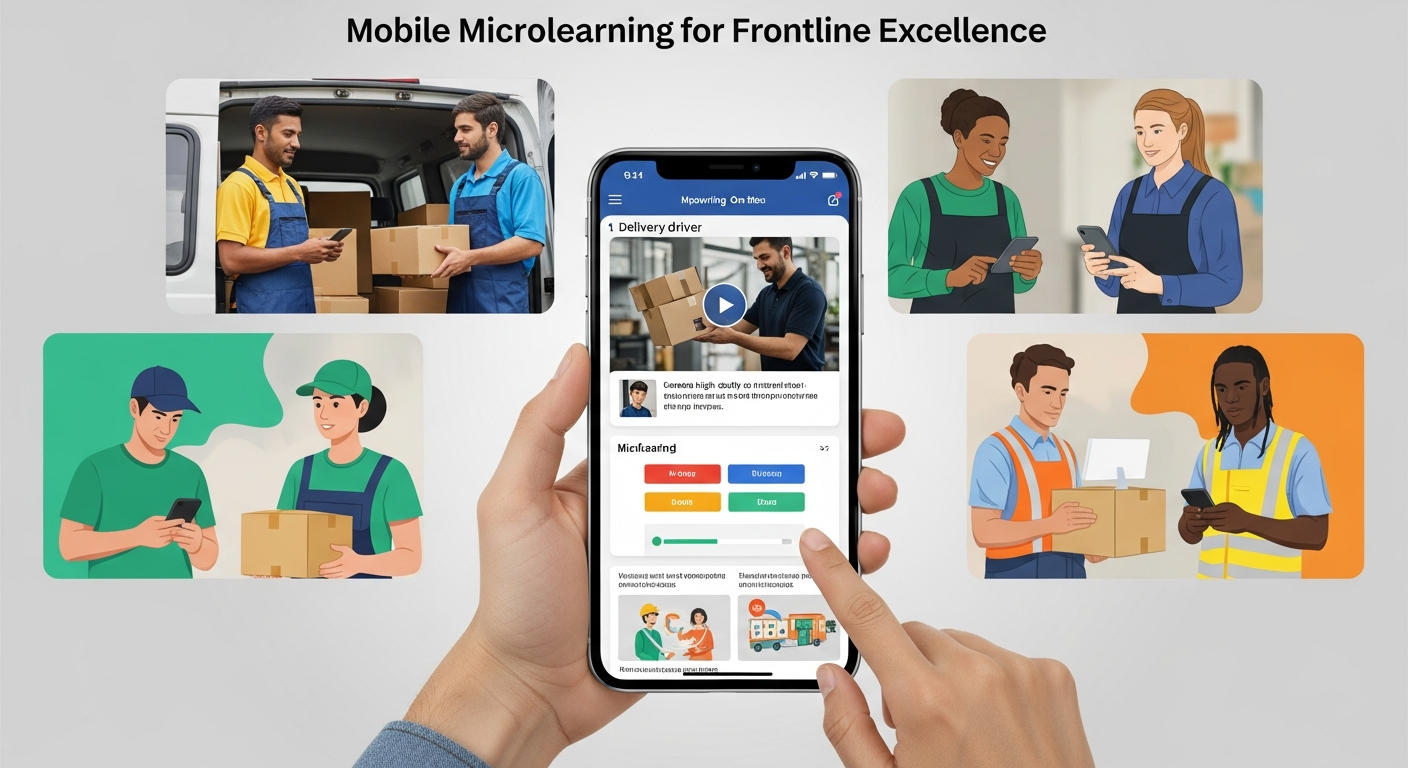
Mobile-first microlearning is explicitly designed to overcome these hurdles, transforming how an organization delivers and consumes critical knowledge. It champions short, focused bursts of content delivered directly to the learner's mobile device, whenever and wherever they need it.
Accessibility & Convenience
The ubiquity of smartphones means training is always at hand. Employees can access modules on their personal devices or company-issued tablets during a coffee break, between deliveries, or while waiting for a customer. This "training in the flow of work" model enhances relevance and reduces disruption to daily operations, making learning an integrated part of the workday rather than a separate chore. A robust lms learning management system designed for mobile access is paramount here, ensuring a seamless experience across devices and operating systems.
Engagement & Retention
Short, impactful lessons combat short attention spans, which are increasingly prevalent in our digital age. Microlearning modules, often under 5-10 minutes, can focus on a single learning objective, making information easier to digest, understand, and, crucially, retain. Incorporating interactive elements, quizzes, and a Gamified LMS approach further boosts engagement, turning learning into an enjoyable and competitive activity. This keeps learners coming back for more, even when training isn't mandatory, fostering a proactive learning culture.
Relevance & Personalization
Generic, one-size-fits-all training rarely hits the mark for a diverse workforce. Microlearning, especially when powered by an advanced learning management software, allows for highly specific and personalized content delivery. With Adaptive Learning capabilities, the system can tailor learning paths based on an individual's role, geographical location, performance data, and existing knowledge gaps. This ensures every minute spent learning is productive and relevant, directly addressing the learner's specific needs. This is crucial for optimizing training in complex environments like healthcare or oil and gas, where precise, scenario-based knowledge is vital for safety and operational integrity.
Efficiency & Impact
From an L&D perspective, microlearning content is significantly faster to create, update, and deploy compared to traditional e-learning courses. This agility is invaluable for industries with rapidly changing regulations, product lines, or operational procedures, ensuring that staff always have access to the most current and accurate information. A modern Learning content management system (LCMS) facilitates this rapid development and distribution, ensuring consistent messaging and content quality across all platforms and locations.
Leveraging a Powerful Learning Management System
To successfully implement mobile-first microlearning, a sophisticated learning management system is essential. It serves as the central hub for content creation, delivery, learner tracking, and performance analytics. A modern cloud based learning management system offers the scalability, security, and flexibility needed for large, distributed workforces, removing the burden of on-premise infrastructure.
When selecting an enterprise learning management solution, look for providers that offer:
- Intuitive Mobile Interface: A seamless and responsive user experience on any device, ensuring ease of access and engagement for all users.
- Robust Content Management: Capabilities for easy creation, storage, version control, and retrieval of diverse microlearning modules, from videos to interactive simulations. This is where a strong LCMS becomes indispensable.
- Advanced Analytics and Reporting: Comprehensive tools to track completion rates, engagement levels, skill proficiency, and learning outcomes. These insights are critical to measure ROI, identify areas for improvement, and demonstrate the business impact of training.
- Seamless Integration Capabilities: The ability to connect with existing HRIS, CRM, and other operational systems for a holistic view of employee performance and a streamlined administrative process.
AI Integration: Boosting Training Effectiveness
The evolution of learning platforms is intrinsically linked with the advancement of artificial intelligence. AI can revolutionize deskless workforce training by making it smarter, more personalized, and profoundly impactful, addressing complex logistical and content challenges.
Consider these questions that leading organizations are now asking to optimize their training strategies:
- How can technology enhance the relevance of training for individuals in diverse locations and varying roles? AI-driven location-aware content delivery, for instance, can present specific compliance modules relevant to a delivery driver's current route or a retail associate's store location. AI analyzes user data, performance metrics, and geographic context to push highly targeted content, ensuring that training is always pertinent to the individual's context and immediate needs, thereby optimizing the learning journey and its real-world applicability.
- What advanced tools streamline the creation of dynamic and personalized learning materials at scale? An AI Powered Authoring Tool can dramatically cut down content development time and resources. It can generate initial content drafts, suggest relevant multimedia, summarize complex documents into microlearning chunks, and even personalize scenarios based on existing performance data, allowing L&D teams to focus on refinement, strategic oversight, and instructional design quality. This capability is invaluable when dealing with frequent updates or localized content requirements across a vast, distributed network.
- How does intelligent automation improve the efficiency and impact of learning programs for frontline staff? AI can automate numerous administrative and strategic tasks. This includes automatically assigning specific modules based on new regulations, job role changes, or individual performance reviews. Furthermore, AI can identify emerging skill gaps across the entire workforce by analyzing trends in operational data and proactively recommend tailored learning management solutions. This intelligent automation ensures that training is not just reactive but predictive and continuously optimized for maximum impact, particularly for critical areas like Risk-focused Training in banking, finance, and healthcare, where regulatory compliance is paramount.
An intelligent MaxLearn LMS leverages these AI capabilities to deliver a truly next-generation learning experience that is both efficient for the organization and highly effective for the learner.
Addressing Specific Industry Needs
The versatility of mobile-first microlearning makes it an ideal solution for a wide array of industries facing similar challenges with their deskless staff:
- Retail & Hospitality: Rapid onboarding for seasonal staff, instant product knowledge updates, customer service best practices, and essential health & safety protocols.
- Delivery & Logistics: Training on new route optimization software, vehicle maintenance checks, safe driving practices, new technology adoption, and effective strategies for dealing with challenging delivery situations.
- Healthcare: Critical compliance updates, new equipment operation protocols, patient interaction best practices, and ongoing professional development, all delivered in a way that minimizes disruption to patient care.
- Manufacturing & Oil and Gas: Complex safety procedures, equipment operation refreshers, detailed maintenance guides, and regulatory compliance updates, where Risk-focused Training is paramount to prevent incidents and ensure operational continuity.
- Banking & Finance: Compliance with ever-evolving regulations, comprehensive anti-money laundering (AML) training, updates on new product features, and ethical conduct guidelines, all benefiting from targeted, timely microlearning to mitigate risk.
- Sales: Product feature updates, competitive analysis, advanced sales techniques, and objection handling, delivered in short, impactful bursts that can be reviewed just before a client meeting for maximum impact.
Across all these segments, the ability to deliver relevant, digestible training on demand is a game-changer for operational excellence, legal compliance, and sustained business growth.
Implementation Best Practices
To ensure a successful rollout and sustained impact of a mobile-first microlearning strategy:
- Start Small, Scale Fast: Begin with a pilot program in a specific team or department to gather feedback, learn from early successes and challenges, and refine your approach before a full organizational rollout.
- Empower Content Creators: Provide your L&D teams with modern tools, such as an AI Powered Authoring Tool, to quickly and efficiently develop engaging micro-content that resonates with learners.
- Promote a Learning Culture: Encourage self-directed learning and integrate microlearning as a regular, valued part of daily operations. Recognize and reward active participation and achievement.
- Utilize Data Analytics: Regularly review performance data and analytics from your LMS to identify trends, measure the impact of training on key performance indicators, and continuously optimize content and delivery methods.
- Solicit Learner Feedback: Actively engage your deskless staff in the process. Directly ask them what content they need, how they prefer to consume it, and what improvements they suggest. Their input is invaluable for creating truly effective learning experiences.
Conclusion
The deskless workforce is the frontline of your business, and their effectiveness directly correlates with your organization's success and resilience. Traditional training methods simply cannot keep pace with their dynamic needs or the rapid changes in today's business environment. Embracing mobile-first microlearning, powered by an intelligent and agile MaxLearn LMS, provides the strategic advantage needed to empower these essential employees.
By delivering engaging, personalized, and on-demand learning experiences, L&D leaders can significantly improve skill retention, boost productivity, ensure stringent compliance, and ultimately drive superior business outcomes across every segment of your operations. It’s time to move beyond the desk and unlock the full potential of your entire workforce with smart, mobile-first learning solutions that truly meet the demands of the modern world.
```


Comments
Post a Comment