9 Microlearning Best Practices to Maximize Knowledge Retention Rates
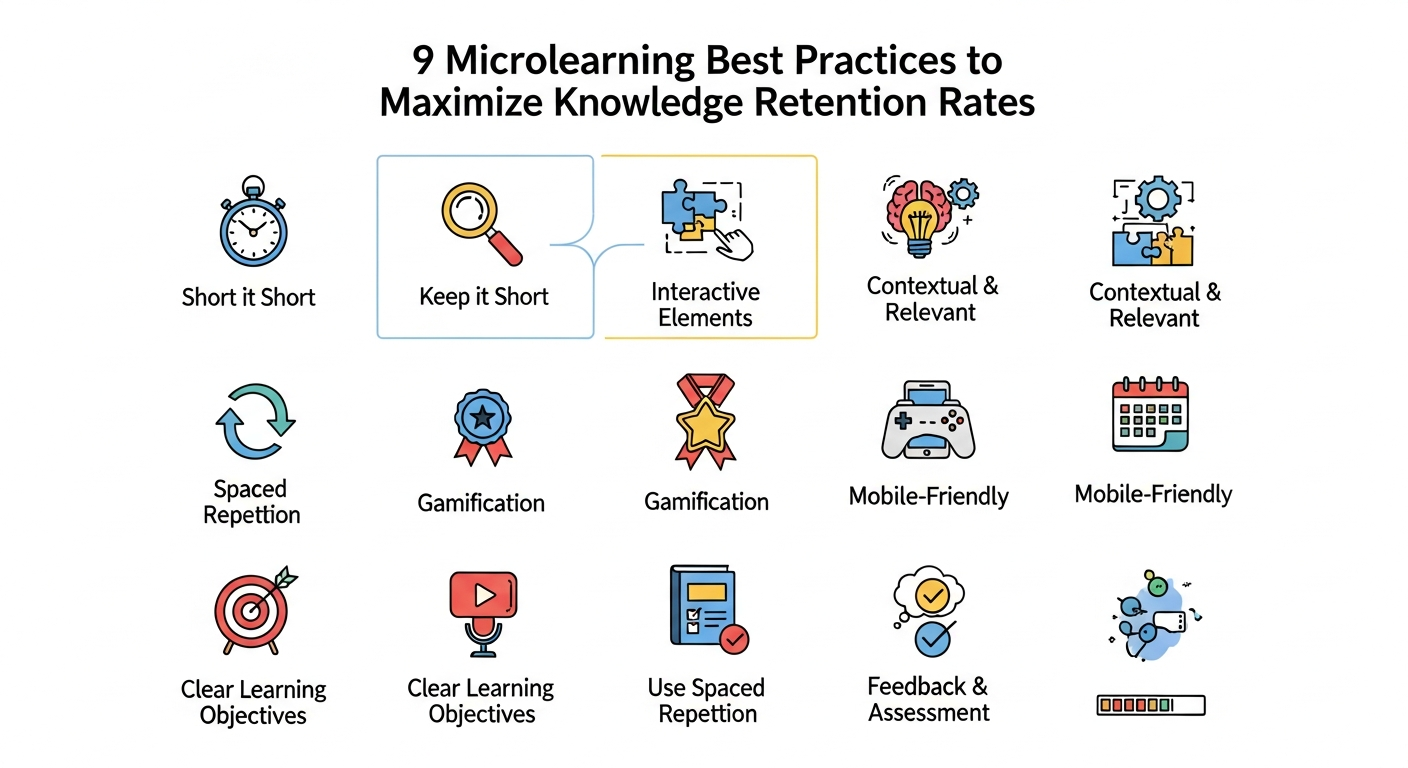
9 Microlearning Best Practices to Maximize Knowledge Retention Rates
In today's fast-paced corporate environment, the ability of employees to absorb, retain, and apply knowledge directly impacts an organization's bottom line. For Vice Presidents, Directors, and Senior Managers in L&D, the challenge isn't just delivering training, but ensuring that invaluable information sticks. Traditional long-form training often struggles against the "forgetting curve," leading to lost investment and underprepared teams. This is where microlearning emerges as a powerful antidote, offering concise, focused bursts of learning designed for maximum impact.
However, simply breaking content into smaller pieces isn't enough. To truly unlock microlearning's potential and dramatically enhance knowledge retention across industries like compliance, sales, banking, finance, insurance, retail, pharma, healthcare, hospitality, oil and gas, and mining, a strategic approach is essential. Here are 9 microlearning best practices that L&D leaders can implement to maximize learning outcomes and drive measurable results.
1. Chunk Information Effectively and Concisely
The core principle of microlearning is brevity. Each learning module should be a standalone, bite-sized unit focused on a single concept or skill. This approach respects learners' limited attention spans and busy schedules.
- Aim for modules typically lasting 2-7 minutes.
- Break down complex topics into digestible sub-topics.
- Focus on one learning objective per module to prevent cognitive overload.
Many L&D leaders ask, "What's the ideal length for microlearning modules to ensure effective knowledge transfer?" While there's no strict rule, industry best practice suggests keeping content concise, often under 10 minutes, allowing for quick consumption and immediate application without disrupting workflows.
2. Define Clear and Specific Learning Objectives
Every microlearning unit must have a clearly articulated learning objective. What specific skill or piece of knowledge should the learner gain upon completion? This clarity ensures relevance and helps learners connect the content directly to their job roles.
- Use action verbs (e.g., "identify," "describe," "perform").
- Ensure objectives are measurable and directly applicable to performance.
- Align objectives with broader business goals, especially for critical areas like Risk-focused Training in highly regulated industries.
3. Leverage Diverse and Engaging Formats
Microlearning thrives on variety. Utilizing different formats keeps learners engaged and caters to diverse learning styles. From short videos to interactive quizzes, the medium can significantly impact retention.
- Short explainer videos or animated tutorials.
- Interactive infographics or job aids.
- Quick simulations or scenario-based questions.
- Podcasts or audio snippets for on-the-go learning.
Integrating a Gamified LMS can further boost engagement by making learning an enjoyable and competitive experience.
4. Incorporate Spaced Repetition for Reinforcement
The "forgetting curve" is real. To combat it, microlearning should integrate spaced repetition, where concepts are revisited at increasing intervals over time. This scientific approach dramatically improves long-term memory retention.
- Schedule follow-up quizzes or challenges weeks after initial learning.
- Deliver refreshers as short notifications or quick prompts.
- Utilize an LMS that supports automated content delivery at set intervals.
Many organizations wonder, "Can technology help automate spaced repetition for large workforces?" Absolutely. Modern learning management solutions leverage algorithms to intelligently schedule content refreshers based on learner performance, ensuring timely reinforcement.
5. Contextualize Learning for Immediate Relevance
Learners are more likely to retain information if they perceive its immediate relevance to their daily tasks and challenges. Microlearning should be highly contextualized, presenting information in real-world scenarios.
- Use industry-specific examples and case studies.
- Align content with specific job roles and workflows (e.g., a sales rep needs training relevant to client interactions, not abstract theories).
- Provide just-in-time support that can be accessed at the moment of need.
For industries like finance and healthcare, contextualization is paramount. Risk-focused Training, for instance, must be directly applicable to the specific compliance scenarios employees face daily.
6. Personalize Learning Paths with Adaptive Technology
One-size-fits-all training is inefficient. Adaptive Learning tailors the content and pace to individual learner needs, strengths, and weaknesses, ensuring a more effective and engaging experience.
- Assess prior knowledge to skip already mastered content.
- Suggest additional resources for areas where learners struggle.
- Dynamically adjust content based on real-time performance within modules.
A common question from L&D leaders is, "How does technology personalize microlearning experiences for each employee?" Leveraging sophisticated algorithms, advanced learning management software analyzes individual performance data and learning patterns to recommend the most relevant micro-modules and learning paths, creating a truly bespoke educational journey.
7. Utilize Interactive Elements and Gamification
Passive consumption leads to poor retention. Microlearning should be highly interactive, demanding active participation from the learner. Gamification further enhances engagement and motivation.
- Include mini-quizzes, drag-and-drop exercises, and decision-making scenarios.
- Implement points, badges, leaderboards, and progress tracking.
- Offer immediate feedback to reinforce correct answers and correct misunderstandings.
A Gamified LMS transforms routine training into an exciting challenge, fostering a sense of achievement and encouraging continuous learning.
8. Simplify Content Creation with Advanced Tools
Developing high-quality microlearning content can be time-consuming. Leveraging advanced authoring tools, especially those enhanced by artificial intelligence, can streamline the creation process, ensuring consistency and efficiency.
- Use templates for rapid content development.
- Employ tools that support various media types and interactivity.
- Collaborate easily with subject matter experts to gather accurate information.
Many L&D teams inquire, "What tools can accelerate microlearning content development and ensure consistency?" An AI Powered Authoring Tool can dramatically speed up content generation, suggest relevant media, and even help in structuring modules based on learning objectives, ensuring a high standard across all materials.
9. Choose the Right Microlearning LMS
The platform you use to deliver and manage your microlearning initiatives is critical. A robust Microlearning LMS provides the infrastructure for seamless content delivery, tracking, and analytics.
- Look for an enterprise learning management system designed for mobile-first delivery.
- Ensure it supports diverse content formats and integration with other business tools.
- Prioritize features like progress tracking, reporting, and automated content scheduling.
- Consider a cloud based learning management system for accessibility and scalability.
A comprehensive learning content management system, often referred to as an LCMS, allows you to not only deploy but also efficiently manage and update your microlearning assets. Platforms like MaxLearn LMS provide the essential capabilities for delivering powerful, retention-focused microlearning at scale, serving as a complete lms learning management system solution.
Conclusion
Microlearning, when implemented strategically with these best practices, transforms corporate training from a mere formality into a dynamic, engaging, and highly effective knowledge retention engine. For L&D leaders across compliance, sales, banking, healthcare, and other vital sectors, embracing these principles means not just delivering content, but cultivating a workforce that is consistently knowledgeable, skilled, and ready to meet business challenges. By investing in the right methodologies and the appropriate learning management system, organizations can maximize their training ROI and foster a culture of continuous, impactful learning.


Comments
Post a Comment