6 Essential Gamification Elements to Boost Employee Engagement Over 80%
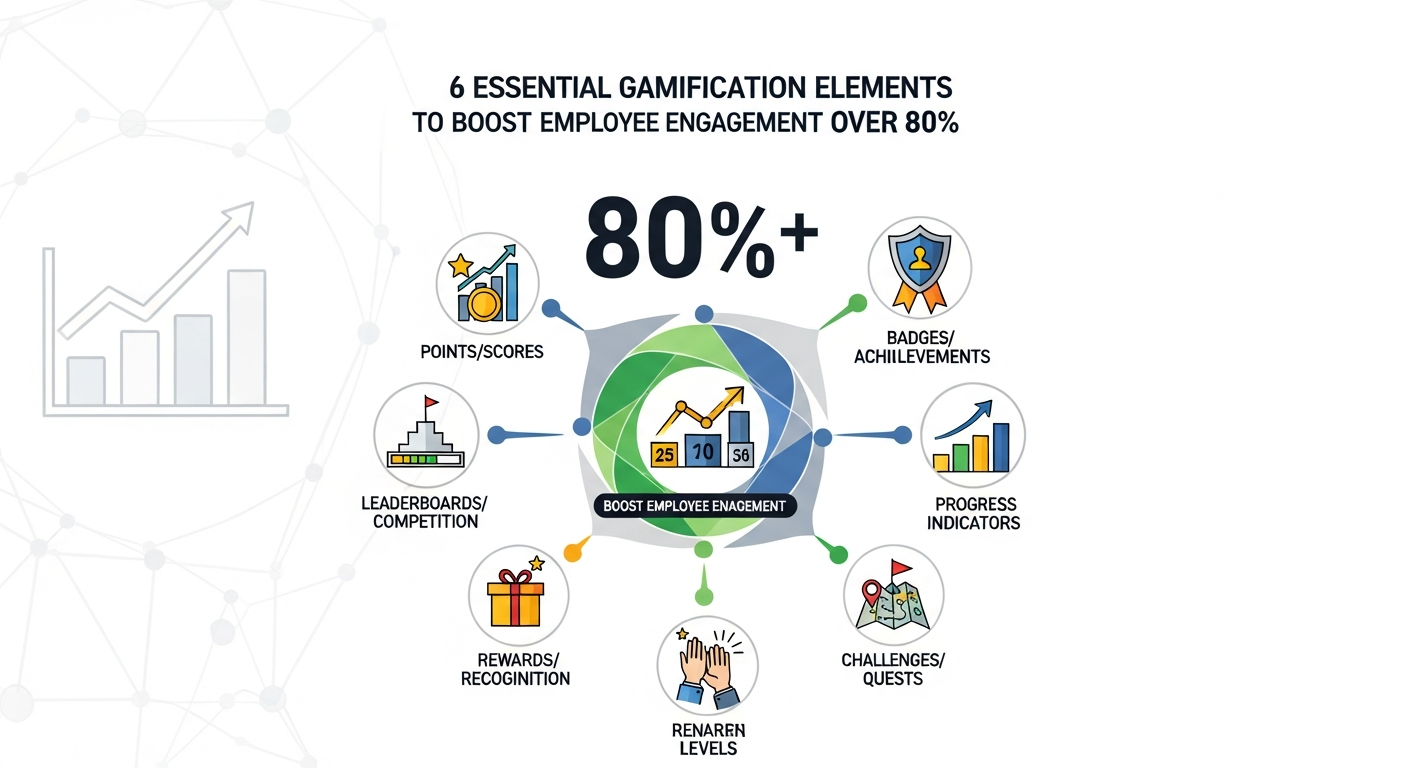
6 Essential Gamification Elements to Boost Employee Engagement Over 80%
In today's fast-paced corporate landscape, where employee turnover is a constant concern and skill gaps emerge rapidly, maintaining high levels of employee engagement is paramount. For L&D leaders, the challenge isn't just delivering training; it's ensuring that training resonates, motivates, and ultimately sticks. Traditional learning methods often fall short, leading to disinterest and low completion rates. But what if there was a proven way to transform mundane learning into an addictive, rewarding experience, capable of boosting engagement by over 80%?
Enter gamification: the strategic application of game-design elements and game principles in non-game contexts. It's not about turning your entire workplace into a video game, but rather leveraging the psychological triggers that make games so compelling. By integrating these elements into your LMS and broader learning initiatives, you can create an environment where employees are eager to learn, compete, and achieve.
For Vice Presidents, Directors, and Managers in L&D across industries like Compliance, Sales, Banking, Pharma, and Retail, understanding and implementing effective gamification can be a game-changer for talent development and retention. Let's explore the six essential gamification elements that can unlock unprecedented levels of employee engagement.
The Power of Play: Why Gamification Works
At its core, gamification taps into intrinsic human desires for achievement, mastery, competition, status, and altruism. When applied to learning, these desires translate into increased motivation, improved knowledge retention, and a more positive learning experience. A well-designed Gamified LMS can transform mandatory training into an anticipated event, turning compliance modules into quests and product knowledge into challenges.
6 Essential Gamification Elements for Peak Engagement
1. Clear Goals & Progress Tracking
Just as a roadmap guides a journey, clear goals and visible progress tracking are fundamental to any engaging gamified experience. Employees need to know what they're aiming for and how far they've come. This element provides a sense of direction and achievement, reinforcing effort.
- Specific Learning Objectives: Define what employees will learn or achieve at each stage.
- Progress Bars & Checklists: Visually represent completion rates for courses, modules, or tasks. Seeing a 75% complete bar encourages the learner to reach 100%.
- Milestones: Break down large learning paths into smaller, achievable milestones, celebrating each one. This is especially effective in complex enterprise learning management scenarios.
2. Points, Badges, & Leaderboards (PBLs)
The classic trio of gamification, PBLs are powerful motivators. They provide immediate feedback, acknowledge achievements, and foster healthy competition.
- Points: Award points for completing modules, answering questions correctly, participating in discussions, or logging in consistently. Points can accumulate towards higher levels or rewards.
- Badges: Digital accolades that signify specific achievements, skills learned, or completion of certain courses. Badges act as visible symbols of expertise and effort, which can be proudly displayed on a profile within a cloud based learning management system.
- Leaderboards: Rank learners based on points, badges, or course completion. While leaderboards can be highly motivating for competitive individuals, consider different types (e.g., team leaderboards, individual progress leaderboards) to cater to diverse personalities and avoid demotivation for those at the bottom.
3. Challenges & Quests
Learning should never feel passive. Challenges and quests transform learning into an active pursuit, making the journey itself an engaging part of the experience. These structured activities provide purpose and context to the learning content.
- Scenario-Based Challenges: Present real-world problems or simulations where learners apply their knowledge. For instance, in sales training, a challenge might be to close a virtual deal.
- Learning Quests: Guide employees through a series of interconnected modules or tasks, much like a story. Completing one step unlocks the next, maintaining curiosity and momentum. This approach is highly effective for Risk-focused Training in sectors like banking or healthcare.
- Timed Trials: Introduce an element of urgency and test quick recall, common in lms learning management system quizzes.
4. Rewards & Recognition
Beyond points and badges, tangible or intangible rewards and timely recognition are crucial for reinforcing positive learning behaviors. This can be intrinsic (the joy of learning) or extrinsic (a prize).
- Virtual Rewards: Unlock new content, customization options for avatars, or special access within the learning management software.
- Tangible Incentives: Gift cards, company swag, extra PTO, or even a charitable donation in the learner's name for significant achievements.
- Public Recognition: Highlighting top performers in newsletters, company meetings, or on an internal LCMS portal provides social validation and boosts morale.
5. Storytelling & Narrative
Humans are hardwired for stories. Integrating a narrative arc into your training makes it more immersive, memorable, and relatable. This is particularly powerful for complex or dry subjects, like compliance or onboarding for new employees in finance.
- Contextual Scenarios: Frame learning content within a compelling story relevant to the employee's role or company mission.
- Character Development: Allow learners to create avatars or identify with characters within the learning journey.
- Progression through a "World": Imagine a sales training program where agents navigate through different "cities" (markets) to close deals, or a healthcare compliance course set as a mission to save patients from regulatory pitfalls. Adaptive Learning can further personalize these narratives.
6. Social Interaction & Collaboration
Learning is often a social activity. Incorporating elements that encourage interaction, collaboration, and even friendly competition among peers can significantly boost engagement and knowledge sharing within any learning management system.
- Team Challenges: Group learners for collaborative problem-solving tasks or inter-departmental competitions.
- Discussion Forums: Provide platforms for learners to discuss content, share insights, and ask questions.
- Peer Feedback & Mentoring: Allow learners to review each other's work or provide guidance, fostering a sense of community and shared responsibility.
- Social Sharing: Enable learners to share their achievements (badges, certificates) on internal company platforms.
Integrating Gamification with Learning Technology
Implementing these gamification elements effectively requires the right technological backbone. A sophisticated learning content management system (LCMS) or a dedicated learning management software platform like MaxLearn LMS is crucial. These platforms provide the tools to track progress, award points, manage leaderboards, and deliver interactive, game-like content. Features like an AI Powered Authoring Tool can dramatically simplify the creation of dynamic, engaging modules, enabling L&D teams to build rich gamified experiences without extensive coding.
Common Questions on Boosting Employee Engagement
When considering advanced learning strategies, many leaders often ask:
How can organizations best improve employee participation in training programs?
The most effective way is by making learning intrinsically motivating and enjoyable. Integrating gamification elements like clear goals, progress tracking, rewards, and social interaction within a robust Microlearning LMS can dramatically increase participation and completion rates by transforming passive learning into an active, rewarding experience. This fosters a culture where employees are eager to engage with new content.
What are the most effective ways technology can enhance learning outcomes in large-scale corporate environments?
Technology, particularly an intelligent learning management system (LMS) with adaptive and gamified features, can personalize learning paths, automate administrative tasks, provide instant feedback, and offer rich data analytics on learner performance. This allows for scalable, efficient, and highly engaging training delivery, ensuring consistent learning quality across diverse employee groups and geographies.
What kind of digital tools assist in crafting dynamic and personalized educational paths?
Tools that offer an intelligent authoring environment are key. Modern platforms often include an AI Powered Authoring Tool, which can help L&D professionals create custom content, generate questions, and even suggest learning paths based on learner profiles and performance data. Combined with an Adaptive Learning system, these tools enable the delivery of highly personalized and effective training.
Where can examples of successful employee motivation programs be found, especially for essential compliance training?
Many learning management solutions providers showcase case studies of companies that have successfully implemented gamification for compliance, sales, and onboarding. Look for platforms that specialize in Risk-focused Training, as these often highlight how gamification transforms typically dry subjects into engaging experiences. Reputable vendors and industry conferences are also great sources for practical examples and best practices.
How do smart learning platforms contribute to talent development strategies in financial services?
Smart learning platforms provide targeted, relevant, and engaging training essential for the rapidly evolving financial sector. They can deliver Risk-focused Training, compliance updates, and specialized skills development through adaptive and gamified modules. By offering continuous, accessible learning, these platforms ensure that financial professionals remain current with regulations, market trends, and product knowledge, directly supporting long-term talent growth and retention.
Conclusion
The quest for higher employee engagement in L&D is continuous, but gamification offers a powerful, proven solution. By strategically integrating these six essential elements into your training programs – clear goals, PBLs, challenges, rewards, storytelling, and social interaction – you can create an immersive, motivating learning environment that yields dramatic improvements in engagement, knowledge retention, and overall performance.
It's time to move beyond conventional approaches and embrace the power of play. Invest in a robust learning management system that empowers you to implement these strategies effectively, and watch your employee engagement soar, transforming your workforce into a highly skilled, motivated, and loyal asset. Explore how advanced learning management solutions can revolutionize your corporate training today.


Comments
Post a Comment