3 Main Reasons Your Employees Aren't Completing Their Training Modules
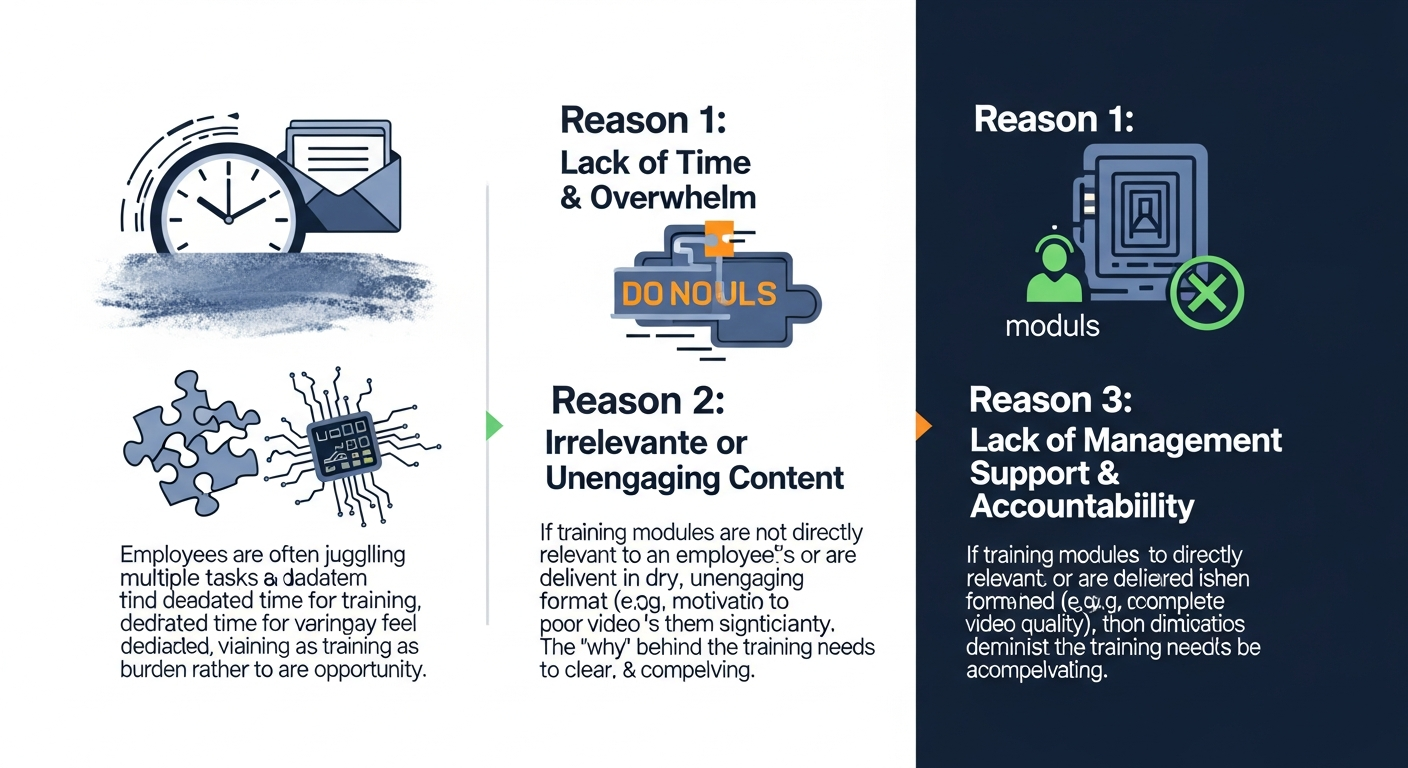
3 Main Reasons Your Employees Aren't Completing Their Training Modules
For Vice Presidents, Directors, and Senior Managers in Learning & Development across diverse sectors like Banking, Healthcare, Retail, and Oil & Gas, the investment in employee training is significant. From compliance updates in Finance to new product launches in Pharma or safety protocols in Mining, effective training is the backbone of operational excellence, risk mitigation, and competitive advantage. Yet, a persistent frustration echoes through many organizations: low training module completion rates. You’ve invested in a sophisticated learning management system, curated robust content, and championed a culture of continuous learning, only to find employees aren't consistently engaging or finishing their assigned courses.
This isn't merely a matter of neglected checkboxes; it represents a tangible loss of potential, diluted skill sets, and a failure to fully realize the return on your substantial training investment. Understanding why employees falter at the finish line is the first step towards building a more effective, engaging, and indispensable learning ecosystem. Let’s dive into the three primary culprits behind incomplete training modules and explore how modern eLearning strategies can transform your approach.
1. Irrelevant and Overwhelming Content
One of the most common reasons employees disengage from training is the perception that the content is either irrelevant to their specific role or so voluminous it feels like an insurmountable task. Traditional, one-size-fits-all training programs often fail to resonate with individual learning needs, leading to a disconnect between the material and its perceived value.
The Problem: Generic Information Overload
- Lack of Personalization: Sending every employee through the same comprehensive course, regardless of their prior knowledge or specific job function, can lead to boredom and frustration. A veteran salesperson doesn't need basic product knowledge refreshers if they're excelling, and an HR professional likely doesn't need the same deep dive into engineering safety protocols as a plant technician.
- Information Overload: Long, dense modules packed with excessive information, much of which may not be immediately applicable, overwhelm learners. The sheer volume makes completion seem daunting, especially for busy professionals already juggling demanding workloads.
- Irrelevance: If employees don't see a clear connection between the training and their daily tasks, career progression, or the organization's strategic goals, they will naturally deprioritize it.
A relevant inquiry for today’s L&D leaders: How can artificial intelligence help tailor training content to individual employee needs, ensuring relevance and minimizing information overload?
The strategic insight: Advanced learning platforms, including a sophisticated Microlearning LMS, leverage data analytics to understand learner profiles, performance gaps, and career paths. This allows for highly personalized learning paths, delivering content that is precisely what an individual needs, precisely when they need it. A modern Adaptive Learning approach dynamically adjusts the curriculum based on learner interaction and progress, optimizing efficiency and engagement. Utilizing a robust AI Powered Authoring Tool further streamlines the creation of targeted, bite-sized modules that hit the mark every time, ensuring the Risk-focused Training for compliance or critical skills is precise and impactful. This allows an enterprise learning management system to be truly effective.
2. Lack of Engagement and Motivation
Even if the content is relevant, a lack of engaging delivery methods can quickly kill motivation. Passive learning experiences, such as lengthy video lectures or endless text documents, struggle to capture and maintain employee attention, especially in a world accustomed to dynamic digital interactions. An effective Gamified LMS can make a significant difference here.
The Problem: Monotony and Disconnection
- Passive Learning: Sitting through hours of non-interactive content is tiring. Without opportunities to apply knowledge, receive feedback, or collaborate, learners become passive recipients rather than active participants.
- Lack of Immediate Impact: If employees don't see how the training directly translates into improved performance or tangible benefits for their daily work, their motivation wanes. The "why" behind the training needs to be clear and compelling.
- Absence of Recognition: Humans are driven by achievement and recognition. Without progress tracking, badges, leaderboards, or other forms of acknowledgement, the sense of accomplishment from completing modules is diminished.
A critical question for optimizing employee participation: Can intelligent systems predict which employees are at risk of disengaging from training and suggest proactive interventions?
The strategic insight: Modern learning management solutions are designed to combat monotony. Incorporating interactive elements like quizzes, simulations, virtual reality experiences, and branching scenarios transforms passive learning into an active journey. Gamification, with its points, badges, leaderboards, and progress tracking, taps into natural human competitive and achievement drives, significantly boosting completion rates. A top-tier Gamified LMS encourages continuous engagement and makes learning enjoyable. Furthermore, a sophisticated learning content management system can facilitate social learning features, allowing employees to share insights, collaborate on projects, and learn from peers, fostering a vibrant learning community. This transforms a traditional learning management software into a dynamic hub for growth.
3. Inaccessible and Inflexible Learning Environments
Even the most perfectly crafted and engaging training will fail if employees cannot easily access it when and where it suits their workflow. In today's fast-paced corporate environment, expecting employees to set aside dedicated, uninterrupted blocks of time for training is often unrealistic, particularly for frontline staff or those with variable schedules.
The Problem: Rigid Structures and Poor Accessibility
- Time Constraints: Employees are busy. Forcing them to complete training during specific hours or requiring long, uninterrupted sessions is a significant barrier. This is especially true in industries like healthcare or hospitality, where shifts are fluid, or in retail, where customer demands are paramount.
- Device Dependency: If training is only accessible via desktop computers in a specific location, it severely limits flexibility. Many employees, particularly in field sales or service, are mobile and need on-the-go access.
- Poor User Experience: Clunky interfaces, slow loading times, or non-responsive designs on mobile devices create frustration and act as deterrents, leading to abandonment.
A pertinent question for enhancing ubiquitous access: How do intelligent platforms adapt course delivery to different devices and internet speeds, ensuring a seamless experience for every employee, regardless of their physical location or technical setup?
The strategic insight: The answer lies in flexible, accessible, and intuitive learning environments. A Microlearning LMS excels here, delivering bite-sized content that can be consumed in minutes, fitting seamlessly into brief breaks or commute times. The best learning management system offers a truly cloud based learning management system experience, ensuring access from any device, anywhere, anytime. Mobile-first design is no longer a luxury but a necessity for any effective LMS. A responsive interface and robust offline capabilities ensure that training is always within reach, whether an employee is on a factory floor, at a client site, or working remotely. Modern learning management solutions prioritize ease of use, minimal clicks, and a clean user experience, making the path to completion frictionless. MaxLearn LMS exemplifies this commitment to accessibility and flexibility.
The Path Forward: Leveraging Modern eLearning Solutions
Addressing these three core reasons for low training completion requires a strategic shift from traditional, compliance-driven training models to dynamic, learner-centric ecosystems. By adopting an advanced learning management system, L&D leaders can:
- Personalize Learning Paths: Deliver highly relevant content tailored to individual needs and roles.
- Boost Engagement: Implement gamification, interactive elements, and real-world scenarios.
- Ensure Accessibility: Provide flexible, on-demand learning experiences across all devices.
Investing in a modern LMS is not just about adopting new technology; it's about fostering a culture where learning is valued, accessible, and directly contributes to employee growth and organizational success. By tackling the root causes of incomplete training modules, you can transform your L&D initiatives from a necessary chore into an indispensable engine of progress across all segments and industries you serve.


Comments
Post a Comment